



Most programmatic platforms look reliable when traffic is predictable.
Auctions run. Campaigns deliver. Dashboards update. Buyers get their impressions, publishers monetize their inventory, and the technology operates quietly in the background.
Then election season arrives.
Advertising demand can change quickly. Budgets move into competitive markets, campaign deadlines become tighter, and multiple advertisers compete for the same inventory. At the same time, publishers must handle changing traffic patterns while maintaining a consistent user experience.
For programmatic infrastructure, this creates a demanding operating environment.
The real test isn't simply whether a platform can process more bid requests. It's whether it can maintain auction speed, transparency, inventory quality, and reliable delivery when demand becomes less predictable.
And those capabilities matter well beyond political advertising.
Why Election Season Creates Pressure on Programmatic Advertising
Election campaigns operate within fixed timelines. Unlike many commercial advertisers, political campaigns cannot simply extend their advertising activity when a deadline passes.
This creates a particular type of demand.
Campaign activity can intensify around major political events, early voting periods, and election dates. Advertisers may also shift budgets between geographic markets as their plans change.
For programmatic systems, the result can be a sudden increase in bidding activity concentrated in specific locations and inventory categories.
Consider a publisher serving a regional news audience.
During an ordinary week, advertising demand may be relatively stable. As an election approaches, additional campaigns may compete for impressions associated with the same geographic area.
Auction competition can increase even if the publisher's available inventory remains unchanged.
The challenge is therefore more complicated than handling additional traffic. Infrastructure must manage changing demand, pricing, campaign eligibility, and delivery requirements simultaneously.
A platform designed only for predictable workloads may encounter difficulties when these conditions change quickly.
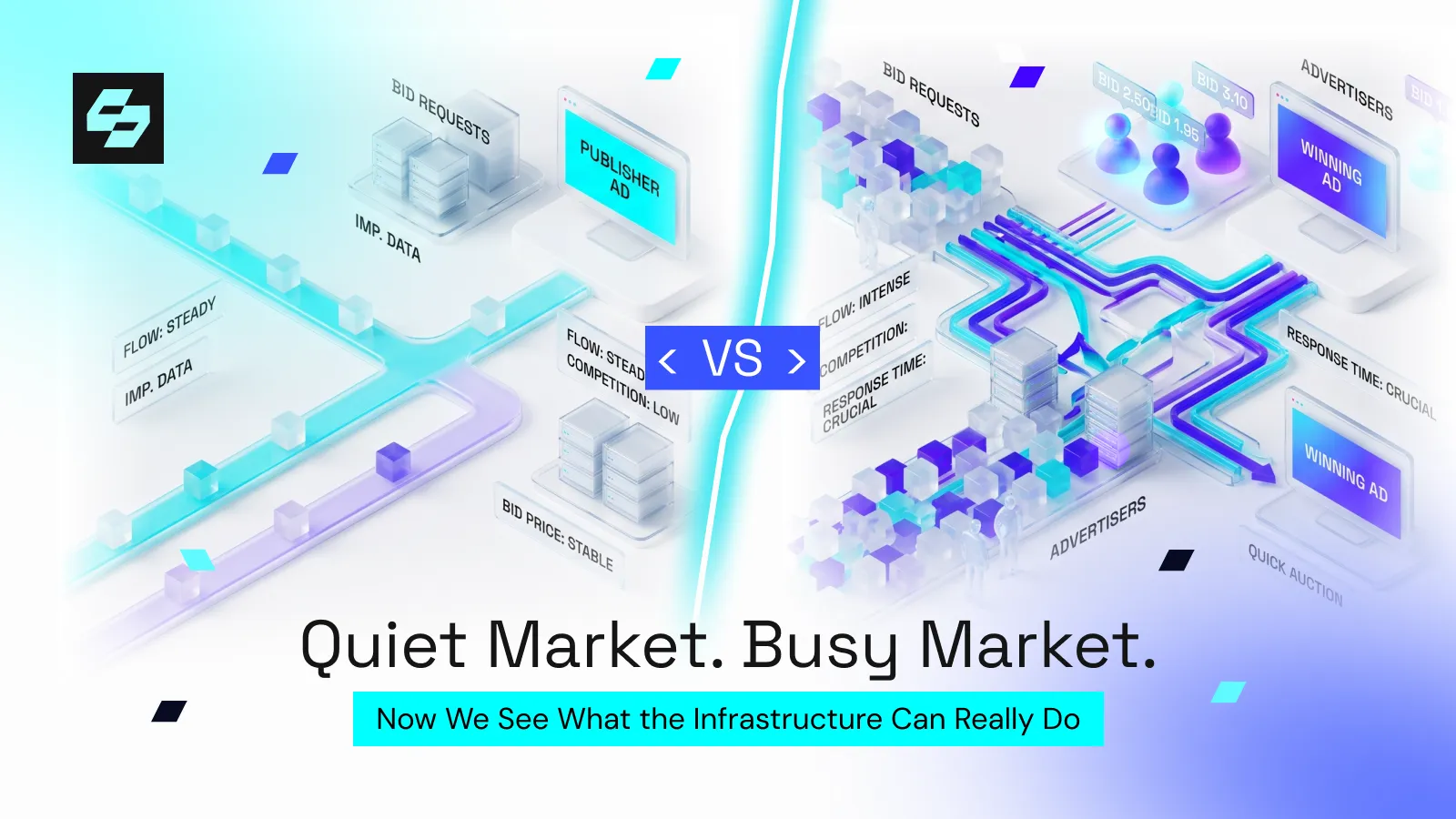
Programmatic infrastructure compares steady data flow during low competition with high-intensity bid request traffic and millisecond auction response times during market spikes.
Real-Time Bidding: Where Infrastructure Faces Its First Test
Programmatic advertising depends on decisions made in milliseconds.
When an impression becomes available, an ad exchange or supply-side platform sends bid requests to eligible demand partners. Those partners evaluate the opportunity, return bids, and compete for the available impression.
The process must finish within a strict time window.
During periods of concentrated advertising demand, the number of interested buyers may increase. Platforms still need to evaluate requests, apply campaign rules, and return responses before auction deadlines expire.
A slow response is not simply a technical inconvenience.
It can mean a missed auction.
For advertisers, missed opportunities can disrupt delivery. For publishers, inefficient auctions can limit competition and affect monetization.
This is why processing capacity alone provides an incomplete picture of programmatic scalability.
A platform might handle a large volume of requests under normal conditions but struggle when traffic arrives in sudden bursts.
Latency, timeout rates, infrastructure availability, and response consistency all become important.
Election season makes these weaknesses easier to notice because there is less room for delayed execution.
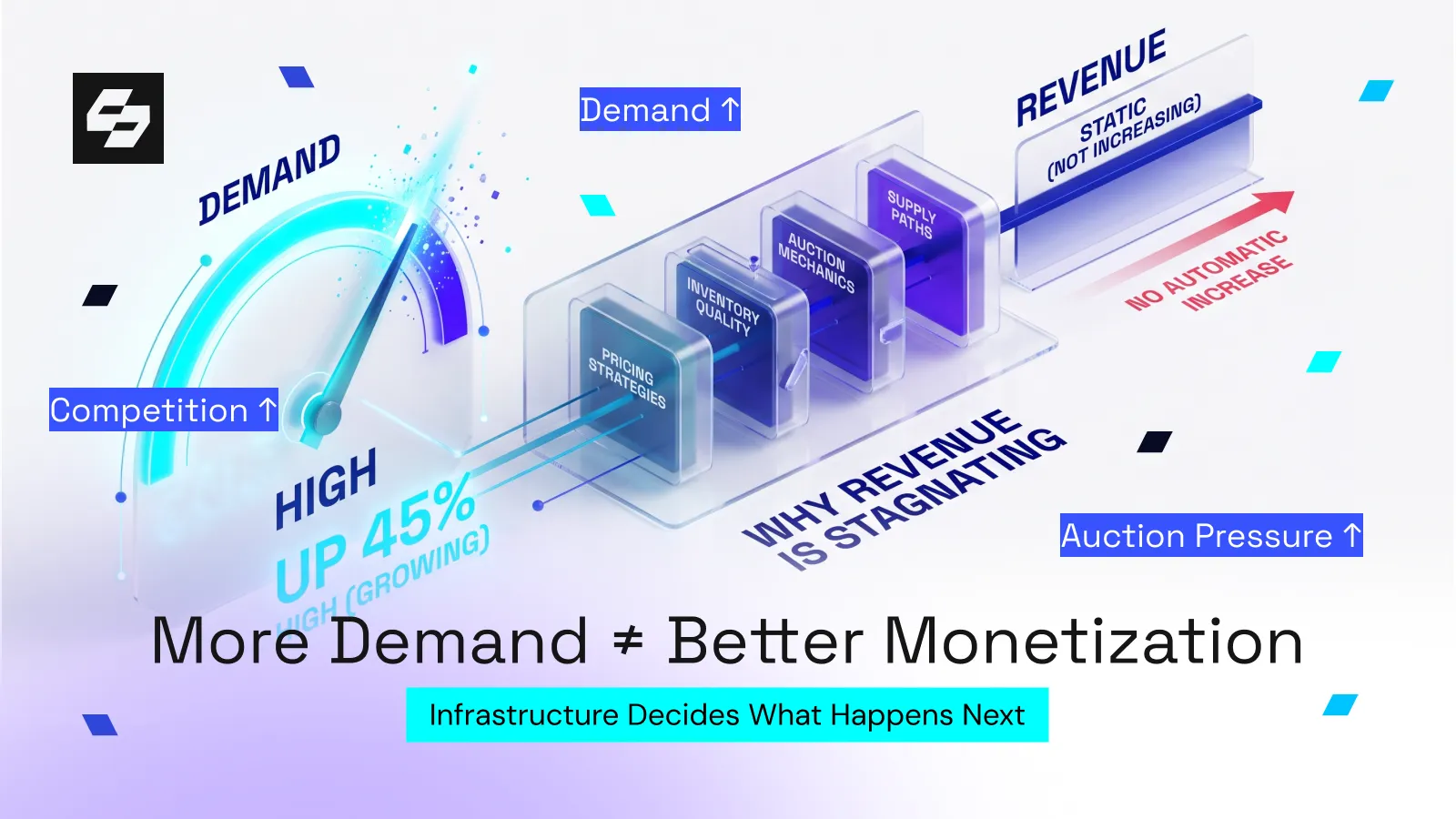
Programmatic monetization framework illustrates how rising ad demand and auction pressure fail to yield higher revenue without optimized supply paths and pricing strategies.
More Demand Doesn't Automatically Mean Better Performance
An increase in advertising demand can create additional revenue opportunities for publishers.
But higher demand also introduces operational complexity.
Multiple buyers may access the same inventory through different exchanges and resellers. Without effective supply management, this can create duplicated auction opportunities and unnecessary processing.
Advertisers may encounter the same impression through several supply paths, each with different fees and levels of transparency.
The result is more auction activity without a corresponding increase in available advertising opportunities.
This is where Supply Path Optimization (SPO) becomes relevant.
SPO helps buyers identify efficient routes to inventory and reduce unnecessary intermediaries. For publishers and technology providers, cleaner supply connections can also simplify the auction environment.
During election season, when demand may be concentrated in particular markets, supply efficiency deserves close attention.
Processing additional requests is useful.
Processing unnecessary requests is expensive.
A strong programmatic infrastructure should support meaningful auction competition without adding avoidable complexity to the transaction.
Transparency Becomes More Important Under Pressure
Election-related advertising creates additional requirements around disclosure, eligibility, and accountability.
Rules differ between jurisdictions, platforms, and advertising categories. Some environments restrict political advertising, while others impose specific authorization, labeling, or recordkeeping requirements.
These requirements cannot be handled by bidding algorithms alone.
Programmatic systems need clear inventory information, reliable campaign classification, appropriate policy enforcement, and transparent transaction records.
Advertisers need to understand where their ads appear and which supply partners are involved.
Publishers need visibility into the demand accessing their inventory.
Technology providers need processes for applying applicable policies and investigating delivery issues.
When these systems are fragmented, troubleshooting becomes harder.
A campaign may experience rejected creatives, unexpected delivery gaps, or inconsistent inventory access. Without clear reporting, identifying the cause can take longer than the campaign timeline allows.
Transparency is therefore an operational requirement, not simply a reporting feature.
The ability to trace transactions and understand why advertising decisions were made becomes especially valuable when conditions change rapidly.

Competitive programmatic bidding environment displays political, retail, auto, and finance advertisers competing with high bids for a single premium CTV ad impression.
Traffic Quality and Brand Safety Cannot Be Afterthoughts
Periods of increased advertising activity can create opportunities for invalid traffic and other forms of advertising abuse.
The underlying risk is familiar: automated traffic, misrepresented inventory, and fraudulent impressions can consume advertising budgets without delivering legitimate audience exposure.
Election season adds another reason to pay attention.
Advertising content may be subject to additional restrictions, and publishers may have specific policies governing which political advertisements they accept.
A campaign that meets technical delivery requirements may still be ineligible for a particular environment.
Effective infrastructure needs to support inventory verification, traffic-quality controls, and appropriate content policies throughout the transaction process.
Pre-bid filtering can help identify unsuitable opportunities before an advertiser spends money. Post-bid verification and transparent reporting provide additional information about delivered impressions.
These controls also protect publishers.
Poor-quality demand can create operational problems, affect the user experience, and damage relationships with advertising partners.
When transaction volumes increase, quality controls must remain effective rather than becoming a bottleneck or being bypassed for the sake of delivery.
Scale without quality is an expensive achievement.
Why AI-Driven Optimization Matters During Demand Spikes
Traditional campaign management often depends on predefined rules.
Budgets are allocated, bidding parameters are configured, and performance is reviewed before adjustments are made.
This approach can become difficult when market conditions change rapidly.
AI-driven optimization can help programmatic platforms analyze incoming signals and adjust bidding, pacing, and budget allocation within configured campaign rules.
For example, an automated system may identify that certain inventory is becoming more expensive while alternative eligible placements offer comparable performance.
It can then adjust bids or spending distribution based on the campaign's objectives and constraints.
The value comes from responding to changing conditions without waiting for every adjustment to be made manually.
However, automation still requires reliable infrastructure.
An optimization model cannot compensate for missing auction data, unreliable reporting, or poorly configured campaign restrictions.
It also cannot replace human decisions about legal compliance, advertising eligibility, or campaign objectives.
AI is most useful when supported by clean data, transparent decision-making, and dependable execution.
During election season, these foundations become particularly important.
How Screencore Approaches Scalable Programmatic Infrastructure
At Screencore , we build programmatic technology around scalable execution, transparent auctions, verified inventory, and efficient connections between advertisers and publishers.
Our infrastructure supports more than 500,000 real-time bid requests per second, connects over 30,000 publishers, and operates across more than 160 markets, according to our company media kit.
These capabilities support a programmatic ecosystem in which demand and supply need to interact quickly across multiple advertising environments.
For advertisers, Screencore provides access to cross-screen activation, intelligent audience signals, AI-driven optimization, and transparent reporting.
For publishers, our supply-side technology supports real-time auctions, premium demand access, and yield optimization.
Flexible integrations, including OpenRTB, Prebid Server, SDKs, and APIs, help connect different parts of the advertising ecosystem.
Supply path efficiency is another important part of our approach. By prioritizing transparent connections and reducing unnecessary intermediaries, we aim to support cleaner transactions and more efficient media spending.
Election season illustrates why these infrastructure capabilities matter.
When demand changes quickly, advertisers and publishers need technology that can continue processing transactions, applying controls, and delivering reliable performance.
Infrastructure should be designed for demanding conditions before those conditions arrive.
Election Season Reveals Problems That Exist All Year
The pressure associated with election advertising is temporary. The underlying infrastructure challenges are not.
Retail campaigns can create similar demand spikes during major shopping events. Large sporting events can generate sudden changes in audience traffic. Product launches and seasonal promotions can concentrate advertising budgets within short periods.
The same technical weaknesses can appear in every case.
Slow auctions remain slow auctions. Duplicated supply paths still create unnecessary costs. Poor reporting continues to limit optimization.
Election season simply makes these problems harder to ignore.
For adtech companies, advertisers, and publishers, the practical lesson is to evaluate infrastructure under demanding conditions rather than relying exclusively on average performance.
A platform should be assessed by how consistently it handles traffic, how clearly it reports transactions, and how effectively it maintains quality controls when demand changes.
Reliable programmatic infrastructure isn't defined by the number of impressions it can process on a quiet Tuesday.
It's defined by what happens when the system is under pressure.
Understand the Foundations of Display Advertising
Election season exposes the complexity behind automated media buying. But understanding that complexity starts with the basics: how impressions are bought, how real-time auctions work, and what determines the performance of a display campaign.
Our previous article, What Is Display Advertising? [Beginners' Guide], explains the fundamentals of display advertising, from targeting and ad formats to programmatic buying and campaign measurement. It's a useful starting point for anyone looking to understand the technology behind digital advertising before exploring infrastructure at scale.
Is Your Programmatic Infrastructure Ready for the Next Demand Spike?
High-volume advertising periods reveal exactly where infrastructure needs to improve.
Whether you're an advertiser looking for more efficient media buying or a publisher aiming to maximize inventory value, Screencore helps you connect demand and supply through transparent, scalable programmatic technology.
From real-time bidding and AI-driven optimization to verified inventory and flexible integrations, our solutions are built to support reliable execution across CTV, video, display, and mobile.
Don't wait for a traffic spike to discover the limits of your adtech stack.
Build for Scale. Stay in Control.
Talk to the Screencore team about your programmatic infrastructure, inventory monetization, or advertising technology needs. Contact our team.