


![What Is Display Advertising? [Beginners' Guide]](/storage/blog/posts/202609153915_what-is-display-advertising-beginners-guide.webp)
What Is Display Advertising? [Beginners' Guide]
When visiting online shops only to see ads of the same shop on several websites afterwards, it really is no coincidence. This is termed display advertising, which is a very useful marketing tool in the modern world. This guide is aimed at novices in the field and describes what display advertising is, how it works, meaning of display advertising in business and what types of advertisement exist. We will also provide information about programmatic display advertising, how it is different from search advertising and how to start your first successful campaign.
What Is Online Display Advertising?
Online display advertising refers to marketing where visual material such as banners, images and videos is used to attract users’ attention and inform them about the company and its products. A simple definition of display advertising is the use of visual digital ads, including banners, images, video, and interactive formats, to promote a brand, product, or service across websites, apps, and other online environments. Unlike search marketing, where ads appear as search results, display ads are rather shown directly on different platforms, including news, articles, social media, apps, and emails. Moreover, online display ads promote the organization’s products and strengthen its brand image due to being presented in various media sources. In simple terms, what is considered display advertising includes visual ads such as banners, images, videos, native placements, and interactive creatives shown across websites, apps, and other digital platforms.
Banner ads are the most commonly used display ads, which can appear in various sizes and formats. Modern responsive ads allow advertisers to make ads more attractive by changing their size and appearance. Moreover, ads can also be animated or video format to get consumers’ attention and provide a more immersive experience. Another popular type of display ads is native advertising, which is often disguised as the website’s content. Finally, video content has become an integral part of online advertising, being included in various online platforms.When marketers discuss what is general display advertising, they usually mean visual advertising delivered across websites, apps, and digital networks to build awareness, generate traffic, or encourage conversions.
An essential feature of online display advertising is targeting, which enables the customization of advertising banners based on the consumer’s characteristics – age, location, interests, and several other attributes. Furthermore, the advertising could be made to target depending on the behavior of the consumer, meaning that advertising could be done depending on the website visited by the user. For example, there are retargeting display ads that involve bringing back the user to the site after they exit.

In programmatic display advertising, an ad opportunity can trigger an auction, receive competing bids and produce a winning impression in around 100 milliseconds.
What Is Programmatic Display Advertising?
Programmatic display advertising is a relatively new way of buying ads that has come a long way in a short time. Traditional methods involved hours of email correspondence and lengthy contract signing sessions. With programmatic advertising, all this is a thing of the past. With the help of automated technology and algorithms, advertising space is bought in real-time. To understand what is display advertising technology, think of the platforms, algorithms, ad servers, targeting tools, and bidding systems that automate how display ads are bought, delivered, and measured.
Advertisements are therefore much more efficient, relevant, and measurable than before.
The most fascinating part of the buying process in this case is Real Time Bidding. As soon as someone visits an advertising space page, an auction starts, the results of which are determined within approximately 100 milliseconds. That means that several bidders are competing for one advertising space and the one who bids more gets it. In this case, the advertiser reaches the precise target audience. Every day there are billions of auctions of this type happening.
Modern programmatic advertising platforms use artificial intelligence and machine learning algorithms to bid automatically. These programs independently determine the strategy for finding customers, find the most relevant audiences, predict customer conversion, and much more. Thus, the advertiser gets maximum efficiency with a minimum of effort.
The most incredible thing about programmatic advertising is that now small local businesses and start-ups have a chance to compete with large giants for advertising resources. This is made possible by the ability to customize all aspects of advertising – from the audience to the cost of impressions. In other words, any company can find its own unique customers using this system.
Search vs. Display Ads
Search advertising and display advertising both play important roles in digital marketing, but each technique has different goals, and they should be considered as complementary elements.
Search ads pick up the active demand. When people perform a search on Google, they are searching actively for something, whether it is a piece of information, a product, or a solution. The search ads ensure their place at the top of the results, thus being consistent with the intention of users through textual forms of expression. This type of advertising is efficient for producing high traffic and high conversion rates, although the audience consists only of users who are already looking for something related to the business.
Display advertising implies a different approach: rather than waiting for the audience to look for the business, display advertising makes the audience meet the brand while browsing the web. This means that the advertisement is creating passive demand. Display advertising is a very effective mode of advertising because it produces brand awareness among people who have never heard of the brand.
The winning strategy uses both channels together. Search captures existing demand, while display creates new demand and nurtures users through the funnel.
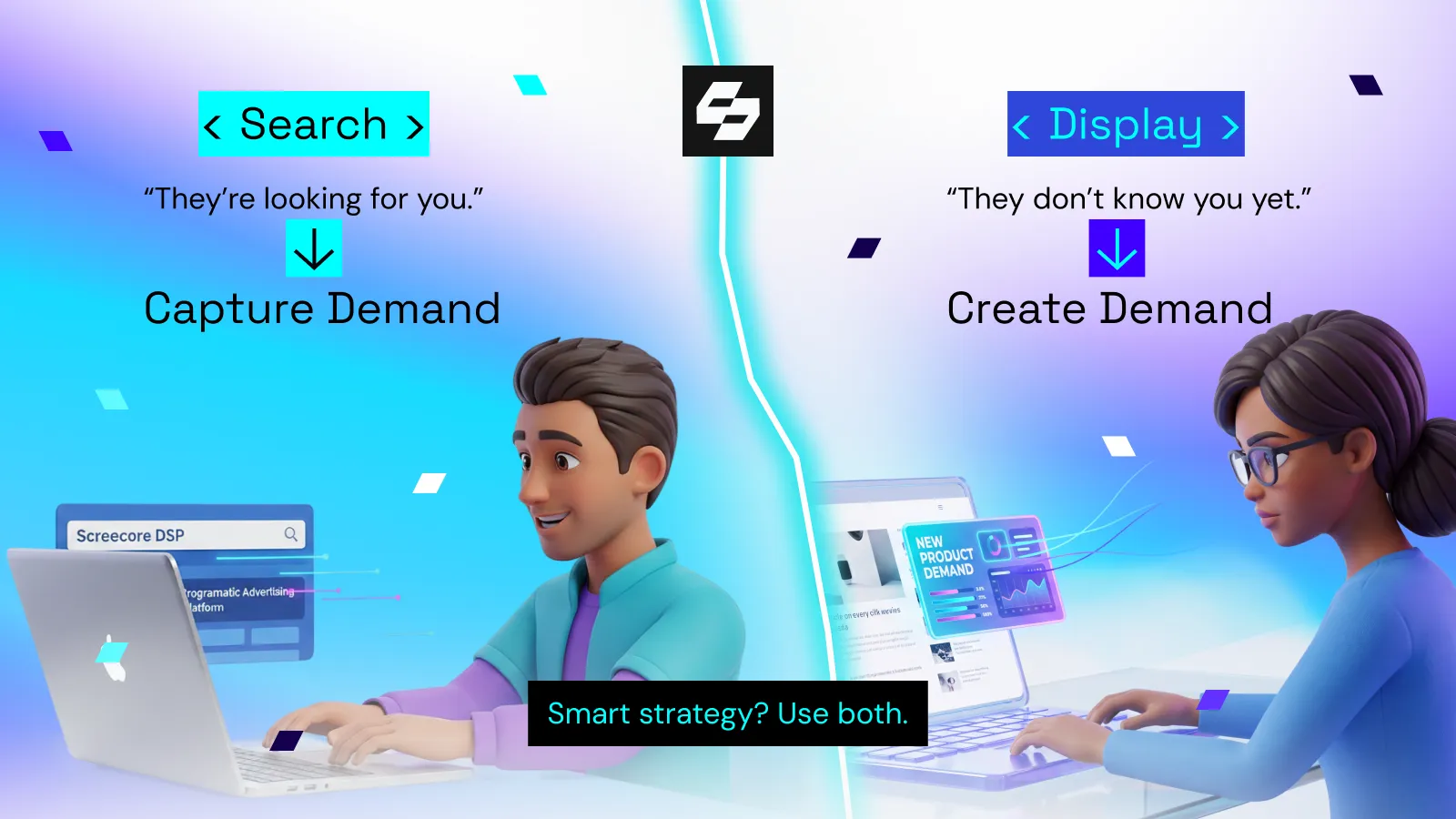
Search advertising captures existing intent. Display advertising helps create demand among audiences who may not know the brand yet. Strong digital strategies can use both.
Targeting Methods of Display Ads
How you target your audience is pretty much the deciding factor for how well your display campaign goes. Modern display ads come packed with smart targeting tricks.
Some of the classical ways are demographic, geographic, and contextual targeting. Demographic includes basic information such as age, gender, income, and education. Geographic targeting refers to some specific locations whether nationally or at city level. Contextual places your advertisements in those websites which have something to do with your business. Dayparting is another way that displays your advertisements only during the period your target customers are online and active. If brand awareness is your objective, then targeting a large audience is also beneficial.
Responsive ads
They resize, rearrange elements, swap out creative so your ads look good wherever they appear. They actively test headlines, descriptions, and images, keeping whatever combinations get the best clicks. This makes things much simpler for the creative team, and automated optimization gives your campaign a real boost.
Retargeting ads
If someone visits your site, you drop a cookie. Next time they're browsing another site, your ad shows up. Since these people already recognize your brand, conversion rates jump way up. Retargeting by marketers is used in reminder messages about abandoned carts, showcasing products that the person looked at but did not buy, as well as engaging with former customers.
Native display ads
The design matches, interruptions are minimal, and it usually says "sponsored." If you want to run content campaigns or prove you know your stuff, native ads are gold.
Social display ads
Every platform Facebook, LinkedIn, and others comes with its own style: carousels, stories, collections. Targeting is extremely focused, and you get extra value from social proof. Likes, shares, and all that engagement amplify your campaign and drive stronger results.
Display Advertising Formats
Every display ad format offers something a bit unique, and selecting the right one depends on your goals.
Banner ads
They're the rectangular image ads that appear almost everywhere online. Think medium rectangle (300×250), leaderboard (728×90), or skyscraper (160×600). Brands use these to increase logo visibility, drive traffic to certain pages, or promote new products and offers. If you are wondering what is an example of display advertising, a banner promoting a product on a news website is one of the most common examples.
Media ads
Instead of only a static image, these ads feature movement-animation, motion graphics, sometimes even video or interactive 3D elements. You might get to play a brief game or expand the ad for additional information. The result? More clicks, higher engagement, and better brand recall. You also gain more detailed data on user interactions.
Video ads play a major role too
These combine the power of video story telling with the reach of display networks. In-stream advertisements are those that appear before, during, and after other videos. Out-stream advertisements pop up when you are scrolling down an article. Bumper advertisements-which are unskippable short clips-have a duration of six seconds. For effective video advertisements: they have to be brief (under thirty seconds); they have to convey the message right away; they should have a call to action and be made sound free.
Interactive content
This is where there is engagement and interaction as opposed to mere passive exposure. There can be quizzes, polls, gamified product demos, and even 360-degree views of an item. Time is spent, conversions increase, and you gather more information on the interests of your audience.
Display Advertising Billing
It’s very important to understand how you will be billed because it helps plan your budget well. The advertising industry has multiple billing models to fit various campaign objectives.
Cost Per Mille (CPM)
It charges advertisers based on 1,000 impressions of an ad. This model is ideal for brand awareness campaigns where you want to reach a large audience and build top of funnel visibility.
Cost Per Click (CPC)
Aligns ad spend with user engagement you pay only when users click. This model is ideal for traffic generation campaigns and testing creative variations.
Cost Per Lead (CPL)
Charges based on leads generated form submissions, signups, or other conversion actions short of a sale. This model is common in lead generation campaigns and content downloads.
Cost Per Acquisition (CPA)
Is the most performance-oriented model, charging only when a specific action is completed, typically a purchase. This is the gold standard for e-commerce sales campaigns where ROI is paramount.
Flat rate
Involves a fixed cost for a specific ad placement, negotiated directly with the publisher. This offers predictable budgeting and guaranteed placement.
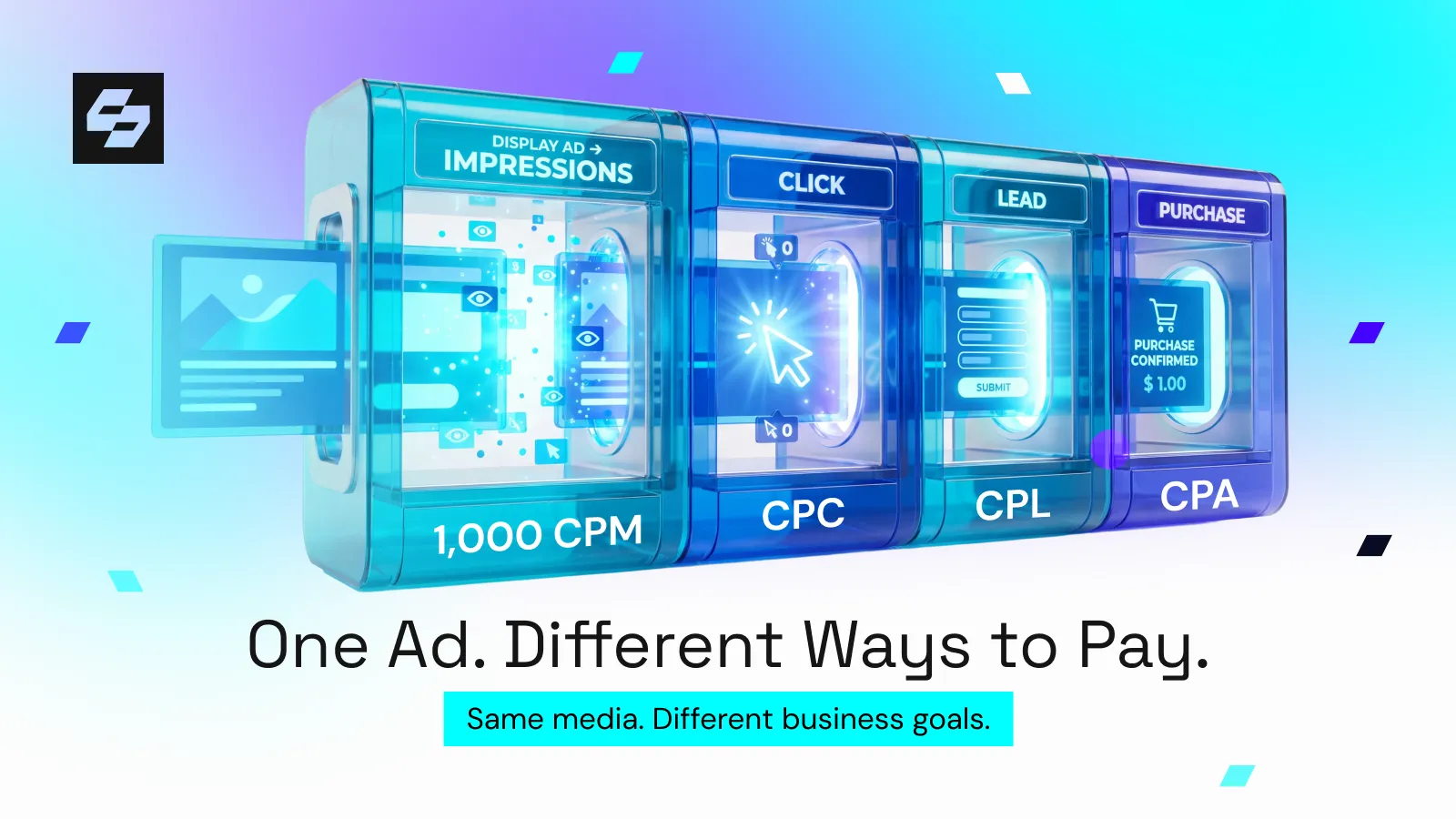
Display campaigns can use different pricing models depending on the objective - from CPM for reach and awareness to CPC, CPL and CPA for increasingly performance-focused outcomes.
Benefits of Display Advertising
Display advertising offers numerous advantages that make it essential in any digital marketing strategy.
Increase Brand Awareness
The primary advantage is the increase in brand awareness. Display ads ensure that people see your brand all across the web again and again, which leads to increased recognition of the brand and trust. In contrast to search ads, display ads introduce the brand to new people proactively.
Reach the Right Audience
One important advantage is the ability to reach the right audience. You can target the users based on their interests, in-market behavior, lookalike audiences, first-party data, and retargeting. The accuracy of targeting helps to ensure that your budget is spent on converting customers.
Support the Full Customer Journey
Advertising supports running through the complete customer journey - bringing your brand into the limelight at the recognition level, strengthening your message in the consideration phase, generating leads and securing loyalty with the help of a re-engagement approach.
Create Ads More Efficiently
Creating ads more efficiently is achievable with dynamic and responsive creatives. You can create multiple ad variations from a single asset, automatically test and optimize combinations, and scale campaigns without proportional increases in creative costs.
Bring Visitors Back
Re-engaging visitors remains the most common way of retargeting. This helps reconnect with people who visited your website before and remind them about products previously viewed in order to bring an abandoned cart back.
Measure Campaign Performance
Finally, advertising also delivers numerous measurable metrics such as impressions, click rates, conversion rates, cost per conversion and return on advertisement that can improve the campaign performance.
Start with Display Advertising Step-by-Step
Launching your first display campaign is not as scary as it seems. There is a simple process that will help you get through all the important campaign details without missing anything vital.
Step 1: Select the Right Advertising Platform
Choose the advertising platform that suits your needs and goals. The options may include a display advertising network, DSP, or another ad exchange. The choice depends on your promotion goals, budget, inventory, targeting options, reporting requirements, integrations, and brand safety needs. You should also determine whether you need self-service advertising or agency assistance or want to use both options.
Step 2: Identify Your Target Audience
Define your target audience. You need to know who you want to advertise to. Use the information you have about your customers and what you know about your product and define your ideal customer segments. You can also use first-party data, purchase intent, and other available resources.
Step 3: Set Your Campaign Objectives
Based on your advertising goals, choose the primary metric that will drive your campaign. For example, you want to drive awareness, traffic, leads, or sales. You also need to define secondary metrics and success KPIs. For example, for awareness, you will choose OOH, reach, and viewability, and for lead generation, you will pick CPA, conversions, and ROAS.
Step 4: Create Effective Ad Creatives
Your ads should have a clear message, visuals, and CTA. You should also make sure that your creatives are optimized for mobile devices and viewable at all times. Make sure that the information is easy to read and understood at first glance. You should also prepare different creative sizes for various platforms.
Step 5: Launch Your Campaign
Choose the channels, websites, segments, and audiences you want to use. Set your campaign budget, bids, dates, frequency capping, brand safety settings, and conversion tracking.
Step 6: Measure and Improve Performance
Compare the results you get from different audiences, channels, devices, creatives, and frequencies. Pause the underperforming campaigns and continue investing in the successful ones. Also, try new options and experiment with different ad variations, channels, and audiences. You can also try different approaches within one campaign, for example, by changing the CTA or testing new channels.
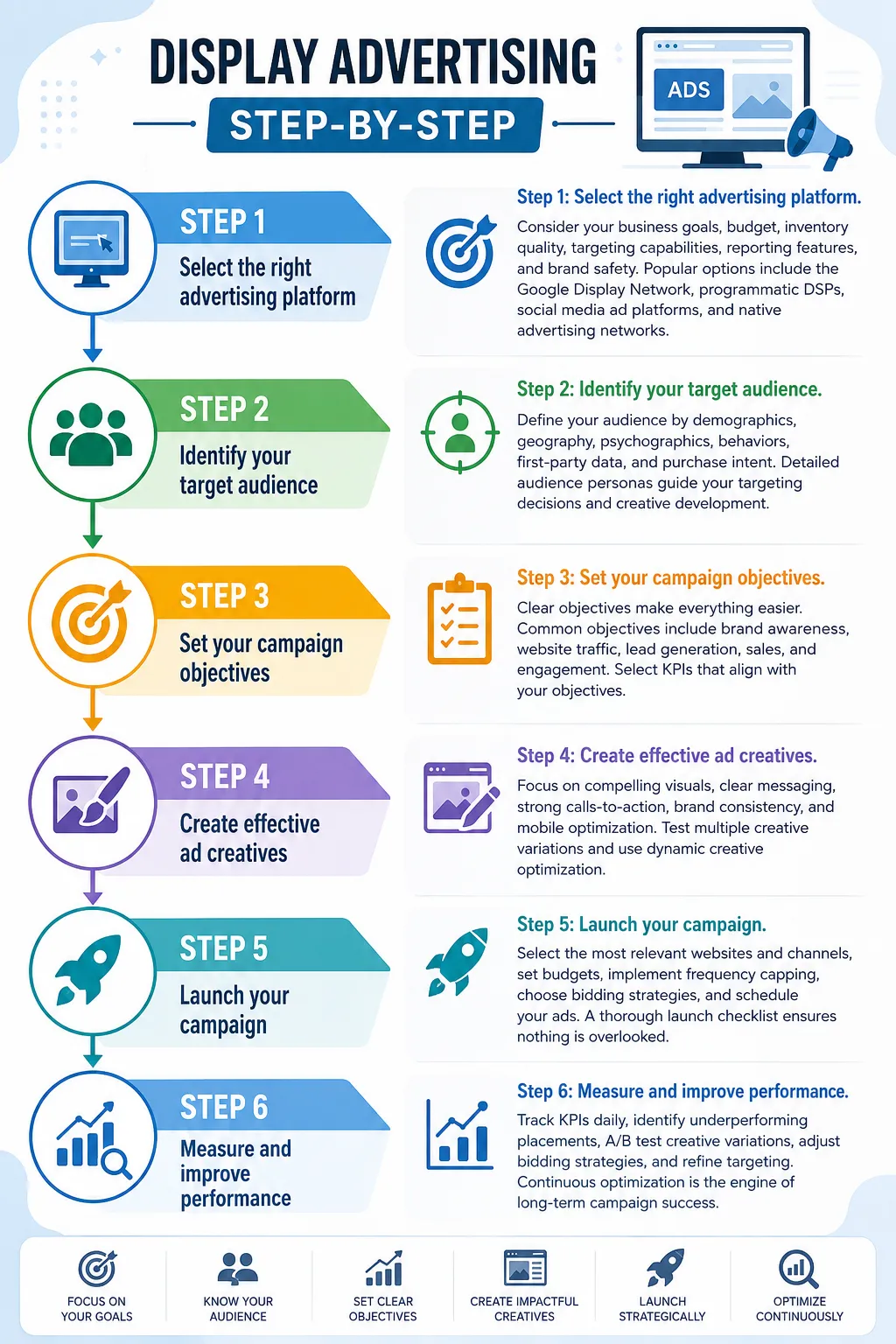
Following this structured approach transforms display advertising from an intimidating challenge into a manageable, repeatable process. By working through each step methodically, even beginners can launch campaigns that deliver meaningful results. Remember that display advertising is as much about learning and iteration as it is about execution each campaign provides valuable data that informs and improves the next one. Start small, test thoroughly, and scale what works. With this roadmap in hand, you are well-equipped to navigate the display advertising landscape and achieve your marketing goals.
Challenges of Display Advertising
Display ads are challenging-there are obstacles everywhere, so you need to stay alert. Data privacy is a major headache right now. With GDPR, CCPA, and browsers cutting off cookies, finding and measuring your audience has become difficult. What can you do? Rely heavily on your own first-party data, use privacy-friendly targeting methods like contextual advertising, and manage consent properly to avoid legal trouble.
Ad fatigue is another problem. If people keep seeing the same ad, they start ignoring it. Keep things interesting: limit how often each user sees your ads, refresh your creatives every few weeks, try new versions, and use dynamic creative optimization to shake things up.
Brand safety and ad fraud are big concerns-nobody wants their ads to appear next to inappropriate content or pay for bogus impressions. Protect your brand and your budget. Set up brand safety measures, work with trusted partners, use third-party verification, and monitor where your ads are being shown.
Finally, scaling creative production can drain resources quickly. Manually creating lots of ad variations isn't efficient. Use modular creative assets, automate creative optimization, and get tools to help you test and launch new ads fast.
Conclusion
Display advertising isn't limited to flashy banner ads anymore. It's a detailed system filled with various ad formats, advanced targeting, and countless ways to refine and improve your campaigns. Whether you manage a small business wanting more brand recognition or you're a marketer focused on conversions, understanding display advertising is essential. It's become a crucial skill in digital marketing.
Let's break it down. Display ads use visuals to catch attention across different websites, apps, pretty much anywhere online. Programmatic platforms handle the ad buying-think real-time auctions powered by AI. While search ads connect with users already interested in your offerings, display ads are about igniting new interest. With plenty of targeting options, you can reach your exact audience, and there are ad formats for every objective, whether it's building awareness or pushing for a sale.
At its core, display advertising is about sending the right message, in the right style, to where your audience is-and timing it just right. Begin with clear goals. Know your audience. Choose your platform carefully. Create ads people actually want to see. Test everything, then adjust based on what performs best. The entire display ad landscape is open to you, and now you know how to jump in and make your campaigns effective.
Ready to Put Display Advertising to Work?
Knowing how display works is the first step. The next is turning the right audience, inventory, creative and bidding strategy into measurable performance.
With Screencore, you can take display from theory to real campaigns — with programmatic buying, smarter targeting and optimization built for your goals.
Ready to get your ads in front of the right audience? Start Your Campaign.
FAQ
What is display advertising in digital marketing?
The definition of digital display advertising refers to visual ads placed across websites, apps, social platforms, and other digital environments to promote brands, products, or services. Unlike search ads, display ads create awareness and nurture audiences through visual storytelling and targeted placements across the web.
How long does it take to see results from display advertising?
Results vary based on campaign goals. Brand awareness metrics appear quickly, while conversions typically require two to four weeks of optimization. Retargeting campaigns often show faster results since audiences are already familiar with your brand. Contact us for personalized guidance.
Is display advertising suitable for small businesses?
Yes. Programmatic platforms allow small businesses to start with modest budgets and target local audiences effectively. Display ads help build brand recognition, retarget website visitors, and compete with larger brands on a level playing field. Explore our platform to learn more.
Can display advertising work without cookies?
Yes. The industry is adapting with solutions like contextual targeting, first-party data, cohort-based approaches, and privacy-safe alternatives. Building first-party relationships and using owned data are becoming essential strategies.
What type of advertising is displayed?
Display advertising is visual digital advertising using images, video, rich media, and interactive content across the web. It includes banner ads, video ads, native ads, social media ads, and programmatic advertising designed to build brand awareness and drive conversions. Learn more about our solutions today.