


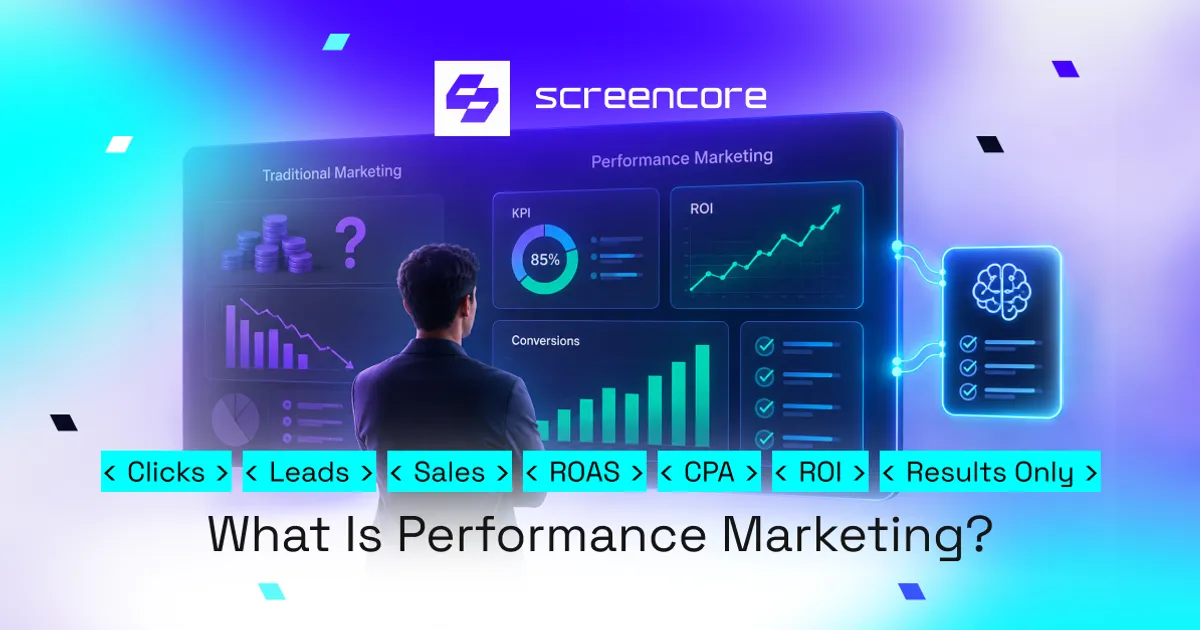
When it comes to marketing campaigns, businesses want to know how their investments will pay off. They mainly think of tangible results and measurable achievements. While traditional campaigns require you to pay upfront and may not always deliver what’s promised, performance marketing changes the game. What is performance marketing definition? Basically, advertisers pay not for promises but only for specific actions that have already happened. They move from guessing the results and wasting budgets to planning both with precision.
So, what is meant by performance marketing, and how exactly does it work? This article will unpack the performance marketing definition basics, what makes this strategy stand out, and how it’s implemented and measured.
Definition of Performance Marketing
Performance marketing is a results-driven digital advertising model that measures campaigns by specific, trackable actions and pays for the results they generate. Advertisers initially invest not in the ad exposure but in the outcomes the ad triggers, such as clicks, leads, app installs, and other meaningful actions taken by customers. In a word, the major principle performance-based marketing definition rests on is “no result means no payment.”
However, in answering the question “What is performance marketing?” it’s important to clarify that results don’t always mean sales. Hence, depending on the user action defined as a campaign objective, there are a few common performance marketing pricing models advertisers and marketers use for collaboration:
Cost per click (CPC): The payment is charged only when a user clicks on an ad, no matter if that user converts or it’s a random click. CPC is particularly useful for driving traffic to your online assets.
Cost per lead (CPL): You pay when a user completes an action demonstrating genuine interest, like submitting a form, requesting a quote, signing up for a newsletter, or providing contact info. This model is more common for businesses with longer sales cycles operating in B2B, finance, real estate, and education sectors.
Cost per acquisition (CPA): Here, advertisers pay for conversions or acquiring customers, whatever it means to a specific business or company. It could be a sale, an account registration, an appointment booking, a demo request, or a completed subscription. Tying spend to revenue, this model turns marketing into a sales channel.
Cost per install (CPI): Referring to mobile app marketing, CPI entails payment for mobile app downloads and installs. It’s valuable for app developers seeking to build or grow their user base.
Shifting the focus from exposure scope to measurable results that ensure impact, performance marketing allows advertisers to closely track their ad spend and performance to quickly identify the best approaches and accurately refine their strategies.
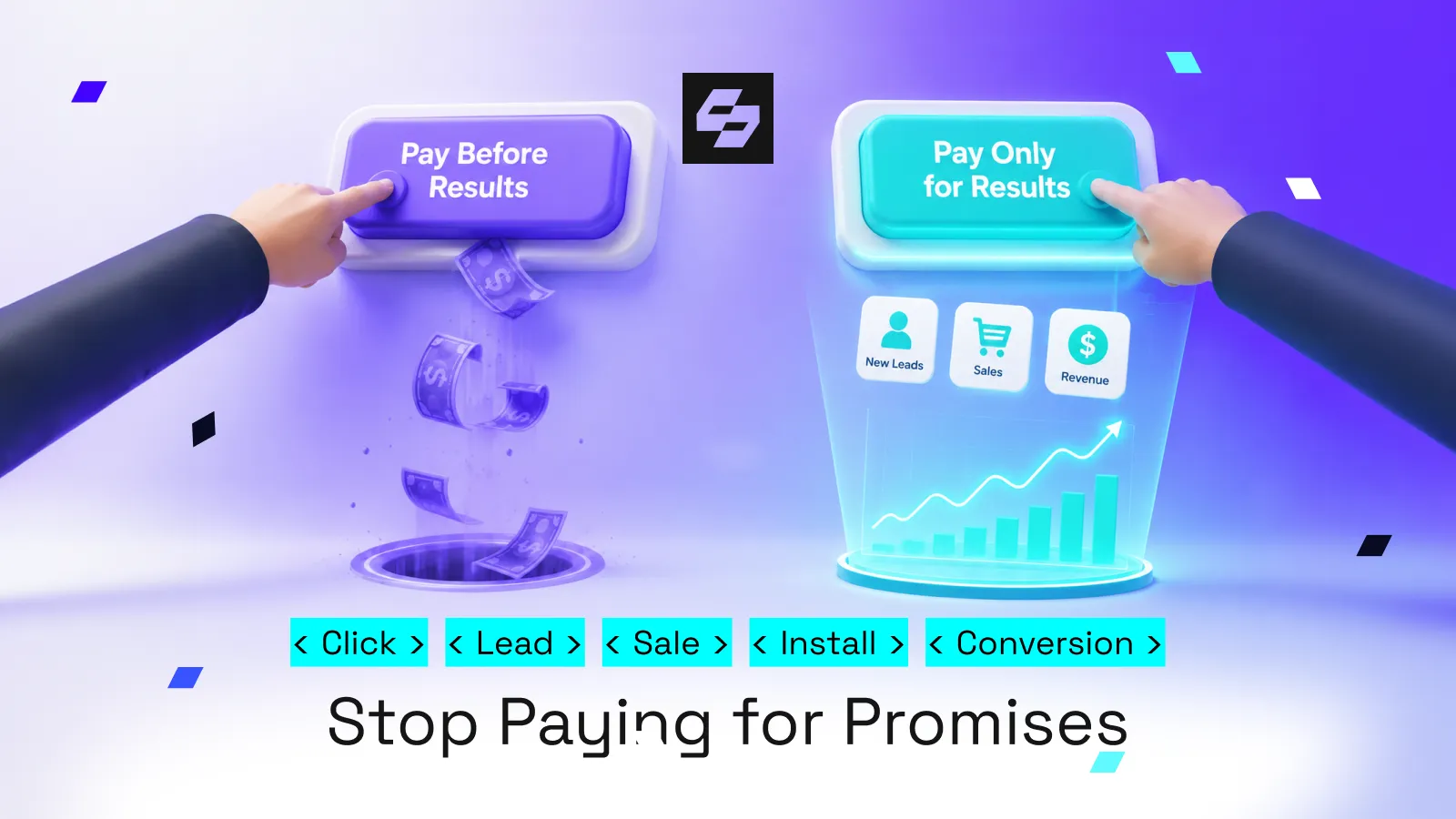
The defining idea behind performance marketing is accountability. Instead of judging success by exposure alone, advertisers connect spend to predefined outcomes such as clicks, leads, sales, app installs, or conversions. The exact payment model depends on the campaign objective — CPC for clicks, CPL for leads, CPI for installs, or CPA for completed acquisitions and conversions.
How Does Performance Marketing Work?
To answer “What is performance-based marketing?” you shouldn’t perceive it as a single-action approach. It’s rather a continuous loop moving through several core stages:
Defining campaign objectives and conversion goals: Performance campaigns are run for a clear objective, and knowing that objective from the start is the foundation everything is built on. So, advertisers should figure out what they want to achieve, setting measurable objectives and deciding what counts as a successful result, be it a phone call, completed purchase, app install, or subscription.
Targeting the right audience: With a clear goal in mind, businesses determine who is most likely to take that desired action. Performance campaigns hinge on precise targeting and address narrow audiences, categorized by demographics, interests, online behavior, search intent, location, purchase history, or even customer journey stage.
Choosing the ad channels and pricing model: Advertisers define their campaign structure, picking the best digital channels and an optimal pricing model depending on the campaign objective, target audience, product, ad budget, and customer journey.
Setting up tracking: Effective, result-driven campaigns are nothing without close tracking since advertisers need reliable data to see what actually brings results.
Measuring performance and optimizing: As the campaign goes live and starts producing data, marketers analyze key performance metrics to evaluate its efficiency, identify strengths and weaknesses, and make further adjustments in budgeting, targeting, bidding strategies, and creative assets.
In a nutshell, the performance marketing cycle is a well-set and controlled process aimed at not only achieving defined goals but also continuous improvement to optimize spend and scale with precision.
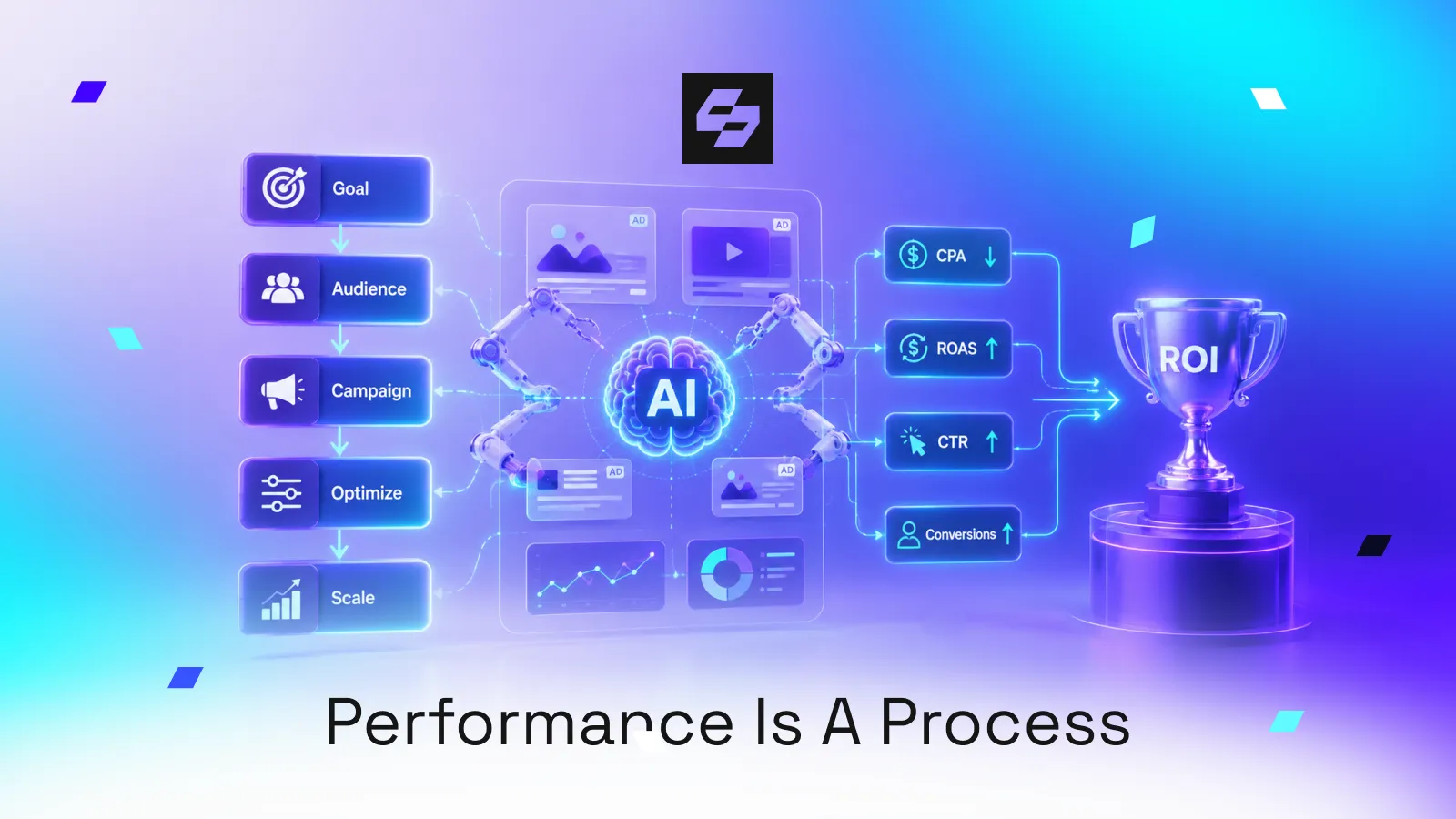
A successful performance marketing campaign is a process, not a one-time ad buy. It starts with a measurable goal and the right audience, then connects campaign execution with tracking and continuous optimization. Metrics such as CPA, CTR, ROAS, and conversions reveal what is actually driving value, allowing marketers to shift budget toward stronger-performing campaigns and scale based on data rather than assumptions.
Performance Marketing vs Advertising
When explaining “What is performance marketing in digital marketing,” even professionals often call it “performance advertising.” Though both focus on measurable results, data, and performance, these two terms are not the same.
Performance marketing stands for a complete strategic framework, while performance advertising is a part of this framework referring to pay-for-result ad campaigns per se. It’s a specific tactic or tool within a broader approach. The online performance marketing definition already embraces advertising.
Performance Marketing | Performance Advertising | |
Scope | Embraces end-to-end process, including planning, channel selection, measuring, and optimization | Focused specifically on execution |
Goal | Revenue growth, customer acquisition, lifetime value | Immediate cost-effective user actions |
Core Components | Landing page design, conversion rate optimization (CRO), attribution modeling, paid ads | Ad creatives, copy variations, platform targeting, keyword bidding |
Major Metrics | CAC (Customer Acquisition Cost), ROAS, LTV (Lifetime Value), Conversion Rate | CPC, CPM, CTR, CPA |
Function | Comprehensive strategy | Single component |
Example | Campaign combining paid ads, affiliate sales, and CRO to boost revenue | A CPA campaign on Instagram to drive product sales |
Performance Marketing vs Brand Marketing
What is digital performance marketing compared to brand marketing? These are two different approaches that contribute to business growth by attracting customers, increasing revenue, and strengthening business market position, yet serve different objectives.
The key focus of performance marketing is actions that can be quickly tracked and measured, such as clicks, leads, purchases, and conversions. Brand marketing, on the other hand, has broader aims that take longer to achieve, such as brand awareness, recognition, trust, and customer loyalty.
Performance Marketing | Brand Marketing | |
Primary Goal | Drive immediate, trackable conversion and revenue | Build long-term equity, trust, and loyalty |
Major Focus | Capturing existing demand | Creating and shaping demand |
Target Audience | High-intent buyers ready to take action | Broad market, prospects |
Timeframe | Short-term, immediate | Long-term, cumulative |
Success Metrics | CPA, CPC, CPL, ROAS, Conversion Rate | Brand recall, sentiment, organic search volume, share of voice |
Common Channels | Paid search, paid social, affiliate marketing, display, programmatic, and retargeting | TV, video, social media, PR, sponsorships, content, events, and brand campaigns |
Payment Structure | Pay-for-result | Upfront costs, capital investments in brand equity |
Building awareness and recognition, brand marketing helps create demand while performance marketing helps convert this demand into measurable outcomes. So, these approaches perfectly complement each other and work best when applied together, helping businesses maintain sustainable growth.
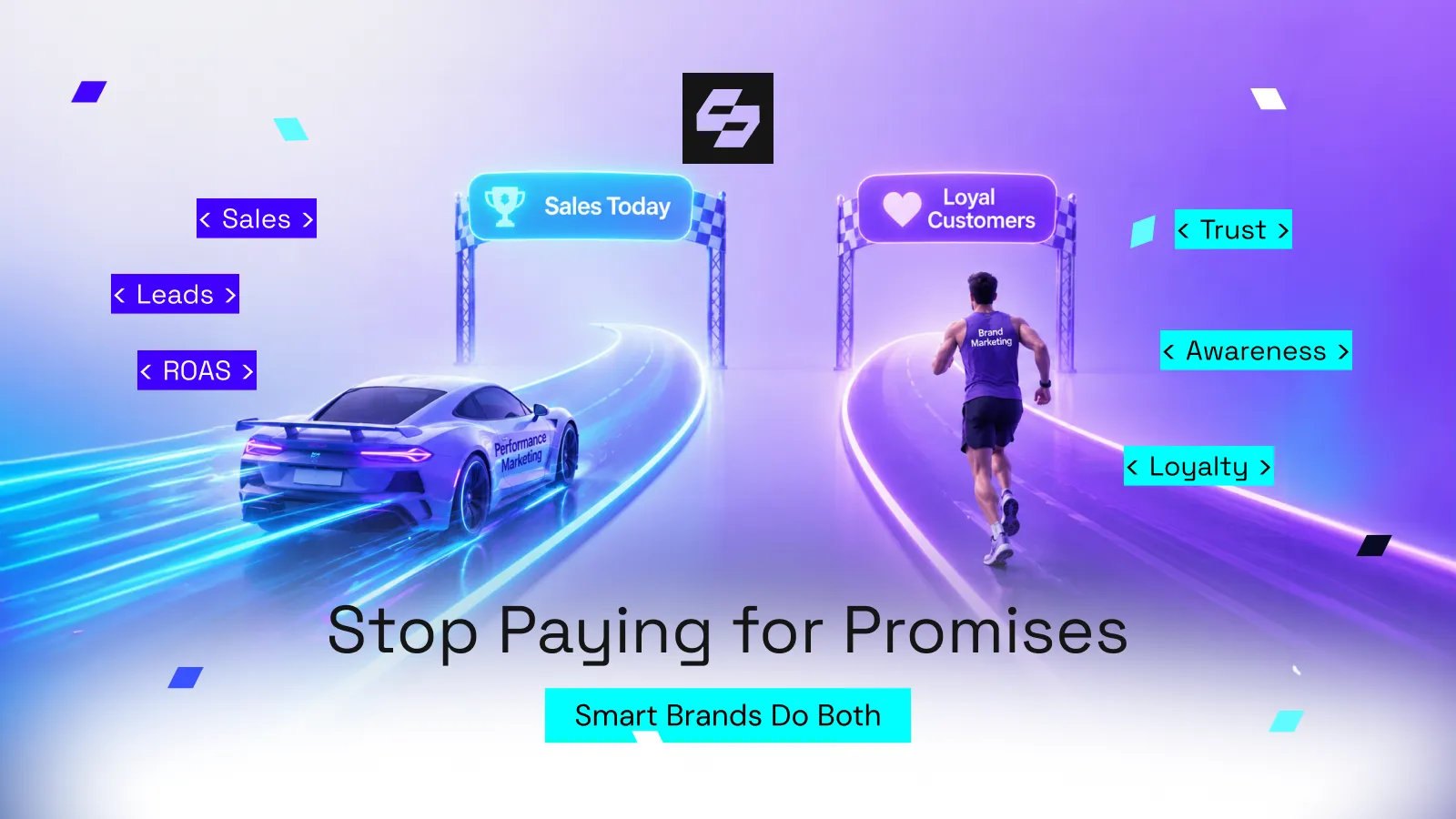
Performance marketing and brand marketing solve different parts of the growth equation. Performance marketing focuses on measurable outcomes such as leads, sales, conversions, CPA, and ROAS, while brand marketing builds awareness, trust, and customer loyalty over time. The strongest marketing strategies don’t force a choice between the two: brand creates demand, while performance turns that demand into measurable business results.
Types of Performance Marketing Channels
Though the performance marketing campaign definition looks quite straightforward, in practice, it embraces multiple ad formats and relies on multiple digital channels, each ensuring a different way to reach audiences and playing a different role.
Affiliate marketing
It’s the purest form of performance marketing when brands promote their products or services through third parties (affiliates) on a commission-per-result basis. External publishers, review sites, coupon platforms, content creators, bloggers, and influencers earn commissions for purchases, qualified leads, subscriptions, and any other predefined conversions triggered by affiliate links.
Connecting businesses to highly targeted audiences, affiliate marketing allows them to expand reach and distribution networks without paying upfront for exposure. It’s a cost-effective and highly efficient channel suitable for businesses of all sizes.
Search engine marketing (SEM)
SEM uses paid ads on search engine results pages to capture high-intent users actively searching for specific products, services, information, or solutions. It relies on PPC advertising on platforms like Google Ads or Bing Ads and uses a CPC model.
Putting brands in front of users who have already demonstrated interest and are close to taking action, SEM is by far the most conversion-oriented channel, particularly effective for local businesses, e-commerce, B2B, software companies, and service providers.
Social media advertising
Social media advertising involves paid ads on platforms like Meta, TikTok, LinkedIn, Pinterest, or X. Targeting users based on their interests, behaviors, online activity, or previous interactions with a brand, social media ads meet customers earlier in their journey, before they even know they want or need something, to stimulate decision-making. That’s why social ads are often used for CPL or CPI campaigns aimed at lead generation rather than immediate sales.
Native advertising
Native ads are designed to blend into the platform or media environment they appear on, matching the format and context of the surrounding content. They don’t look like ads. These are “recommended content” widgets, sponsored articles, or promoted listings meant to naturally attract user attention and encourage action without disrupting the user experience. Such content-driven engagement greatly combines with paid distribution to push users from awareness to consideration and decision-making.
Sponsored advertising
This channel covers paid ads where a brand pays for placing its content, product, message, or listing on a third-party platform, which is often an e-commerce marketplace, app store, or content platform. Sponsored product listings on Amazon are a vivid example.
Aimed at users with a buying mindset and direct conversions, sponsorships are great for advertising niche products, special consumer products, and professional services.
Connected TV (CTV)
CTV brings video commercials to a whole new level, delivering video ads through streaming platforms and smart TV ads. This format combines the visual impact and emotional power of traditional television with the precise targeting, optimization capabilities, and trackability of digital channels.
Benefits of Performance Marketing
With the performance marketing definition explained and its major principles and processes uncovered, let’s consider what makes this approach one of the most trusted growth strategies in modern advertising, which accounts for nearly 60% of all digital ad spending.
Efficient ad spend: Instead of relying on gut feelings and unmeasurable promises, performance marketing offers measurable outcomes and you pay only for actual results, making every dollar spent accountable. Not only does this allow for smarter investment planning and ad budget allocation, but it also helps minimize wasted spend on inefficient campaigns.
Actionable data: Through consistent performance monitoring and data collection, marketers can continuously evaluate and analyze their efforts, getting real-time insights into what really works and brings the best results and what needs tweaking.
Greater control and agility: Real-time data on campaign performance and outcomes enable faster and more efficient decision-making and hands-on control over every campaign component, from creative assets and ad placements to bids, targeting, and budget distribution. Businesses can react to any issues immediately and quickly make strategy adjustments for sustainable growth.
Flexibility for all businesses: Performance marketing is for everyone. Requiring no substantial upfront budget and offering scalability, it suits small businesses. Meanwhile, larger enterprises can manage cross-channel campaigns across several markets.
Targeting precision: Set for the most relevant audiences from the start, result-driven performance campaigns continuously generate data for efficient real-time optimization to suit your audiences even better and trigger more conversions.
How to Measure Performance Marketing
What is the best performance marketing strategy for your business? To know which approach works best for you, you should know how to evaluate your efforts and translate the results you get into actionable insights. There is a well-established set of metrics or key performance indicators (KPIs) that will help you get a complete picture of each campaign and assess its efficiency.
Cost Per Mille (CPM)
CPM measures the cost of reaching 1,000 ad impressions. Simply put, how much it costs to display an ad to the audience, no matter if any action is taken or not. Basically, CPM measures ad exposure.
CPM = (Total Advertising Cost ÷ Number of Impressions) × 1,000
Showing the cost of being seen, this metric is used to evaluate brand visibility and reach, especially in campaigns designed to establish awareness rather than drive conversions.
Cost Per Click (CPC)
CPC literally stands for the cost of every single click on an ad, showing the price of engagement, not simply viewing the message.
CPC = Total Advertising Cost ÷ Number of Clicks
CPC indicates how effectively a campaign drives traffic to your website, landing page, or other destination. A low CPC is positive, meaning your ads are compelling and strongly resonate with the audience, bringing more traffic.
Cost Per Lead (CPL)
CPL determines the cost of getting a single lead, a user who has taken a meaningful action, such as signing up for a newsletter, filling out a form, or booking a consultation. It’s a critical metric for businesses with longer sales cycles, where a purchase decision takes time to consider.
CPL = Total Campaign Spend ÷ Number of Leads Generated
Notably, cheap leads are not always the best ones. So, CPL should be tracked along with the lead quality to understand whether those are qualified leads who eventually convert to customers.
Cost Per Acquisition (CPA)
CPA is the cost of generating a predefined conversion, such as an actual sale or a new paying customer.
CPA = Total Ad Spend ÷ Number of Acquisitions or Conversions
CPA is considered one of the most important performance marketing metrics because it directly links spend to revenue outcomes. Yet, CPA alone doesn’t indicate profitability unless it’s compared against product margins, operational costs, repeat purchases, and customer lifetime value.
Return on Ad Spend (ROAS)
When considering “What is performance media marketing?” and how it impacts revenue growth, one of the key efficiency metrics is ROAS, which shows how much revenue your business generates on every dollar spent on advertising.
ROAS = Revenue Attributed to Ads ÷ Total Ad Spend
ROAS is normally expressed as a ratio. Thus, ROAS 5 to 1 means that $1 of ad spend brought $5 in revenue, indicating the financial efficiency of campaigns. But a high ROAS doesn’t necessarily mean high profit since other related costs may remain high. So, an efficient ROAS should be defined taking into account profit margins.
Customer Lifetime Value (CLV)
CLV shifts beyond transactional measurements and evaluates the total revenue a business can get from a customer throughout their entire relationship, not from a single purchase. It also accounts for repeat purchases, upsells, and long-term loyalty, uncovering the customer’s true value.
CLV = Average Purchase Value × Purchase Frequency × Average Customer Lifespan
Revealing long-term impact, CLV provides important context for other performance marketing metrics, showing immediate or short-term effects. Thus, seemingly expensive campaigns may appear highly profitable if they bring customers who continue buying.
How to Do Performance Marketing: Step-by-Step Guide
From the performance marketing definition and examples of key tactics we’ve explained, it’s clear that performance marketing is a comprehensive strategy that should be approached as a structured process to build successful campaigns.
Step 1: Define your goals
What does a successful campaign mean for you? The answer to this question is your clear starting point that lays a foundation for all further steps. Is it generating leads, increasing online sales, or driving website traffic? Importantly, you should decide on conversion goals that are measurable, specific, and time-bound, not vague or too general. It should be something like “acquiring 1,000 app users this month” or “hitting 4:1 ROAS by the end of the year.”
Step 2: Choose the right channels
Different channels serve different purposes and excel at different tasks. The right channel choice largely depends on your campaign goals, target audience, budget, and customer journey stage. The key point to remember here is that there is no one-size-fits-all formula for every business and that you don’t have to try to embrace multiple channels at once. You’d better start with one or two well-established channels, prove they work, and then gradually expand.
Step 3: Set your budget and KPIs
Before launching a campaign, decide how much you are ready to invest and determine a set of the most meaningful performance metrics to measure your success. You can set a lower budget first and test the waters before further scaling. Ensure you have tracking and analytics tools at hand for efficient performance tracking.
Step 4: Launch and optimize campaigns
Build ad creatives and landing pages, ensure they are trackable, and let them go live. Run A/B tests with multiple variations of headers, visuals, and CTA buttons to pinpoint the best-performing ones. Continuously monitor campaign data and refine strategies, removing underperforming ads, reallocating budgets, or adjusting bids to improve efficiency.
Step 5: Work with experts if needed
If you are new to performance marketing, lack expertise, or need to manage multiple channels, plan a complex campaign, or scale your strategy, or if you are simply short of time, you can cooperate with a marketing agency, hire a consultant, or partner with an affiliate network. Engaging professionals will help improve performance tracking and increase campaign efficiency.
Step 6: Analyze results and improve
Evaluate campaign results against your goals and essential KPIs. Use the insights to define success elements and analyze those that underperform to start the next campaigns smarter and optimize budget allocation.
Conclusion
Performance marketing has brought transparency and accountability to digital advertising, which was once hinged on a spend-first approach. With a pay-per-result principle at the core and access to real-time performance insights, this strategy makes it easier for businesses to achieve both immediate results and sustainable long-term growth without going down a trial-and-error path and bloating ad budgets.
FAQ
You can observe initial results, such as ad impressions, clicks, or even early conversions, within just a few days after launching a campaign. But to get meaningful insights, it will take two to three months.
The best part of performance marketing is that it’s suitable for all business sizes. SMBs in particular will benefit from controlled budgeting, precise targeting, and gradual campaign scaling.
There is no benchmark for a minimum budget, since the right amount depends on your industry, target audience, channel, niche competitiveness, and primary conversion goals. A recommended average is about $1,000 to $3,000 per month.