



Privacy used to sit next to the product.
There was the programmatic platform, doing the actual work. Then there were privacy policies, consent banners, legal reviews and compliance documents surrounding it.
That separation is becoming difficult to defend.
Programmatic advertising processes decisions in milliseconds. Audience signals arrive. Consent information travels through the supply chain. Auctions happen. Data moves between publishers, SSPs, DSPs and other technology partners.
If privacy controls cannot survive that journey, a polished privacy policy will not fix the infrastructure underneath it.
For publishers and AdTech platforms, privacy readiness is becoming a product requirement.
Privacy Has Moved Into the Bidstream
A programmatic platform does not become privacy-ready because somebody updated the website footer.
The harder questions happen deeper inside the stack.
What does the platform do when it receives a Global Privacy Control signal? How does it process GPP or TCF information? Where does consent enter the data flow? Which vendors receive information? What changes after somebody opts out?
Those are engineering questions as much as legal ones.
BidSafe One makes this distinction particularly clearly in its analysis of privacy in 2026: compliance is increasingly judged through the technical layer, including OpenRTB fields, GPP segments, TCF strings, GPC and state-level opt-out signals. The practical test is whether an opt-out actually changes how data is processed.
That is a much higher bar than having the correct documentation.
It is also a healthier one.

Privacy-ready programmatic infrastructure connects data, consent, activation and monetization so privacy controls work throughout the advertising process—not only at the compliance layer.
The U.S. Privacy Map Keeps Getting Harder to Ignore
The U.S. market illustrates the problem.
Publishers and AdTech platforms are not operating under one neat national privacy framework. BidSafe One reports that 19 U.S. states now have comprehensive consumer privacy laws in effect, with Indiana, Kentucky and Rhode Island whose laws took effect in January 2026. Its review of recent enforcement also identifies recurring problems with opt-outs, Global Privacy Control and the gap between what companies say they do and what their technology actually does.
This matters because programmatic systems are designed to scale.
A publisher can reach users across multiple states. An AdTech platform can process enormous numbers of bid requests across different jurisdictions. A new integration can change the data flow without anyone touching the privacy policy.
The bigger the system becomes, the more expensive privacy debt becomes.
A missing signal at a small scale is a bug. The same missing signal reproduced across millions of transactions is an infrastructure problem.
Every New Integration Puts Privacy Infrastructure to the Test
Programmatic advertising rarely stands still.
Publishers add demand partners. Platforms introduce new features. Teams expand into CTV and other digital environments. Each change can create new data flows, new vendor relationships and new questions about how privacy signals are handled.
The challenge is not simply managing more transactions. It is maintaining consistent privacy controls as the advertising ecosystem becomes more connected.
When a new partner enters the supply chain, where does user data go? Does the integration respect consent and opt-out signals? Can teams trace what happens to information across the transaction?
These questions matter long after an integration goes live. A platform may process millions of requests, but privacy controls still need to work at the level of each relevant transaction.
For publishers, this is more than a compliance exercise. Clear data flows and reliable partner controls help teams understand the technology behind their monetization.
You cannot manage what you cannot see moving through your infrastructure.
Publishers Cannot Outsource the Entire Privacy Problem
Programmatic has always depended on partnerships.
That makes it efficient. It also makes privacy complicated.
Publishers connect to technology providers. Platforms connect to vendors. Vendors connect to other infrastructure. Data flows rarely stop at one company boundary.
The tempting response is to treat compliance as somebody else’s responsibility.
That is risky.
Recent privacy enforcement has increasingly examined whether consent and opt-out mechanisms actually work across the technology involved. BidSafe One’s review of 2025–2026 enforcement notes that regulators have looked beyond privacy notices and tested whether data sharing really stops after users exercise their choices.
For publishers, partner quality therefore becomes part of privacy readiness.
The question is not simply, “Does this vendor have a privacy policy?”
Ask what the integration actually does.

A single programmatic impression can involve publishers, platforms, auctions and advertisers. Privacy-ready infrastructure helps maintain data control, transparency, trust and compliance across that chain.
Privacy-Ready Does Not Mean Data-Free
There is another mistake worth avoiding.
Privacy-ready advertising does not mean abandoning useful data, targeting or optimization.
It means knowing what data is being used, why it is being used, whether the appropriate signal or legal basis exists, where it travels and what the platform should do when permission changes.
That is a very different proposition.
A strong privacy layer should support the commercial system rather than constantly fight it. Data mapping can expose unnecessary flows. Cleaner consent handling can reduce ambiguity. Better vendor controls can make integrations easier to understand. Clear processes give product and engineering teams something concrete to build against.
Privacy becomes infrastructure when those decisions are part of normal product logic.
Screencore and BidSafe One: Connecting AdTech Reality With Privacy Reality
This is where cooperation between Screencore and BidSafe One becomes relevant.
Screencore operates in the world where programmatic decisions actually happen: media buying, auctions, targeting, inventory, optimization and real-time infrastructure.
BidSafe One approaches privacy from the same operational direction. Its services include privacy audits, data-flow mapping, TCF and GPP implementation reviews, Records of Processing Activities, DPIAs and LIAs, contract reviews and deeper DSP/SSP stack audits.
That combination matters.
Legal teams can understand regulation but miss what happens inside an OpenRTB workflow. Technical teams can understand every field in a bid request but still struggle to translate regulatory requirements into product behavior.
Privacy-ready infrastructure needs both languages.
BidSafe One describes its role as bridging regulation and AdTech reality, with expertise covering consent and user choice, product and integration risks, and privacy frameworks. That fits naturally with Screencore’s focus on transparent programmatic infrastructure and real-time decision-making.
Compliance works better when it is designed with the product rather than attached after launch.
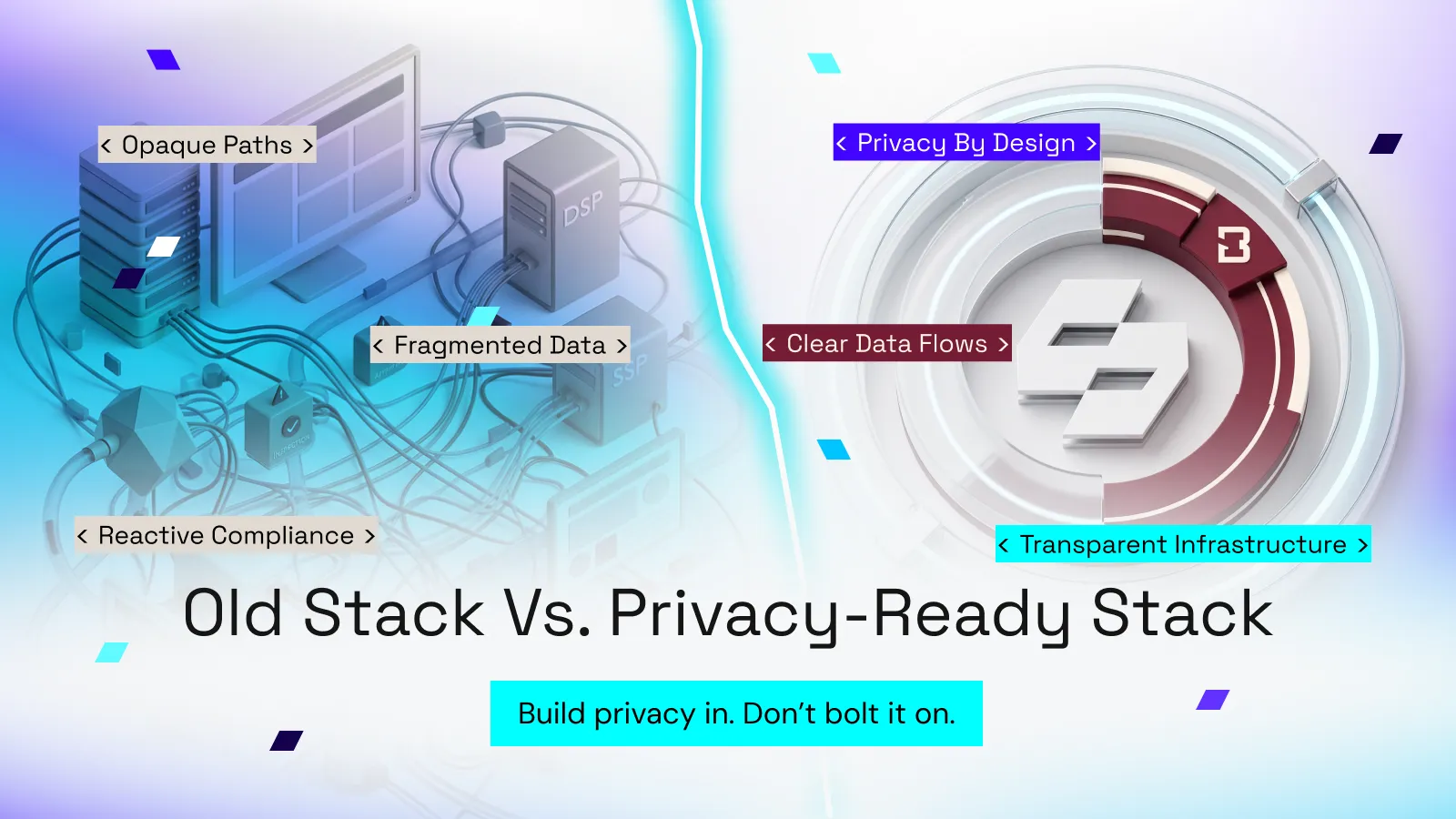
Legacy AdTech stacks can leave teams dealing with fragmented data, opaque paths and reactive compliance. A privacy-ready stack brings privacy by design, clearer data flows and transparency closer to the infrastructure itself.
Privacy Can Be an Infrastructure Advantage
There is a commercial argument here that often gets lost.
Privacy work is usually discussed as risk reduction. Avoid the fine. Pass the audit. Update the contract.
Necessary, yes. Complete, no.
A platform that understands its data flows can integrate partners more confidently. A publisher with clearer controls can evaluate demand relationships more intelligently. A company that has already mapped consent and opt-out behavior is in a better position when regulation changes.
And changes will come.
Privacy-ready infrastructure does not predict every new requirement. It gives the business a cleaner foundation for responding to one.
That is much more valuable than another emergency compliance project six months later.
Build Privacy Into the Pipes
Programmatic infrastructure keeps getting smarter. AI is moving deeper into bidding and optimization. CTV is expanding. Auctions are becoming more sophisticated. New formats, integrations and demand partnerships are making programmatic supply chains more complex.
Privacy cannot remain the slow layer sitting outside all of that.
It has to travel at programmatic speed.
For publishers, that means understanding partners, consent and data flows. For AdTech companies, it means translating privacy requirements into actual platform behavior. And for both, it means being able to demonstrate what happens after a user makes a privacy choice.
That is what privacy-ready infrastructure really means.
Not another policy.
A system that behaves the way the policy says it does.
Privacy Readiness Starts With Visibility
Before adding another demand partner or launching a new integration, understand how data moves through your stack.
Map the flow. Check how privacy signals are handled. Know which partners receive information and what happens when a user changes their preferences.
The goal is not to slow programmatic advertising down. It is to build infrastructure that can scale without losing control of the data moving through it.
Make Privacy Part of Your Programmatic Foundation
Screencore believes strong programmatic infrastructure should be transparent, scalable and built for the realities of modern media.
Together with privacy expertise from BidSafe One, AdTech businesses can move from privacy documentation toward practical systems, clearer data flows and compliance processes that work with the product.
Discover BidSafe One and its practical AdTech privacy services.
Ready to strengthen the programmatic side of your business? Talk to the Screencore team.