


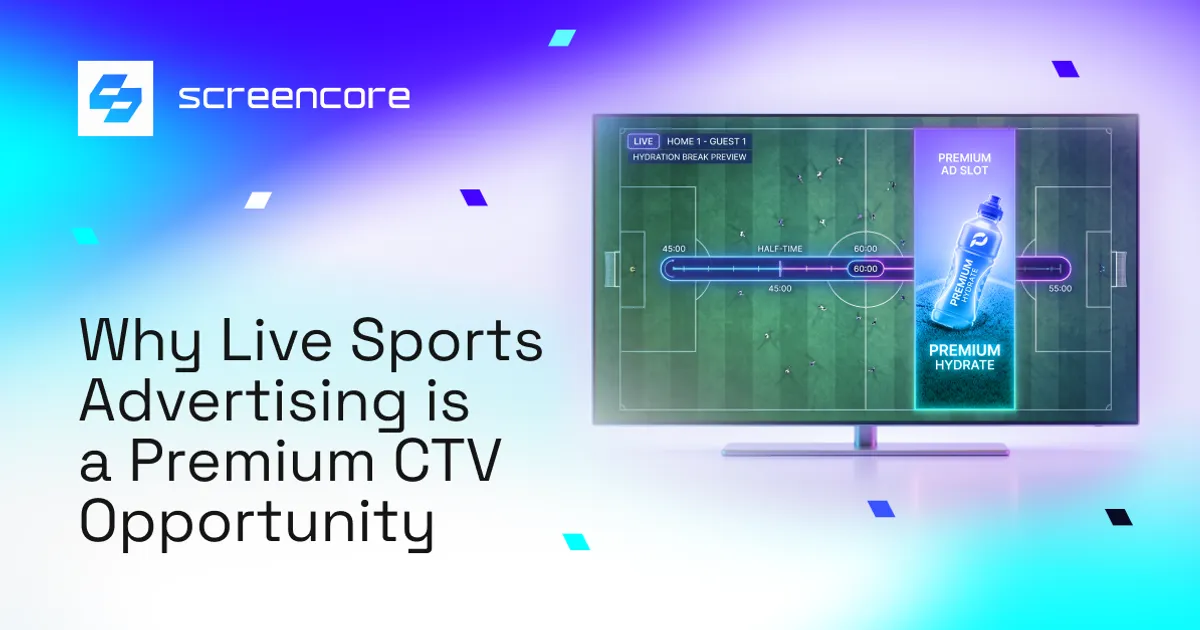
Live sports advertising makes brands connect better with their consumers when their attention is fixed on the screen. Live sports games offer a sense of urgency, excitement, and experiences that cannot be rescheduled as compared to on-demand entertainment—making scaling programmatic live sports campaigns a high-impact opportunity for advertisers capturing real-time viewer engagement.
Connected TV (CTV) refers to television content streamed through internet-connected devices and platforms. CTV live sports advertisements offer brands an opportunity to merge the large screen experience with digital ad buying and measurement technology—especially when evaluating CTV impressions before playback to ensure ad delivery and streaming readiness.
Another area for live sports CTV advertising is seen in the 2026 FIFA World Cup with natural pauses in the game such as water breaks.
Why Premium CTV Inventory Commands Attention
There is a reason media companies continue competing aggressively for sports broadcasting rights. Live sports can gather large audiences at a scale few other types of programming consistently achieve. According to EMARKETER, sports were projected to account for 31.8% of U.S. TV advertising spending in 2026.
At the same time, CTV is gaining a larger share of media investment. EMARKETER forecast that U.S. CTV upfront ad spending would reach $17.73 billion in 2026, surpassing primetime linear TV upfront spending of $16.98 billion. These figures reflect broader advertising market trends, not exclusively live sports CTV spending.
The reason why premium CTV inventory is considered to be desirable is that it consists of live broadcasts, scarce spots, and appropriate content. Fans watch the competition attentively and even stay engaged until halftime or breaks.
Contrary to regular on-demand inventory, live sports events cannot be repeated at a convenient time. The advertising spots are limited, especially during big competitions which attract a large number of fans.
This scarcity may raise the commercial value of spots. For brands, it is not only the opportunity to attract more people. It is the chance to attract people who are interested in the content anyway.
World Cup Advertising and New In-Game Breaks
The 2026 FIFA World Cup offered a clear example of how natural interruptions can create additional advertising opportunities. FIFA introduced mandatory three-minute hydration breaks midway through each half of every match, regardless of weather conditions. Although designed for player welfare, these pauses also gave broadcasters opportunities to introduce advertising without creating new stoppages.
The break could have been partially utilized for commercials, respecting time-related and return-to-live action obligations of broadcasters. The championship proved the value of major sporting events for commercials. Broadcast audience numbers and CTV ad reach should be considered independently of each other.
The total audience of a broadcaster for a particular match includes linear TV, streaming, and other methods of distribution. This does not mean that such a figure is an indicator of the number of potential viewers through programmatic connected TV advertising.
This channel of advertising was shown to advertisers by the World Cup not only as a temporary increase of inventory. There can be a lot of sporting situations that were previously used for rest or strategy discussion and now are media opportunities.

Live sports pauses can create high-value premium CTV ad inventory and new revenue opportunities.
Live Sports Advertising Without Disrupting Viewers
It is important to understand that just because there is more inventory to work with does not mean that there will be improved advertising. When Fox aired a commercial at the 2026 World Cup, it drew complaints when a full-screen commercial did not stop as the game resumed. Meanwhile, Telemundo decided to keep the game going by displaying player actions and replays.
For advertisers, three considerations matter:
Timing: Ads should flow with the pace of the event and end before significant action begins again.
Ad load: An overload of ads within a short interval may irritate viewers, even if the ads relate to the content.
Creative relevance: Ads that tie in with the sporting theme have a higher probability of being suitable rather than irrelevant or repetitive ads.
Frequency control is also important. In cases where it is possible, advertisers can manage how many times their message is repeated during the course of their ad campaign, and not overwhelm the same household with the same message. The advantage of advertising during live sports comes from the audience engagement.
CTV Ad Formats for Natural Breaks in Play
The modern form of advertising in connected TVs is far more flexible compared to the conventional form where the viewer is forced to watch the whole screen. Various forms can be used depending on when the viewer chooses to watch.
Format | Viewing moment | Best suited for |
In-stream video | Halftime, timeouts, and scheduled breaks | Brand awareness and storytelling |
Split-screen advertising | Short pauses while the live feed remains visible | Contextual sponsorships and less disruptive messaging |
Interactive ads | Supported CTV placements and streaming environments | Product exploration and engagement |
Pause ads | When viewers manually pause supported streaming content | Optional interaction without interrupting active playback |
Video ads are another traditional choice for those wishing to reach out on the big screen. The split-screen technology allows broadcasters to retain a portion of the stream while including advertising messages. Interactive technology might also involve more activities that could be performed through a QR code where possible.
More importantly, pause ads initiated by viewers do not amount to the pauses during a sport event itself. The pause made by a fan during viewing and one made by a referee in the game are two separate instances of advertising opportunities. Every format is not available for every event.
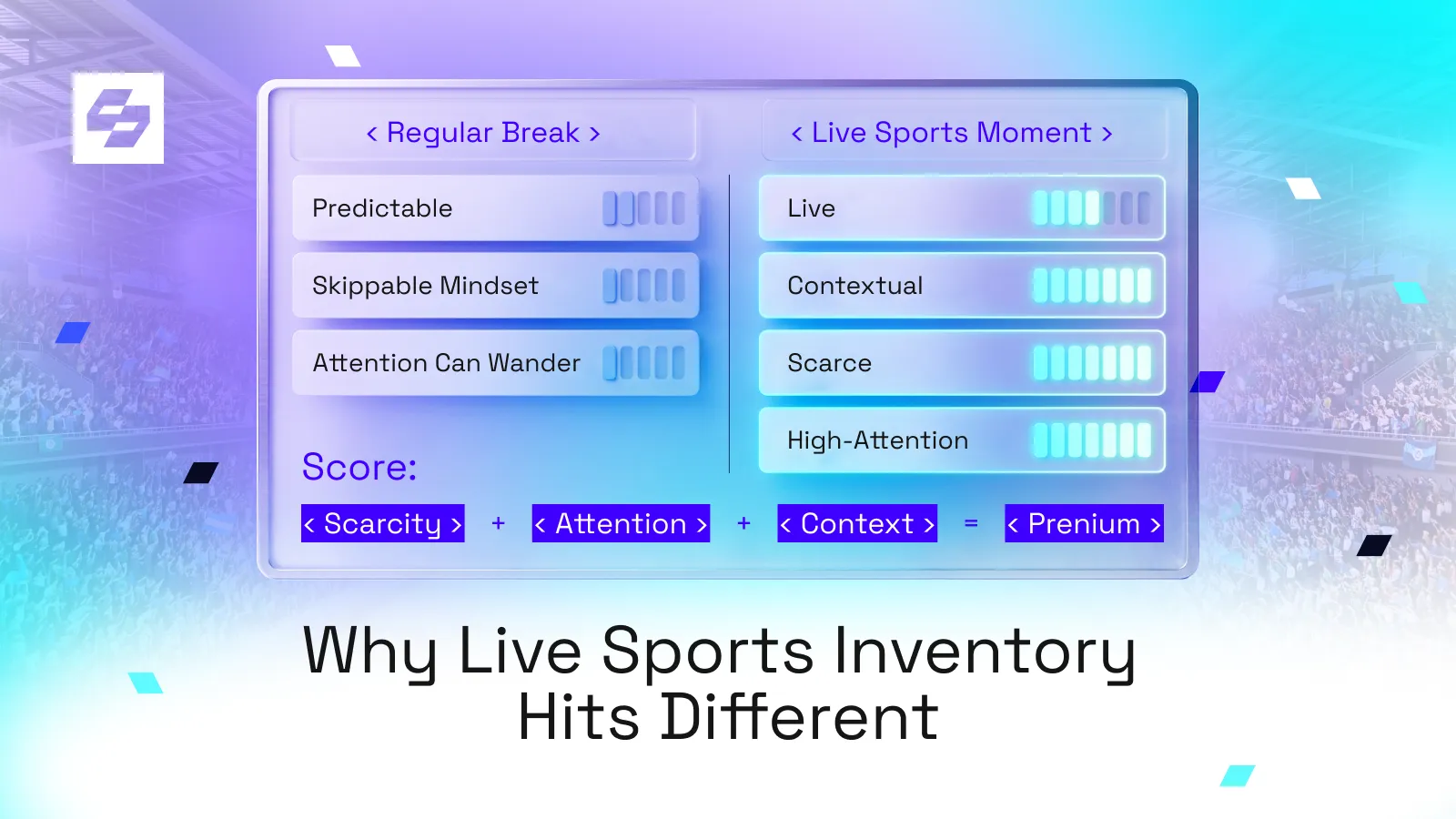
Premium live sports CTV inventory compared with regular ad breaks, highlighting scarcity, audience attention and contextual relevance in connected TV advertising.
How Programmatic Sports Advertising Is Bought
Accessing premium sports audiences requires understanding how advertising inventory is sold.
There are several common buying models.
Direct buys refer to negotiated placements from the broadcaster, streaming service, or its salespeople. Direct buys may provide better control over specific events, sponsorships, and media packages agreed upon.
Private marketplaces (PMPs) give selected advertisers access to publisher inventory via controlled programmatic auctions. The availability and cost depend on the agreement made between the publisher and the advertiser.
Programmatic guaranteed refers to agreements that include predetermined volume, price, and delivery terms in conjunction with the use of programmatic technology to run campaigns.
There are different solutions for different requirements. The direct buying option may be appropriate for a particular major event, whereas private marketplaces may be more flexible in approved environments. But the programmatic sports advertising cannot ensure that all live events or advertising spots will be available.
The rights to air sport events are usually separated by countries, platforms, devices, and agreements on broadcasting. There may be some spots that are exclusive for direct sponsorships or broadcaster management. It is necessary for advertisers to ensure that the event is eligible, its territory, publishers, and the spots are available.
How to Evaluate CTV Ad Inventory
Premium sports inventory will always come under heavy competition. For higher CPM rates, it is imperative that advertisers know what they are purchasing. Supply will become even more crucial.
In terms of CTV ad inventory, advertisers should take into account publisher transparency, legitimacy of streaming environment, placement verification, and the amount of middlemen from publisher to advertiser. A streamlined path will ensure that there is no unnecessary complication involved in the process and make sure that the cost of media is transparent.
Advertisers must find out where the impression will be served - within live sports, related programming or somewhere else. These placements may have varying levels of audience engagement. At Screencore, programmatic infrastructure bridges advertisers and publishers for CTV, video, display, and mobile.
The company has been able to process over 500,000 bid requests per second and deliver over 2 billion impressions per month for 160+ markets with 95%+ viewability. These are company wide numbers and not numbers related to live sports CTV campaigns.
Screencore supports video formats, verified publishing, auction transparency and supply path efficiency. These features allow for advertisers to assess the quality of the inventory rather than counting impressions.
CTV Targeting Around Relevant Sporting Moments
In recent times, online advertising has been centered around scale: more impressions, more reach, and more opportunities for bidding. Sports broadcasting adds a new factor. Not all minutes of attention hold equal weight. An ad that airs just prior to an important game, half-time, or at the end of a decisive outcome will be seen in a different light.
There are opportunities to tie advertising campaigns with the sports calendar and consumer preferences. For instance, a sportswear company can advertise through tournaments, while a food delivery company can market its promotions during match nights in certain geographies. CTV advertising can include geolocation, eligible audiences, data from publishers, and context like categories and timing of events.
Message alignment can also change throughout the event:
Prior to the game: Create excitement and promote related offers.
During the natural pauses: Strengthen brand awareness with succinct and relevant content.
Post-game: Continue engagement with follow-up communications on applicable platforms.
Targeting options depend on publisher capabilities, consent requirements, and available signals. Access to a sporting event does not necessarily mean access to individual viewer-level data. This connects to a broader question we explored in our previous article, As Retail Media Grows, Is Attention Becoming More Expensive?.
The challenge is no longer simply finding impressions. It is identifying moments where audiences have a genuine opportunity to notice and remember a brand.
CTV Measurement Beyond Impressions
The impressions reveal the frequency of ad delivery, although it does not provide the entire effect of a live sports advertising campaign. Advertisers should be able to differentiate between the two.
Delivery metrics typically include:
Reach: The number of unique viewers or households reached, depending on the measurement method.
Frequency: How often the measured audience was exposed to advertising.
Video completion rate: The proportion of video ads played to completion.
These performance metrics are used for measuring distribution and reach, yet they don’t prove business impact by themselves.
Efficiency metrics answer various questions. Brand lift researches may measure change in brand awareness, consideration, or recall. Incrementality testing may measure whether the campaign influenced the results more than no campaign at all.
Attribution metrics may be helpful for linking reach to actions, yet CTV comes with its restrictions. There might be more than one person watching the screen and not every viewer activity may be connected to an individual.
For the case of sports streaming advertising, campaign measurement should include good delivery performance, proper effectiveness studies, and possible business results.
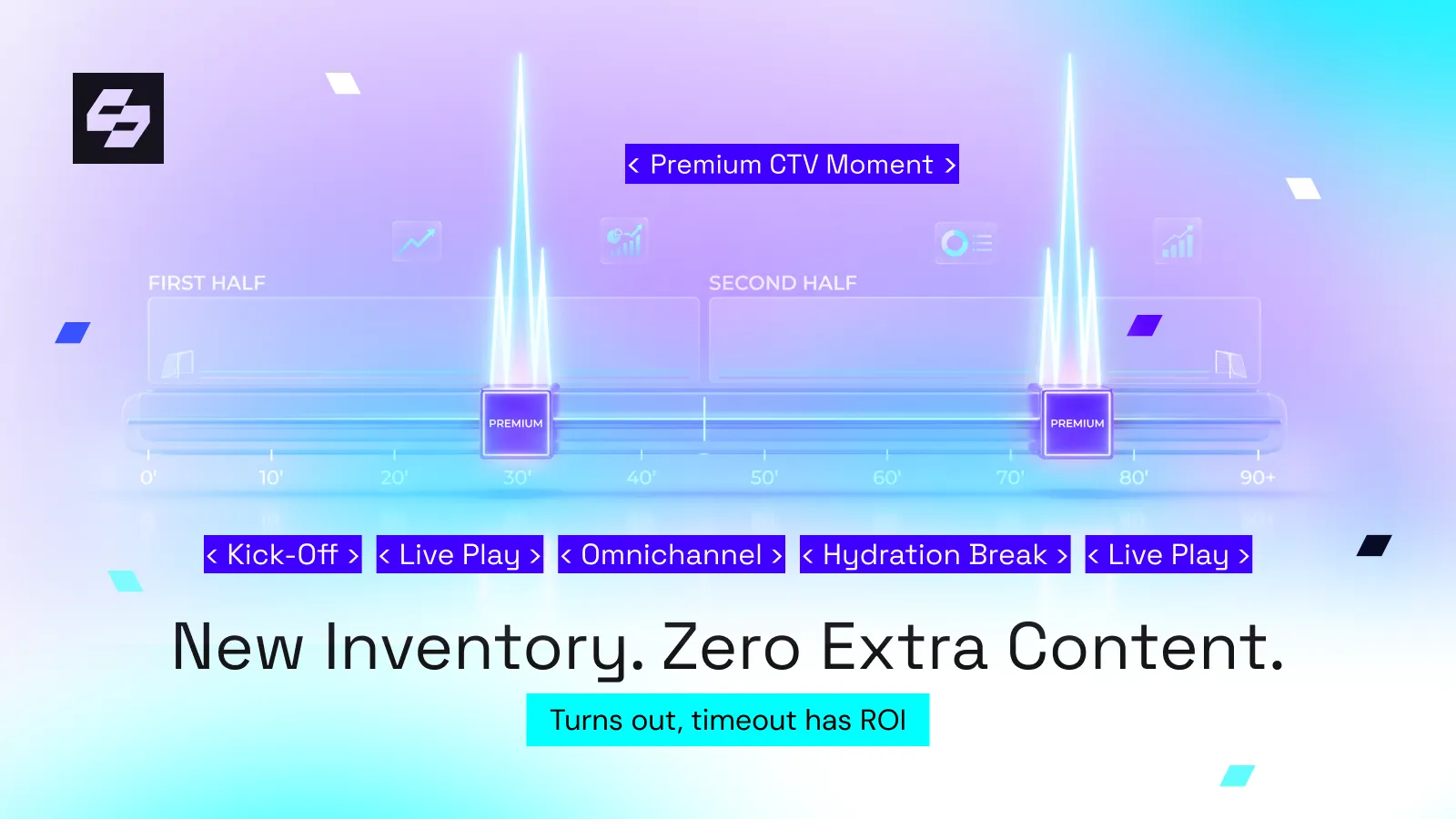
Live football match timeline showing hydration breaks as new premium CTV advertising inventory without adding extra content to the sports broadcast.
Sports Streaming Advertising and the Next Opportunity
Live sports has presented some new ways for advertising, broadcasting, and streaming channels. For example, the 2026 World Cup showed that there are commercial opportunities where no extra breaks from playing are necessary. But the opportunities do not stop at hydration breaks or even at one particular competition.
As the number of sports events being shown via devices grows, the possibility emerges to marry premium attention with relevant video formats and media buying practices. It does not necessarily mean that more ads have to be placed. It means finding the right placement, treating the audience respectably, and measuring the results.
Screencore helps to run premium CTV and video campaigns through our programmatic platform that offers transparency, scalability, and access to the publishers' inventory.
No matter what is the goal – raising brand awareness, engaging the audience or measuring campaign performance – the first step is knowing the right places where the premium attention can be found.
FAQ
What makes live sports inventory premium?
Live sports brings together live audience participation, scarcity of advertising options, and high-interest content. There is always something for viewers to look forward to, thus making premium CTV inventory quite appealing. The importance of such inventory also relies on several other factors.
How can brands access live sports inventory programmatically?
For programmatic sports marketing, brands could consider either private marketplaces or programmatic guaranteed, based on publisher availability. Sometimes, direct deals would have to be made as well. Access would depend on rights, territories, and distribution, so advertisers have to make sure first what is available for their advertising campaigns.
Which CTV formats work best during natural breaks in live sports?
In-stream video ads can be utilized during half-time or time-outs, while split-screen placement is good for maintaining visibility of the game. Interactivity can be used to increase engagement where possible. The ideal format for live sports CTV ads would depend on event policies, publisher capabilities, and viewer tolerance of interruptions.
How should advertisers measure sports streaming advertising results?
First, analyze the reach, frequency, and completion of videos to measure delivery. Next, utilize appropriate brand lift or incrementality research to measure effectiveness. In addition, sports stream advertising needs to account for shared screen viewing and limited attribution. Using multiple metrics together is more informative than just impressions.