



Marketing measurement becomes difficult the moment several channels are working at the same time.
A customer sees a CTV ad on Monday. Searches for the brand on Wednesday. Gets a paid social ad on Friday. Then walks into a store and buys on Saturday.
Which channel gets the credit?
There is no neat click path to answer that question. And giving the sale to the last measurable interaction does not tell us much about what actually created demand.
This is where Media Mix Modeling, or MMM, becomes useful.
MMM looks at marketing from a wider angle. Instead of trying to trace one person's journey from impression to conversion, it examines historical performance across channels and asks a bigger question:
How much did each part of the media mix contribute to the business result?
For advertisers managing CTV, search, social, display, audio, out-of-home and other channels together, that is a question worth answering properly.
What Is Media Mix Modeling?
Media Mix Modeling, also called Marketing Mix Modeling, is a statistical method used to estimate how different marketing activities affect a business KPI such as sales, revenue or conversions.
It works with aggregated data.
That is important.
MMM does not need to know that Person A saw Ad B and later purchased Product C. Instead, it can examine how media spend, exposure and business results changed over time and across markets.
Google's Meridian framework describes MMM as a causal inference tool for estimating the impact of advertising budget levels and allocation on KPIs. In practice, a model may analyze paid media alongside organic activity and non-media factors that also influence performance.
That last part makes MMM much more interesting than a simple channel report.
Because advertising does not operate in a vacuum.
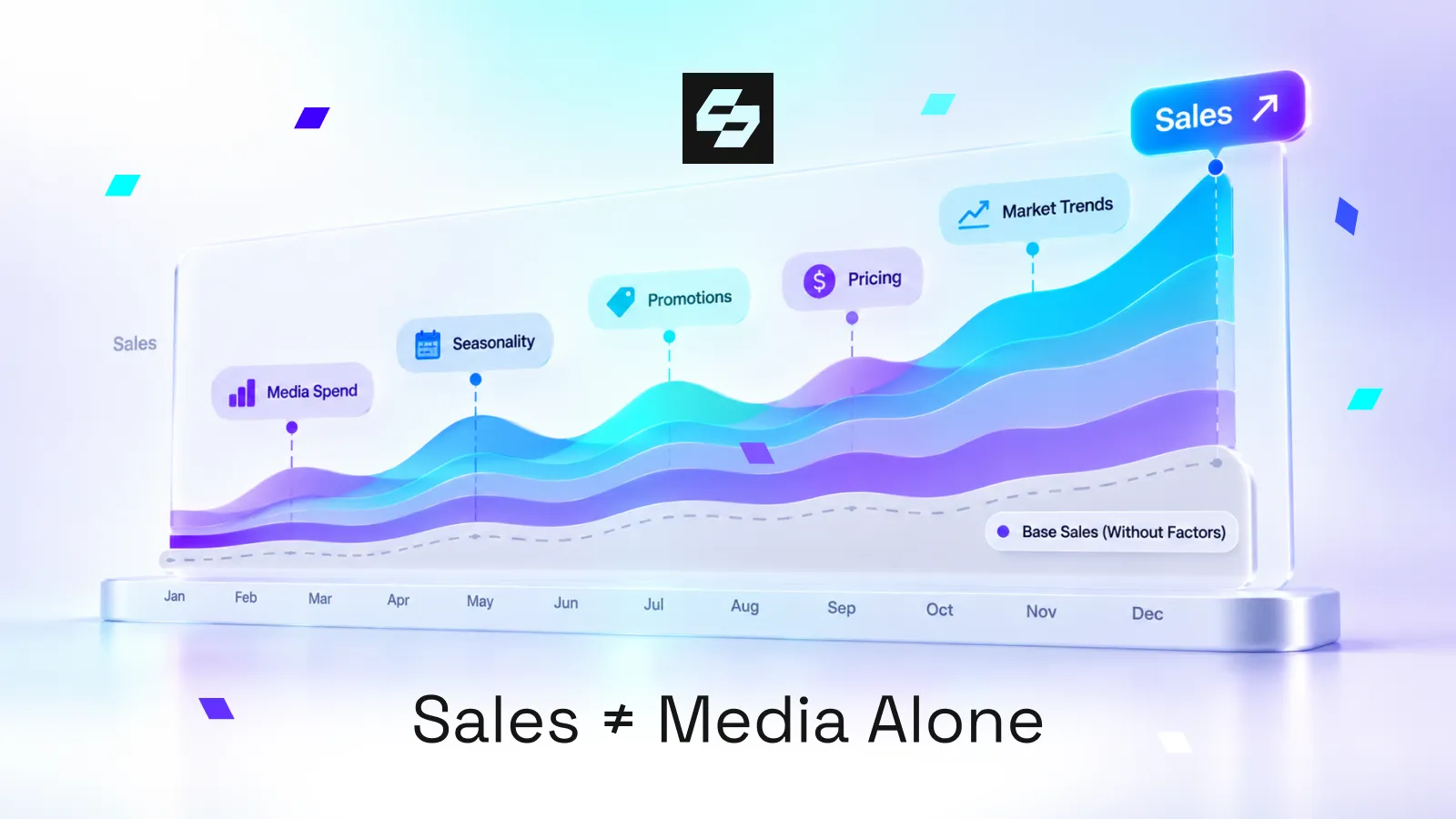
Media mix modeling controls for external variables like seasonality and pricing to isolate true advertising contribution.
How Does Media Mix Modeling Work?
Imagine a retailer has two years of weekly data.
The company knows how much it spent on CTV, paid search, social, display and other media. It also has weekly revenue data.
A basic analysis could compare advertising spend with sales.
A serious MMM goes further.
It tries to separate the effects of media from the other things happening at the same time.
Maybe sales rise every December regardless of advertising. Perhaps a price reduction increased demand. A new store opened. Competitors changed their activity. The weather affected sales. A major sporting event changed viewing behavior.
These variables matter because otherwise a model can give advertising credit for something advertising did not cause.
Google's current MMM guidance therefore emphasizes the careful use of control variables and confounders. The objective is not simply to create a model that predicts sales well. It is to make a credible estimate of media's causal effect.
That distinction gets lost surprisingly often.
A beautiful model with the wrong assumptions can still produce a very confident bad answer.
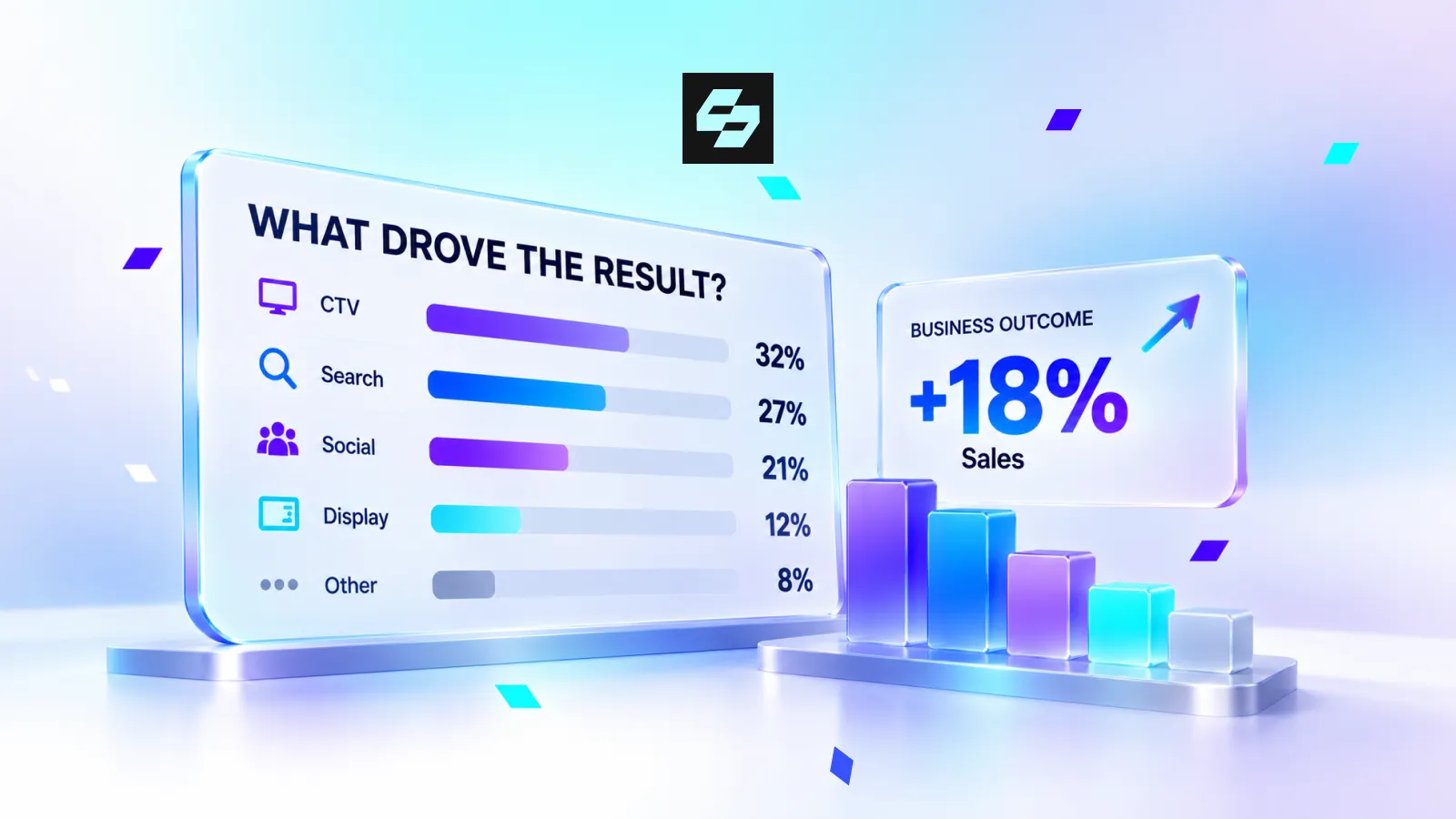
Cross-channel statistical analysis measures the incremental contribution percentage of each media channel toward overall revenue.
What Data Does an MMM Need?
MMM starts with history.
Typically, the model needs a business outcome such as revenue, sales or conversions, combined with media activity and spending across the same time periods.
The data might be organized weekly and, where possible, by geography.
Google Meridian, for example, works with media exposure data such as impressions or clicks, media spend, KPIs and control variables. It can also account for factors such as reach and frequency, seasonality, media saturation and delayed advertising effects.
Why delayed effects?
Because advertising does not always work immediately.
Someone might see a brand campaign today and purchase weeks later. Likewise, doubling a media budget rarely doubles results forever. Eventually a channel begins to hit diminishing returns.
MMM tries to account for both realities.
This is one reason good historical data matters so much. If channel naming changes every quarter, spend is missing, markets are grouped inconsistently or business data cannot be aligned with media data, the model starts with a handicap.
MMM cannot repair bad measurement foundations with mathematics.
MMM Is Different From Attribution
This is probably the most important distinction for beginners.
Attribution typically works closer to the individual interaction level. It tries to connect touchpoints with conversions and decide how credit should be distributed.
MMM works at an aggregated level.
It looks for patterns across time, media activity, geography and business outcomes rather than attempting to reconstruct every customer journey.
That makes the two approaches useful for different questions.
Attribution may help a marketer understand which measurable touchpoints appear close to conversions. MMM is better suited to broader questions such as how much different channels contributed, how offline and online media worked together, and how a budget might be distributed across the overall mix.
They should not be forced into a winner-versus-loser debate.
In fact, IAB's current guidance recommends integrating MMM with attribution, experimentation and financial systems rather than treating one methodology as the universal answer to marketing measurement.
One model cannot answer every marketing question.
Good measurement teams know that.
Why Is MMM Getting More Attention Again?
Media Mix Modeling is not new.
The renewed interest is.
For years, digital advertising trained marketers to expect extremely granular measurement. Cookies, device identifiers and platform data made it possible to connect many advertising interactions with later actions.
That system has become harder to rely on.
Privacy regulation has tightened. Signals have been reduced. Consumer journeys move between platforms and devices. Walled gardens hold their own data. CTV and other channels do not always fit neatly into click-based measurement.
IAB's 2026 State of Data report describes a measurement environment under pressure from privacy changes, signal loss, fragmented data and platform-specific optimization.
MMM fits that environment unusually well because it does not depend on identifying individual users.
Meta's open-source Robyn MMM framework, for example, describes its approach as privacy-friendly because it does not require personally identifiable information or individual log-level data.
That does not make MMM a magic replacement for lost identifiers.
It makes it useful for a measurement problem that has changed.

Budget allocation modeling reallocates spend across media channels to maximize projected sales from the same overall budget.
What Can Advertisers Learn From MMM?
The most useful output is not a complicated statistical chart.
It is a better budget decision.
A media mix model can help estimate the contribution of different channels, compare return on investment and examine how performance changes as spend increases or decreases.
This is where response curves become useful.
Suppose CTV is producing strong returns at the current investment level. The model may suggest that additional spending could still generate meaningful incremental results.
Another channel might look strong historically but already be close to saturation. Adding another $500,000 there could produce much less value.
That is a more useful question than simply asking which channel has the highest historical ROAS.
Marketing budgets are decided at the margin.
The question is not only “What worked?”
It is also “Where should the next dollar go?”
Modern MMM tools increasingly include budget-allocation capabilities for exactly this reason. Meta's Robyn, for example, includes an allocator designed to model budget reallocation against expected outcomes.
What MMM Cannot Tell You
MMM has limits.
It is generally not designed to tell you which specific creative a particular customer saw before buying. It cannot compensate for unreliable source data. And its outputs depend heavily on methodology, assumptions, variables and model calibration.
There is also uncertainty.
This deserves more attention than it usually gets.
A model does not discover a perfect historical truth hidden inside a spreadsheet. It estimates relationships from the available evidence.
Google's Meridian documentation is explicit about this. Directly validating causal inference is difficult without well-designed experiments, which is why model assumptions, confounding variables and calibration matter.
So when an MMM result says one channel produced a particular ROI, marketers should not treat that number as if it came from an accounting ledger.
It is an estimate.
A useful one, when the model is good.
MMM Works Better as Part of a Measurement System
The strongest measurement setups rarely depend on one method.
MMM can provide a strategic, cross-channel view. Experiments can test causal questions more directly. Incrementality studies can help determine whether advertising created additional outcomes. Attribution can provide more granular information where appropriate.
These methods can strengthen one another.
IAB's recent work on modernizing MMM makes the same point, recommending that marketers connect models with experimentation, attribution and business systems.
There is a practical reason for this.
If an experiment consistently contradicts the model, that deserves investigation. If MMM shows a channel is valuable but platform attribution barely recognizes it, that difference can reveal something about how the channel works.
Disagreement between measurement systems is not always a problem.
Sometimes it is the most interesting thing in the report.
Measurement Gets Harder When the Media Market Moves
MMM depends on understanding the environment around advertising, not just counting impressions.
That becomes especially clear during periods when media demand changes sharply.
In our previous article, “Political Advertising and CTV: How Election Demand Is Changing Streaming Advertising,” we look at how election spending is putting new pressure on CTV inventory, pricing, measurement and programmatic infrastructure.
For advertisers trying to understand the forces behind media performance, it is a useful next read.
Better Models Start With Better Advertising Data
Media Mix Modeling answers a question marketers have been asking for decades:
What is our advertising actually doing?
The method has become more relevant because the easy answers are disappearing.
Customer journeys are fragmented. Individual-level signals are harder to use. Media plans stretch across CTV, programmatic video, search, social, audio, DOOH and offline channels.
MMM gives advertisers a way to step above individual impressions and examine how those investments work together.
But the model is only the final layer.
Underneath it, you still need clean data, consistent media taxonomy, reliable integrations and infrastructure capable of connecting advertising activity with meaningful business outcomes.
That is where Screencore comes in.
We build AdTech and programmatic infrastructure for companies that need their media technology to produce more than impressions. From data architecture and platform integrations to CTV and programmatic solutions, our team helps turn fragmented advertising systems into technology businesses can actually use.
Building or upgrading an AdTech product?
Contact the Screencore team about the infrastructure behind better advertising decisions.