



Most AdTech privacy problems do not begin with a spectacular data breach.
They begin with something much less dramatic.
A consent signal that gets lost between systems. A partner added six months ago that nobody has reviewed since. A data field collected because it might be useful later. A privacy policy that says one thing while the product quietly does another.
Individually, these can look like housekeeping issues.
At programmatic scale, they are infrastructure problems.
As AdTech companies prepare for 2027, privacy work should move away from adding more compliance language and toward checking what actually happens to data inside the product.
Here are the mistakes worth fixing now.

Maintaining privacy signal integrity requires preserving user consent across every processing stage, from initial collection to final enforcement.
Mistake #1: Treating Consent as a Banner Problem
A consent management platform can collect a user's choice.
That is only the beginning.
The difficult part is making sure that choice survives the rest of the advertising process. Programmatic advertising can involve publishers, SSPs, DSPs, measurement providers, identity technology and other partners. A privacy signal that appears correctly at the front end but disappears deeper in the chain is not doing its job.
This is particularly important because regulators increasingly look at whether users have genuine control. The UK ICO, for example, states that online advertising technologies used for ad selection, tracking and profiling require consent under the relevant UK rules, and that where personal data is supplied to third parties, consent must apply across that chain.
So test what happens after “Reject.”
Does advertising technology still fire? Which data leaves the environment? What reaches partners? What changes if consent is withdrawn later?
The banner is the visible part.
The data flow is where privacy either works or fails.
Mistake #2: Making “Reject” Technically Possible but Practically Annoying
We have all seen this version of consent design.
“Accept All” is obvious. Refusing requires another screen, several categories and a little patience.
That is becoming increasingly difficult to defend.
In late 2025, the ICO reported that its cookie compliance work assessed whether advertising cookies appeared before users made a choice, whether rejection was as easy as acceptance, and whether advertising cookies were placed despite the absence of consent. After regulatory engagement, 979 of the UK's top 1,000 websites tested met its compliance checks.
That is a useful signal for AdTech product teams: interface design is part of privacy implementation.
The European Data Protection Board has made a related point around “consent or pay” models. Its opinion for large online platforms stresses that consent needs to represent a real choice rather than simply pressure users toward the commercially preferable answer.
If your consent flow is designed to produce an “accept” rather than capture a decision, review it before 2027.
Mistake #3: Collecting Data Because Storage Is Cheap
AdTech has spent years rewarding more data.
More identifiers. More attributes. More events. More historical signals.
The assumption was understandable: if data might improve targeting, measurement or optimization later, keep it.
That logic deserves a reset.
The EDPB continues to emphasize principles including purpose limitation, data minimization, fairness and accountability. Consent does not make those principles disappear.
There is also a practical engineering reason to care. Every unnecessary field creates another thing to classify, secure, govern, document and potentially delete. It can also expand what needs to be considered when systems are integrated or models are trained.
A better question for 2027 is not “Can we collect this?”
It is “What product decision requires it?”
If the team cannot answer clearly, the data probably deserves another look.

Managing user consent across single ad impressions requires end-to-end data control and transparency throughout the entire programmatic supply chain.
Mistake #4: Assuming a Partner's Compliance Covers Yours
Programmatic companies depend on partners. That is unavoidable.
Blind trust is not.
A vendor can change its subprocessors, data usage, retention practices, geographic processing or product functionality long after the original integration was signed. Meanwhile, the technical connection keeps running exactly as before.
This is where privacy reviews often become stale.
The contract was checked. The integration launched. Everyone moved on.
AdTech companies should know which partners receive which data, for what purpose, and under which privacy signals. That map should reflect the actual product, not the architecture diagram somebody created during onboarding two years ago.
The more complicated the supply chain becomes, the more important this visibility gets.
Privacy risk loves forgotten integrations.
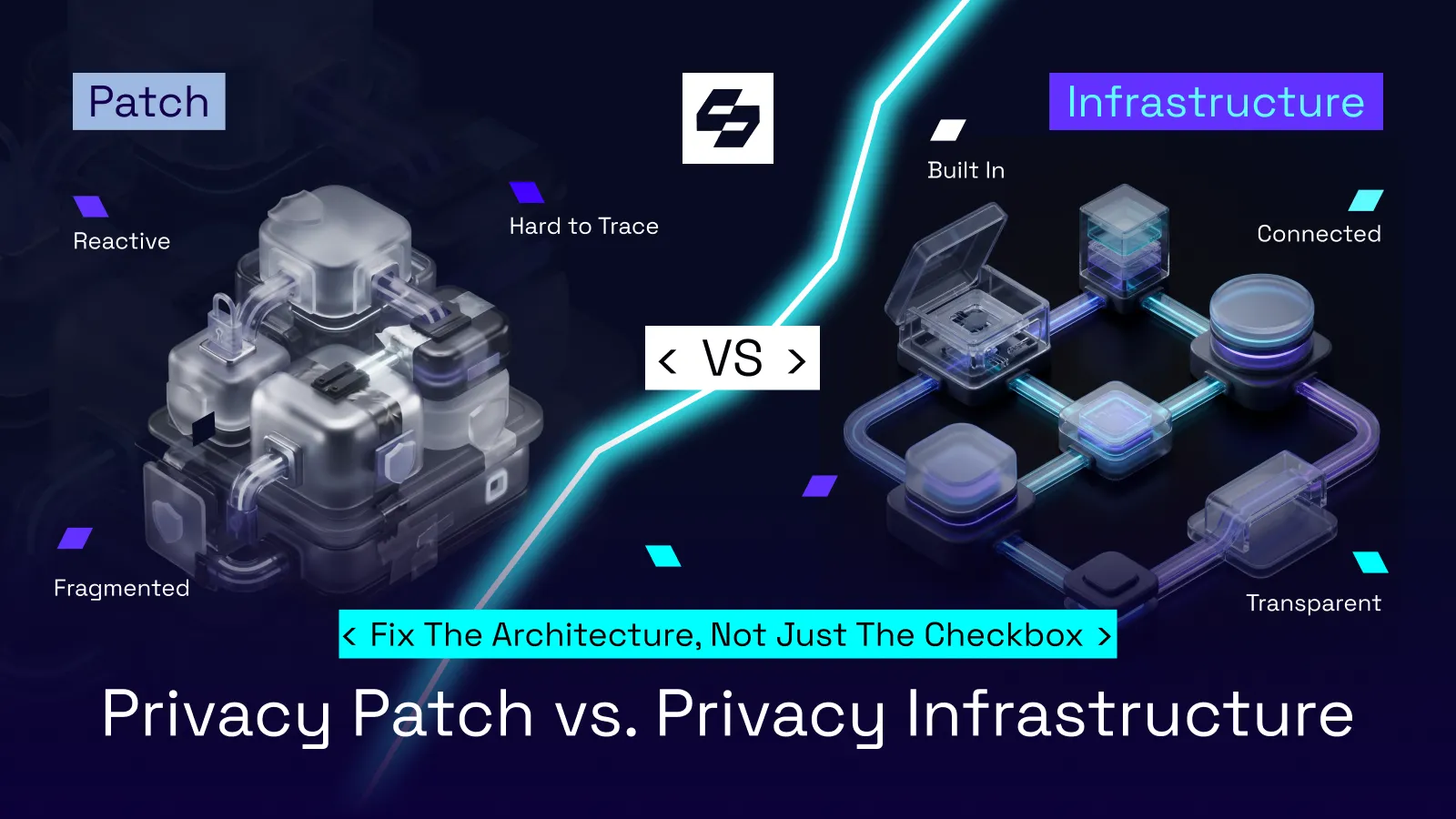
Transitioning from reactive, fragmented privacy patches to built-in, connected infrastructure ensures long-term architectural compliance and transparency
Mistake #5: Building Separate Privacy Logic for Every Market
Privacy regulation is fragmented. Your architecture does not have to be.
Different markets have different requirements, but hard-coding another isolated privacy workflow every time a law changes creates technical debt quickly.
This is one reason industry privacy signaling has become more structured. IAB Tech Lab's Global Privacy Protocol, for example, is designed to transmit privacy, consent and consumer-choice signals between sites, apps and AdTech providers across different regulatory environments.
By August 2026, GPP supported frameworks including IAB Europe TCF, IAB Canada TCF, US national signals and multiple US state sections.
The lesson is bigger than any one protocol.
Build privacy logic that can interpret changing signals and rules without forcing engineers to redesign the advertising stack every time another jurisdiction updates its requirements.
2027 will not reward brittle privacy architecture.
Mistake #6: Forgetting That AI Creates Another Data Flow
AdTech teams are putting AI into bidding, audience modeling, forecasting, fraud detection, campaign optimization and creative workflows.
Good.
But AI does not make the original privacy questions disappear. It adds another place to ask them.
What information reaches the model? Is all of it necessary? Can personal data enter prompts, training sets, logs or model inputs? How long is it retained? Can teams explain what data an automated decision actually depends on?
This matters particularly in programmatic because AI is moving from a separate feature into core infrastructure.
A model that optimizes millions of decisions can also scale a bad data practice remarkably efficiently.
That is an observation worth remembering: automation magnifies architecture. It does not repair it.
Privacy reviews should therefore cover machine-learning pipelines and AI integrations just as seriously as audience databases, pixels and bidstream processing.
Mistake #7: Waiting for the Next Privacy Deadline
This may be the most expensive habit of all.
Compliance teams watch legislation. A deadline appears. Engineering gets a ticket. Everyone rushes.
Then the process repeats.
Privacy-ready AdTech needs a different operating model.
The ICO's recent work shows why. The regulator has continued enforcing consent requirements around targeted advertising while also exploring how lower-risk, privacy-preserving advertising models could be treated differently. Regulation and enforcement are becoming more nuanced, not simply disappearing.
At the same time, technical standards keep evolving. Privacy signals change. New state requirements arrive. AI introduces new questions. Products add partners and data flows.
Waiting for a deadline means the product is permanently catching up.
Privacy should be tested when a feature is designed, when a partner is connected, when a data field is added and when a new model starts consuming signals.
That is cheaper than rebuilding the stack later.
Privacy Readiness Is Really Product Readiness
There is a simple test AdTech companies can run before 2027.
Ignore the privacy policy for a moment.
Can your team explain where user data enters the platform, where it travels, why each piece is needed, which partners receive it, which privacy signals control it, how withdrawal propagates, and what eventually happens to the data?
If the answer requires three departments and an old spreadsheet, there is work to do.
Strong privacy architecture is not about collecting as little data as technologically possible. AdTech still needs signals to deliver, measure and optimize advertising.
It is about knowing exactly what you collect and being able to control what happens next.
That is a much higher standard than putting a consent banner on a website.
It is also a much better foundation for building an AdTech business.
Privacy Matters. So Does the Economics of the Screen.
Privacy infrastructure determines how advertising data can move. Media economics determine what happens once advertisers enter the market.
For a practical look at the other side of the advertising equation, read our previous article, “TV Advertising Cost in 2026: Rates for Commercial Ads.” It breaks down what television advertising costs, what affects rates and how advertisers should think about TV media budgets.
Build the Infrastructure Before 2027 Forces the Conversation
Privacy work is easiest when it happens before something breaks.
Screencore builds programmatic infrastructure around transparent connections, verified inventory, scalable execution and privacy-ready technology. For AdTech companies, publishers and advertising businesses, that means building systems that can perform at programmatic speed without losing visibility into the data underneath them.
If your current stack has accumulated old integrations, fragmented privacy logic or data flows nobody wants to explain on a whiteboard, 2026 is a good time to clean them up.
Build the privacy layer once. Then build growth on top of it.