



There have been significant changes in the way viewers consume television programs since they shifted from watching programmed TV to watching streamed TV. The change provides an intriguing chance for advertisers to harness the power of the screen and digital advertising.
CTV advertising makes that possible. Advertisers can no longer buy ad exposure across all viewers of a programmed TV show, but use data and programmatic tools to target the right audience with ads streamed on connected TV.
This guide will provide more information about CTV advertising, the way it works, what makes CTV advertising different from OTT and linear TV, CTV ad types available for advertisers, and KPIs of successful CTV ad campaigns.
What Is CTV Advertising?
To understand what is connected TV advertising, it helps to think of it as digital video advertising delivered to viewers through internet-connected televisions rather than traditional broadcast or cable networks. In other words, it is a form of digital video advertising for the TV platform.
So, what does CTV mean? CTV stands for Connected TV. The term refers to smart TVs with in-built internet capability or televisions connected to devices used for streaming such as Roku, Amazon Fire TV, or Apple TV. Gaming systems can also be used to deliver the connected TV experience if the viewers watch videos via them.
The CTV advertising meaning is straightforward: it refers to video ads delivered through internet-connected television screens while viewers stream content through apps and digital platforms. In other words, when one wonders about the meaning of connected TV advertisements, they refer to advertisements that reach audiences via the internet-enabled TV medium and not just through traditional broadcasting or cable.
Unlike the traditional TV advertisements, CTV ads may employ signals from the digital audience for their campaigns. One can opt to target specific geographic areas or audience segments as opposed to buying coverage of all people who watch the same broadcast.
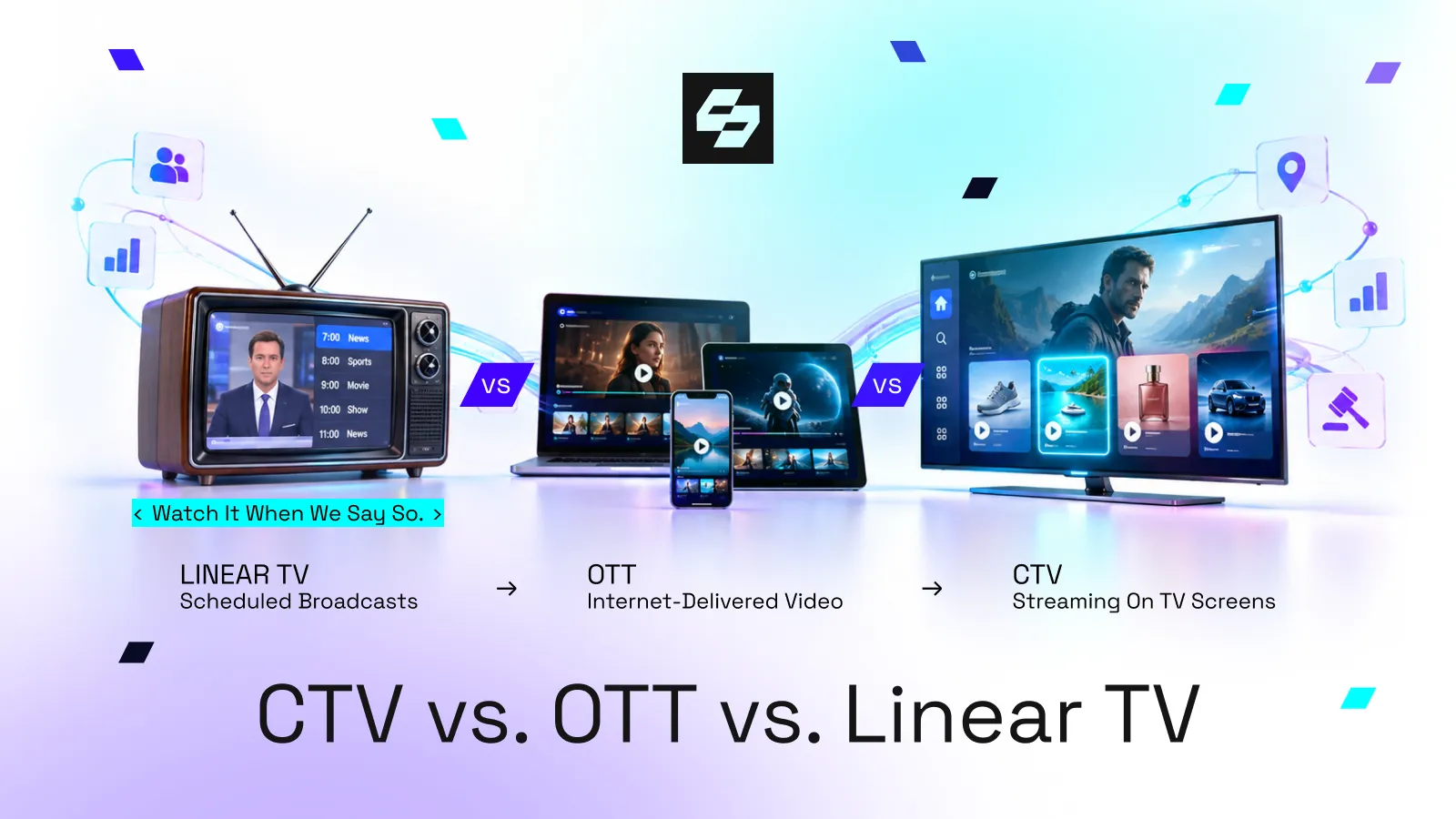
Evolution of television media distribution from traditional scheduled broadcasts to internet-delivered OTT content and big-screen connected TV streaming.
CTV vs. OTT vs. Linear TV: What's the Difference?
These three acronyms are highly interconnected; however, their meanings are different.
Linear TV represents the traditional broadcasting TV where people view certain programs at certain times. Every person tuning in will see the same ads that were placed for this program. Linear TV has wide distribution capabilities, while targeting of the audience is more coarse than in case of digital advertisement.
Connected TV (CTV) refers to watching any TV programming through an internet-enabled TV ecosystem including a smart TV or a TV connected via Roku, Apple TV, Fire TV or gaming consoles. The connected TV advertising definition focuses specifically on ad delivery: brands reach viewers through streaming applications on television screens rather than through traditional scheduled broadcasts.
OTT (Over-The-Top) technology is all about the way videos are transmitted. The videos are not being transmitted via cable or satellite service provider, but via internet only.
When comparing CTV vs OTT advertising, the main distinction is where the ad appears: OTT covers internet-delivered video across devices, while CTV specifically refers to advertising viewed on a connected television screen. OTT is video on the internet for multiple devices, whereas CTV is advertising targeted at viewing on a TV screen in a connected world.
A consumer who is watching video on their smartphone is accessing OTT content, but not through CTV. But when he or she watches the same content using an application on a smart TV, it becomes OTT as well as CTV.
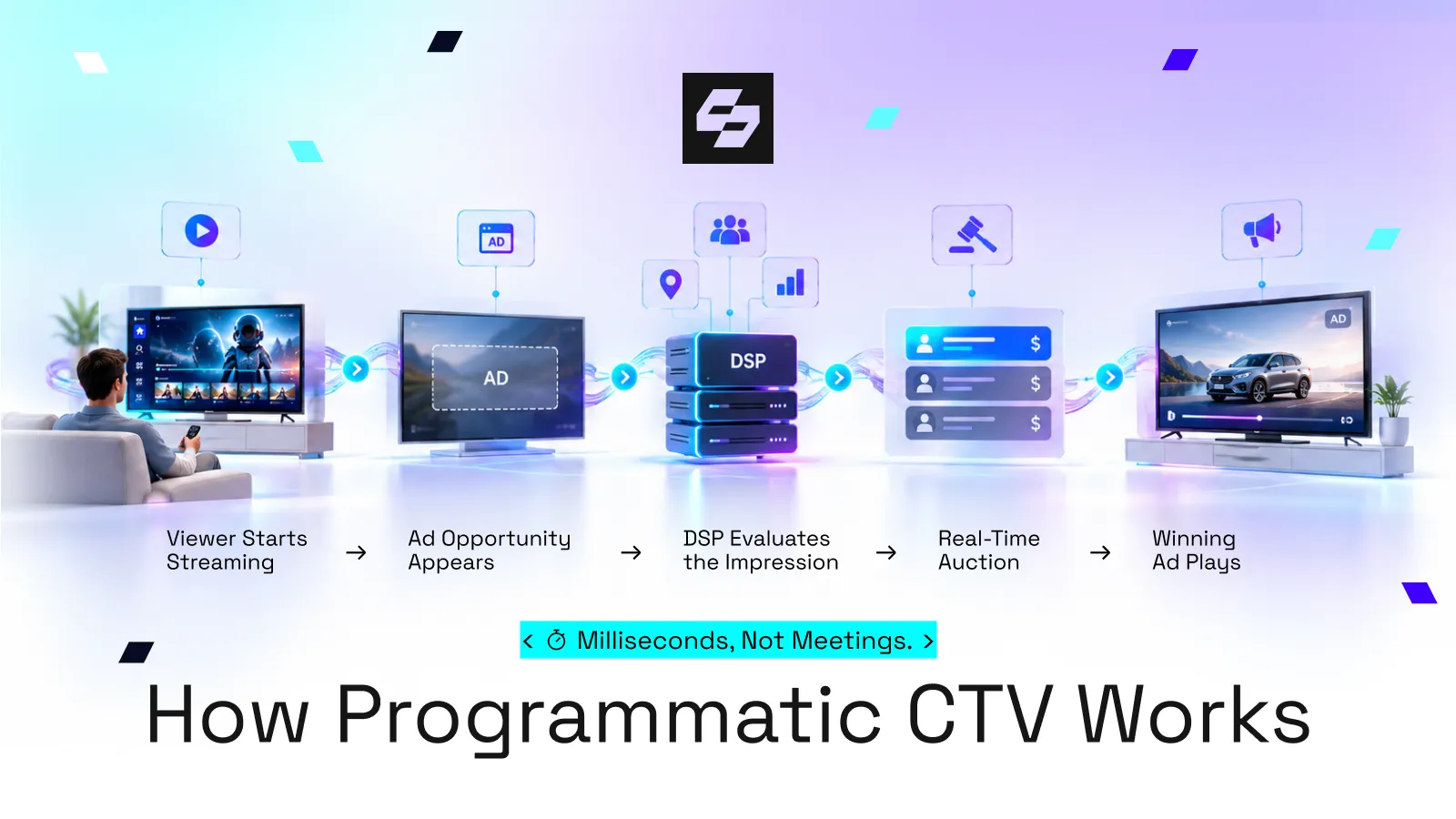
Real-time programmatic DSP bidding evaluates streaming ad opportunities in milliseconds before serving winning creatives to connected TV screens.
How Does CTV Advertising Work?
It is easier to comprehend the mechanics of CTV advertising when considering what occurs in case a viewer decides to stream content.
Within many programmatic ecosystems, as soon as an ad opportunity arises within a streaming application or channel, details about the impression are available to participating advertising platforms. The DSP for an advertiser then evaluates the opportunity according to parameters such as audience, geography, frequency, inventory, and bidding strategy of the particular campaign. If the bid is successful under the campaign criteria, the DSP submits a bid in real time.
If the bid is successful, then the ad is served to the consumer's connected TV. Most of the process may be carried out automatically within milliseconds through an auction-based system very similar to that which is utilized in display and online video ads.
Finally, the use of CTV ads permits advertisers to implement campaign controls and measure their effectiveness in the world of television ads. This is possible depending on the advertising platform and the data available.
For brands looking to activate campaigns across premium streaming inventory, Screencore's CTV advertising solutions bring programmatic buying and audience-focused campaign management to the connected TV environment.
How to Buy CTV Ads: Programmatic vs. Direct
Advertisers generally have two main routes for purchasing CTV inventory: programmatic buying and direct deals with publishers or streaming providers.
Programmatic Buying
Programmatic CTV depends on automated advertising technologies such as Demand Side Platforms (DSPs) to buy inventory.
There is no requirement for advertisers to negotiate the placement manually. All that the advertiser needs to do is set the targeting criteria, budgeting, frequency capping, bidding strategy, etc., and the DSP takes care of the rest.
Programmatic CTV offers flexibility both for publishers and inventory types while providing room for optimizing campaigns based on performance data. More and more, artificial intelligence is being used for such purposes as well.
Read more about how AI optimizes CTV campaigns.
Direct Buying (Direct-to-Publisher)
Advertisers can also buy inventory directly from streaming providers or networks such as Hulu, Peacock, or Roku.
Such direct deals may grant them access to certain shows, environments, or audiences and may be determined on the basis of an agreement between the advertiser and publisher. They may sometimes offer guaranteed inventory or increased certainty about the placement of ads.
Programmatic and direct buying need not always be at odds with one another. Large-scale CTV campaigns can incorporate both techniques.
CTV Ad Formats
There are several types of CTV advertising, ranging from familiar commercial-style videos to interactive experiences. The available CTV ad formats depend on the publisher, streaming platform, device, and inventory source.
Pre-Roll Ads
Pre-roll ads precede the selected streaming content. Such ads operate just like television commercials that precede a program and give advertisers an opportunity to reach customers before they are engaged in viewing.
Mid-Roll Ads
Mid-roll ads are shown while watching the program. This format is similar to a traditional television commercial break and is common in ad-supported streaming environments.
Pause Ads
These ads are shown when a person pauses watching a show, a movie, or any other streaming content. Rather than being intrusive to watching, the ad creative appears on the paused screen with a message from the brand.
Overlay & Banner Ads
Overlay and banner ads take up some of the space on the television screen but do not stop the video itself.
Interactive & Shoppable Ads
Interactive CTV ads let the viewer do something rather than simply watch the video advertisement. This can be done via a TV remote, a QR code, or some other connected device, depending on the platform used.
The use of a QR code, for instance, will transfer the action from the television screen to the phone, letting the viewer navigate to the landing page, find out more information about the product, or even buy the item.
Sponsorship & Branded Content
Brands can also gain access to viewers via sponsorships and branded experiences built into the streaming service interface, programming, or original content experience environment.
Key Benefits of CTV Advertising
The main benefits of CTV advertising come from combining television's large-screen viewing experience with digital advertising capabilities.
Precise Audience Targeting
Linear TV buying typically makes use of programs, broad demographics, and the makeup of the audience expected to be there. CTV allows advertisers to target audiences using signals such as demographics, interests, location, behavior, and first-party data.
This allows advertisers to have more control over who they want their campaign to reach.
Measurable Performance & Attribution
CTV provides more granular digital campaign measurement than traditional television alone. It is possible for advertisers to track such measures like impressions, reach, frequency, completion of videos, and many more delivery metrics. If the right identity and attribution are set up, advertisers can also measure what happens after the advertisement is seen, like visits to websites or sales.
High Completion Rates
Many CTV advertisements are non-skippable and show up in professionally made long-format videos. This leads to a situation wherein the viewer is more likely to see the advertisement all the way through than in many other types of skippable digital video ads.
For advertisers, this means that Video Completion Rate is a particularly valuable CTV metric.
Brand-Safe Premium Environment
CTV inventory allows advertisers to advertise next to professionally created movies, TV shows, news, sports, and other streaming videos.
Advertisers could also use inventory controls, publisher selection, and supply management to figure out where their campaigns will be allowed to run. This makes CTV especially appealing for brands who want to get the impact of television combined with the control of digital media buying.
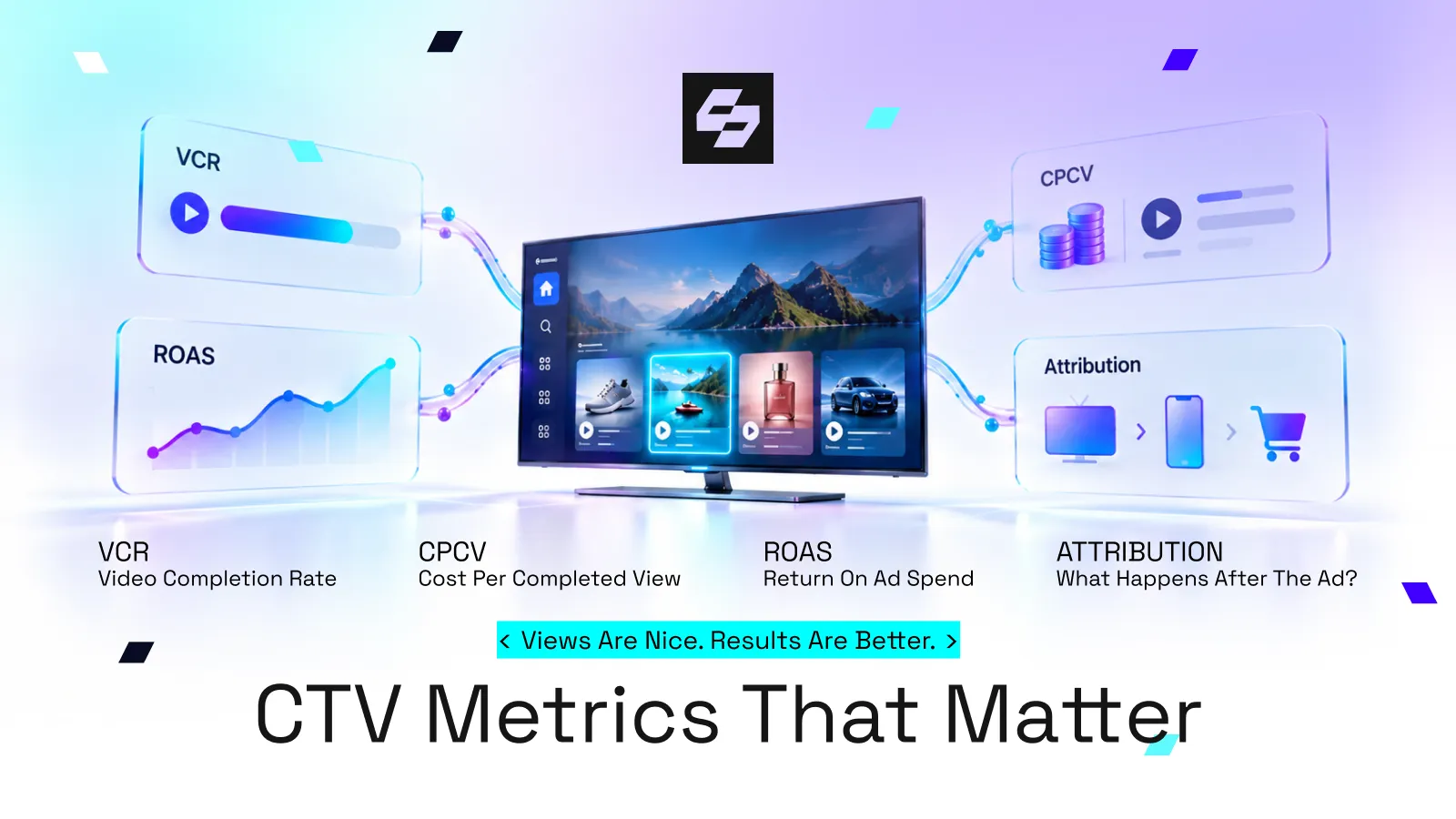
Performance metrics link big-screen connected TV video completion rates to cross-device conversions and return on ad spend.
Key CTV Advertising Metrics to Track
CTV brings digital measurement into the television environment. While the right KPIs depend on the campaign objective, several metrics are particularly useful for evaluating performance.
Video Completion Rate (VCR)
Completion Rate Video is the percentage of video ad plays which have reached the end of the creative.
High completion rates are achievable for CTV campaigns because many of the placements are non-skippable, and the audience is already engaged with long-form streaming. VCR allows advertisers to determine if the video creative is being delivered and completed.
Cost Per Completed View (CPCV)
Cost per Completed View illustrates the expenditure of the advertiser per each completed video view.
Unlike CPM or overall number of impressions, CPCV is related to media expenditure in relation to completed view. This metric may be valuable for analyzing different inventory sources, creatives and campaign approaches based on video views.
Return on Ad Spend (ROAS) & Attribution
In order for performance-driven campaigns, advertisers will eventually need to know what occurred following the advertisement exposure.
It is possible through CTV measurement that the advertisement exposure is linked to further actions, such as web visits, sign-ups, visitations, or purchases, provided there is enough data to do so. Then, advertisers may measure the effect of the campaign in converting leads into sales and, if available, compute the return on advertising spend.
This is because the ad exposure occurs on the television while conversion occurs on another screen.
Final Thoughts
CTV ads combine the power of television with the targeting, automation and measurement capabilities of digital ads – two strengths that had previously operated independently from one another.
In turn, this allows marketers to use television campaigns not only for scheduled audiences, but to address streaming audiences through media buying by audience, test out interactive ad formats, programmatic campaign management, and beyond just reach metrics.
Understanding the nature of CTV advertising and its place amid OTT, linear TV and other digital platforms becomes more crucial amid the continuing evolution of streaming.
With brands that are ready to utilize these skills, Screencore offers programmatic CTV advertising solutions that will ensure audience targeting, premium streaming inventory, campaign optimization, and measurement is integrated into one approach.
Bring Your Brand to the Big Screen with Screencore
Ready to reach your audience where they're streaming? Screencore helps brands make the most of Connected TV advertising through programmatic buying, precise audience targeting, and access to premium streaming inventory.
FAQ
What is the difference between CTV and OTT advertising?
The key difference between CTV and OTT advertising is the device and method of delivery. OTT is internet video delivered over devices such as television, mobile phones, tablets, and computer screens. CTV involves advertising that is seen on internet-connected TV sets, whether a smart TV or connected TV.
What devices count as CTV?
The connected TV meaning covers any television that can access internet-based video content, either through built-in smart TV functionality or an external streaming device. Examples include smart TVs and televisions connected through Roku, Amazon Fire TV, Apple TV, or gaming consoles. More specifically, any internet-connected TV where one can watch internet videos via the device is classified as a CTV device.
How much does CTV advertising cost?
The cost of CTV advertising varies according to factors like inventory type, audience targeting, publisher type, geographical location, scale of campaigns and buying process. The premium type of inventory commands relatively high CPMs whereas the programmatic buying provides more control over bidding and budgeting. Screencore's CTV Advertising Solutions will help you create a media plan according to your requirements and budget.
Is CTV advertising effective for local and small businesses?
Yes. CTV advertising allows local and small businesses to reach audiences in specific geographic areas without purchasing nationwide television placements. Advertisers can control budgets, refine audience targeting, and measure campaign performance. Explore Screencore's CTV advertising solutions to see how programmatic campaigns can support local business goals.