


Television advertising used to be built around scarcity. A limited number of channels controlled premium reach, campaigns were planned weeks or months in advance, and advertisers bought broad audience segments with little ability to change course once a campaign was live.
Connected TV changed that model. With streaming, the TV screen became an addressable digital environment where impressions could be bought individually, audiences were segmented more accurately, and performance metrics were extended beyond simple reach and frequency. With the advent of AI, the transition to performance continues.
AI in CTV advertising is rapidly becoming the decision layer, uniting signals from the audience, media buying, creative executions, measurement, and optimization into one system. AI allows advertisers to navigate the fragmented world of streaming at a pace and scale that is unattainable manually. AI in Connected TV is becoming the new infrastructure rewriting the economic model of television advertising, turning CTV into a continuously learning performance system rather than a fixed media buy.
Why AI is Essential for Connected TV Today
The attention economy has atomized across hundreds of streaming platforms, apps, smart TVs, FAST channels, streaming devices, gaming consoles, and walled gardens. In a single evening, a family could switch from platform to platform while a brand is attempting to manage its reach, frequency, relevance, and budget. That fragmentation is now a defining operating problem in Connected TV AdTech.
Nielsen found that streaming made up 44.8% of all TV watching in the U.S. in May 2025. This was the first time streaming viewership was higher than broadcast and cable combined. By December 2025, streaming's share of TV viewing had grown to 47.5%. That audience no longer watches at fixed times or in a single environment, increasing planning complexity.
Planning for traditional TV advertising used to be straightforward. Advertisers bought ad space based on viewership numbers, assumptions about who was watching, past performance, and set deals. This worked when there weren't many channels and viewers' habits didn't change much. That model breaks down under today’s fragmentation: manual planning and bulk TV buying cannot continuously evaluate thousands of combinations of content, devices, households, timing, pricing, creative, supply paths, and personalization needs.
It is capable of handling numerous data changes and making fast decisions based on them. It can evaluate whether or not the particular ad impression deserves being bid on, identify the target audience for such an impression, choose the right ad creative, determine the price of the impression, analyze if there is any ad frequency excess, and evaluate if the budget should be reallocated to another ad opportunity. All these decisions may change as soon as more performance data arrives.
As for the financial tendencies, they also support the suggested direction. According to IAB's 2026 Outlook, the growth rate of connected TV advertising in the USA will reach 13.8% in 2026 while the rate of linear TV will be -1.7%. Moreover, in 2026, the expenses on digital video in the USA will surpass $80 billion. Money flows to the advertising opportunities where people expect the same efficiency as in case with digital advertisements.
This expectation is important because Connected TV (CTV) is also competing with other video platforms for advertising budgets. Social media platforms naturally offer quick testing of ads, detailed feedback, and automatic optimization. As social video and CTV vie for viewers' attention, TV can't just rely on having a big screen and good content. It needs to be easier to purchase ads, faster to improve campaigns, and simpler to measure results.
AI is what makes that possible. It allows CTV media buying to operate with the responsiveness of digital advertising while retaining television’s high-impact visual environment.
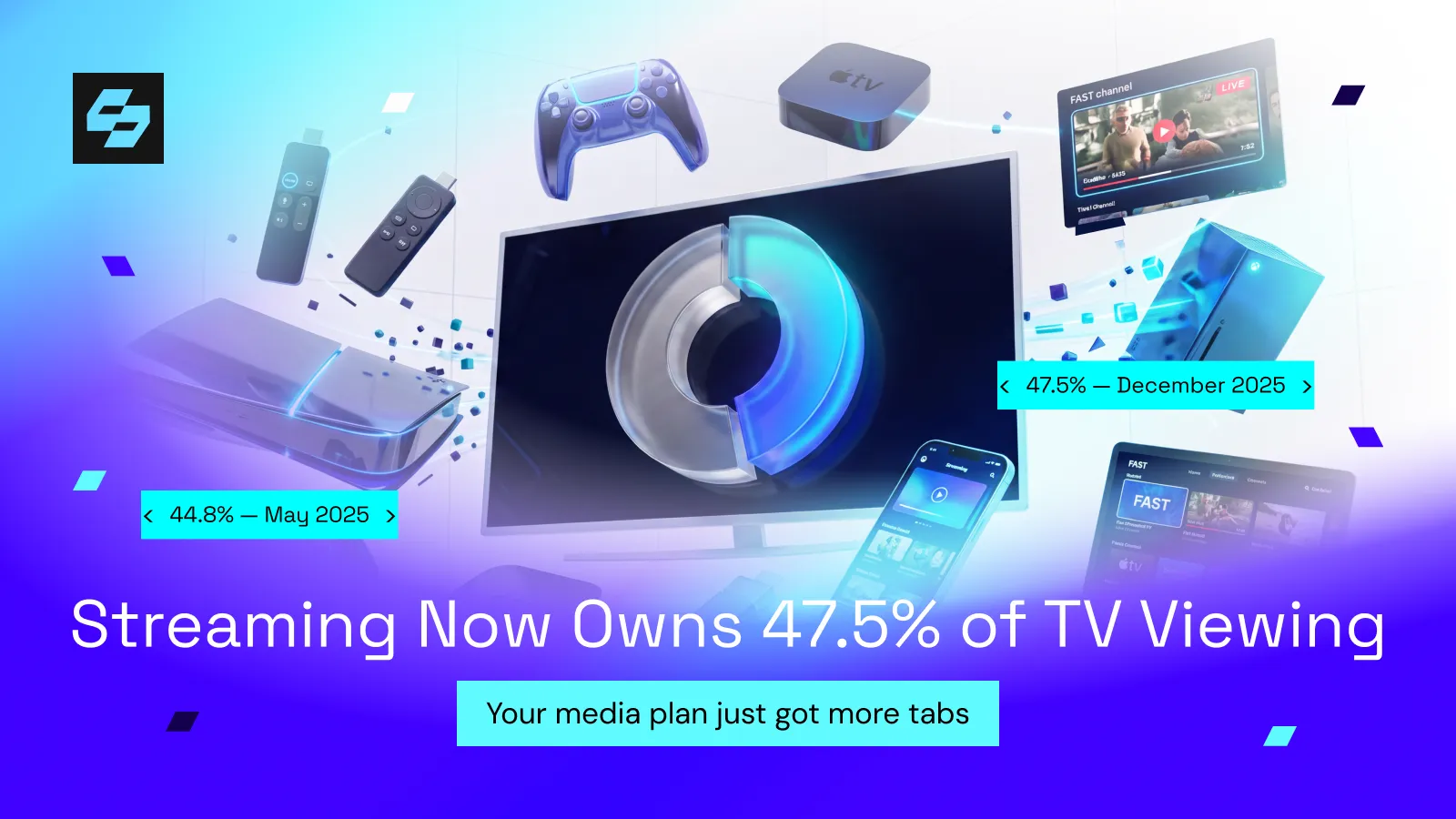
AI in CTV advertising connecting fragmented streaming platforms, devices, audiences, and data signals for smarter media buying.
5 Key Ways AI is Transforming CTV Advertising
The value of AI-driven CTV is not one isolated feature. It appears across the campaign lifecycle, from the instant an impression becomes available to the moment an advertiser evaluates whether that impression contributed to a sale.
AI-Driven Programmatic Buying & Real-Time Bidding
Programmatic CTV replaces much of the fixed, bulk-buying logic of traditional television with impression-level decisioning. AI makes that process substantially more intelligent.
In a real-time auction, a buying platform may need to evaluate the opportunity in milliseconds. AI automates bid adjustments and evaluates dozens of signals in milliseconds to estimate the real-time ROI of each impression. These can include campaign objectives, device type, content type, geographic location, time of day, audience signals, historic propensity to convert, frequency, ad inventory quality, budget pacing, supply chain path, and expected value. Real-time bid decisioning considers these parameters to determine if the impression will be effective in helping achieve the campaign’s objectives and how much to pay for the impression.
That goes beyond simply automating a bid. A rules-based system might raise bids for a predefined audience or stop spending at a frequency threshold. An AI model can learn from outcomes and adjust the value of signals. If a combination of publisher, audience, creative, and time window starts producing stronger results, the system can respond without waiting for a trader to rebuild the plan.
This makes CTV ad optimization continuous rather than periodic. AI can also handle budget pacing, reserving budget for better deals or redirecting it when performance shifts. If several campaigns are run by agencies, it will allow for less tracking efforts but make more decisions on an impression-by-impression basis.
The most important thing here is transparency. The speed of automation is helpful only if advertisers are able to comprehend which inventory was bought and how the optimization process is linked with business goals. AI should enhance the quality of media decisions, not just make media purchasing opaque.

AI-powered programmatic CTV system analyzing audience, inventory, pricing, and campaign signals to optimize real-time bidding decisions.
Hyper-Targeting: Beyond Demographics to Intent
Traditional targeting in TV was based primarily on demographic proxies such as age, income, geographic location, or program preference. While these may have some value, they tend to focus on who the audience is rather than what it is likely to do.
AI CTV targeting moves the focus toward behavior, context, intent, and probability.
Modern systems can combine first-party data, viewing patterns, contextual signals, device activity, commerce data, location-level signals where permitted, and historical response patterns to identify audiences that are more likely to be relevant to a campaign. Audience targeting therefore becomes less dependent on a single demographic definition.
For instance, the marketer for home improvement will not necessarily have to focus on all homeowners belonging to a certain income level. There could be more beneficial segments created through the use of AI to pick up combinations of factors that indicate a consumer’s interest in remodeling their house.
This approach also improves audience segmentation. Instead of a few static groups, machine learning can detect behavioral clusters as data changes. A broad “sports fan” segment may split into viewers with different interests, purchase patterns, device habits, or engagement levels, each requiring a different bidding or creative strategy.
Identity resolution is certainly key here; however, CTV is not exactly the same as mobile or desktop. The television is most likely a family member's viewing platform, and hence, the fact that there is a verified account does not mean that the viewer watching is identified correctly. Thus, strong AI-driven targeting uses a combination of all those things.
The result is not targeting for the sake of precision. It is a better probability that the impression is relevant enough to deserve the budget.
Predictive Performance Forecasting
Most campaign optimization is reactive: launch, collect data, identify what underperformed, then make changes. Predictive performance forecasting moves part of that work earlier.
By analyzing historical campaigns, seasonality, audience response, inventory availability, creative performance, pricing patterns, competitive pressure, and other variables, predictive analytics can estimate how a campaign is likely to behave before or during launch.
That can help planners answer practical questions. Which audience is likely to saturate fastest? What budget is required to reach a meaningful share of a target segment? Which dayparts are likely to become expensive? Which creative is at risk of fatigue? Where is incremental reach likely to fall sharply? How could a change in CPM affect the probability of hitting a conversion target?
AI does not make those forecasts certain. Markets change, models inherit data limitations, and unexpected events can invalidate assumptions. The advantage is that planning becomes probabilistic rather than purely historical.
Predictive performance forecasting will help with scenario planning for agencies as well. Rather than generating one media plan based on one anticipated outcome, planners can generate several media plans and examine the tradeoffs between reach, frequency, costs, and performance that would result from each of them.
In this case, the task of a planner will change. Planners will spend less time making calculations and more time choosing goals and risks that should be considered by the system.
AI-Powered Dynamic Creative Optimization
Media optimization answers where and when to place an ad. Dynamic creative optimization answers what version of the ad should appear when that opportunity arrives.
Generative AI and machine learning can dramatically expand the number of creative variations a CTV campaign can support. A single approved concept can be adapted with different product messages, calls to action, offers, locations, languages, imagery, or contextual elements. Variations can then be matched to audience and environmental signals.
A national retailer, for example, could use one master video while changing the final offer by region. A travel brand could emphasize warm-weather destinations in colder markets. A restaurant chain could serve breakfast messaging in the morning and dinner offers later in the day. Weather, inventory, daypart, geography, audience segment, and campaign stage can all become inputs.
The scale of adoption is accelerating. IAB reported that 86% of video ad buyers were already using or planning to use generative AI for creative, and buyers expected close to 40% of digital video ads to be built or adjusted with GenAI in 2026.
The goal is not simply to create more ads, but to reduce the cost and time of testing. Automated workflows can generate, compare, and retire variations while feeding performance data into the next creative cycle.
Humans' opinion on that still matters. The brand rules, claims, legal issues, cultural aspects, and visuals cannot be left to be created solely by the generation models. The most effective tools combine automation and people's ability to make strategic decisions.
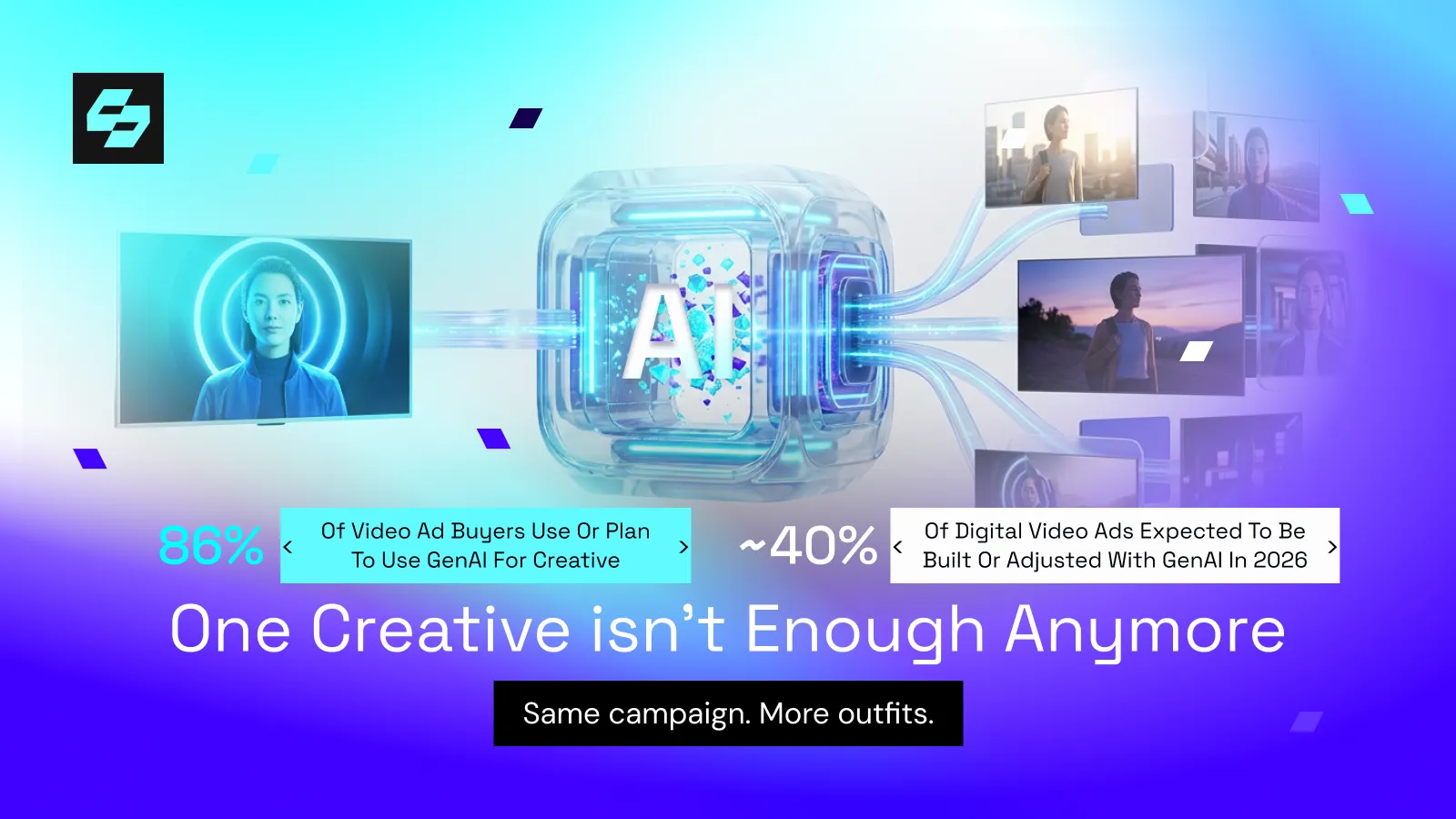
Generative AI in CTV advertising creating multiple video ad variations for dynamic creative optimization and personalized campaigns.
AI-Enhanced Measurement and Attribution
Television has always been good at creating reach and cultural impact. Its historical weakness was proving exactly what happened after exposure.
The situation is made better by CTV since the distribution of ads happens through digital means; however, fragmentation remains a challenge in measuring performance. Each platform has different identifiers, reporting methods, attribution windows, and data standards. For example, a consumer watches an advertisement on the TV, then searches for the brand on their phone, visits a website using a laptop, and buys in a brick-and-mortar store.
AI will be used to tie those activities together to understand the customer journey. AI-powered CTV measurement is the process of connecting ad exposure to activities like website visits and in-store purchase analysis of touchpoints.
Through cross-channel attribution models, a company can analyze trends on CTV, web, mobile, commerce, and offline outcomes to understand how much ad exposure contributed to behavior. Depending on the data collected and the privacy framework in use, advertisers can connect CTV impressions with visits to websites, mobile applications, brick-and-mortar stores, registration, subscription, and purchases.
Machine learning can also detect patterns that last-click reporting misses. A CTV impression may not produce an immediate conversion but can influence branded search, a later display response, or a purchase days later. Better models help marketers understand contribution rather than automatically crediting the final touchpoint.
This is why CTV measurement is the new battleground. As CTV budgets grow, advertisers need proof that reach translates into business impact.
AI-enhanced measurement is also valuable during the campaign, not only after it. If performance signals indicate that a segment is receiving too much frequency, a publisher is producing weak outcomes, or a creative is losing effectiveness, the system can adjust while budget is still available.
That closes the loop between measurement and execution: data does not simply describe what happened. It changes what happens next.
The Role of Generative AI and Contextual Ads
Generative AI is changing the production economics of CTV.
Creating television-quality video traditionally involved long lead times, specialized teams, editing cycles, localization, and significant cost. GenAI can compress parts of that workflow through concept development, storyboarding, copy variations, voice, localization, versioning, and asset generation.
This matters because personalization is only useful when creative supply can keep pace with audience segmentation.
If an advertiser can identify ten valuable audience groups but has only one generic commercial, targeting intelligence is underused. Generative systems make it easier to create enough approved variations to support differentiated messaging without rebuilding every asset from scratch. IAB’s Generative AI Playbook similarly identifies accelerated creative development, personalization, campaign optimization, and measurement among the technology’s advertising applications.
Contextual advertising goes a step further by using the content environment itself as a signal.
Computer vision, natural-language processing, and audio analysis can classify scenes, topics, objects, sentiment, and other contextual characteristics within video. That intelligence can be used to select a more relevant ad or, in emerging formats, to place a branded object directly inside content.
Imagine an AI system recognizing a dining scene in a streaming show. Instead of waiting for a conventional commercial break, an eligible in-scene format could place a branded beverage on the table or integrate another approved product naturally into the environment. Similar technology can add signage to a sports venue or insert branded elements into existing video without reshooting the original content. StackAdapt highlights this type of in-content integration as one emerging application of AI-powered contextual intelligence in CTV.
The concept is moving closer to standardized programmatic infrastructure. Six core CTV ad formats exist: Pause, Menu, Screensaver, In Scene, Squeezeback.s, and Overlays.
For advertisers, the opportunity is greater relevance with less interruption. For publishers, it can create new inventory without simply adding more ad breaks. But contextual intelligence must be paired with strict controls around rights, suitability, disclosure, and brand safety. A model may recognize an object correctly while still misunderstanding the emotional meaning of a scene. Human rules and publisher governance remain critical.
The Future of AdTech: What’s Next for AI and CTV?
The next stage of AI in CTV advertising will move from optimization toward orchestration.
Today, AI commonly recommends bids, audiences, budgets, and creatives within parameters set by a buyer. The emerging model is more agentic: a marketer defines the business objective, constraints, target audience, budget, and acceptable risk, while AI systems construct and continuously manage more of the campaign themselves.
That future is already entering buyer roadmaps. IAB’s 2026 Digital Video Ad Spend & Strategy research found that two in three buyers were already live with, testing, or planning to use agentic AI for digital video campaigns in 2026. And two-thirds of buyers were focused on agentic AI for ad buying and campaign execution.
The practical implication is that campaign management may become increasingly autonomous. An AI agent could forecast results, build audience segments, select inventory, set bid strategies, generate approved creative variations, monitor performance, and reallocate spend when conditions change.
For a deeper look at that transition, see how AI agents will transform CTV advertising.
The second major shift will be cross-channel orchestration.
Consumers do not experience marketing as separate CTV, display, social, audio, retail media, and mobile campaigns. They experience a sequence of brand exposures. AI can help coordinate that sequence by connecting signals across channels, controlling total frequency, selecting the next useful touchpoint, and moving budget toward the environment with the highest predicted incremental value.
A viewer might first encounter a brand through a CTV ad, later receive a mobile display message, then see a retail media placement closer to purchase. The system’s job is not to maximize every channel independently. It is to optimize the overall journey.
That is a major change from siloed media planning.
It also raises the importance of governance. More autonomy means more decisions happen without direct human intervention. Brands therefore need clear controls for inventory quality, data usage, bidding limits, creative claims, exclusions, brand safety, and measurement methodology.
Human expertise becomes more strategic. Machines are suited to evaluating millions of combinations, detecting patterns, and executing repetitive decisions. Humans still define the goal, acceptable trade-offs, brand voice, and the point where an efficient tactic becomes an ethical or reputational risk.
The strongest future model is not AI instead of marketers. It is AI handling computational complexity while marketers retain accountability for strategy.
What Agencies Should Do Next
AI is turning Connected TV advertising from a relatively static media channel into an adaptive performance environment. That shift changes what agencies should demand from both their technology and their own operating models.
First, stop planning CTV as an isolated extension of linear television. Build around audiences, outcomes, and cross-channel behavior rather than fixed channel silos.
Second, demand transparency. AI-powered optimization is only valuable when buyers can see where money is going, which supply paths are being used, how performance is measured, and what data informs the model. Automation without visibility makes it harder to separate genuine intelligence from hidden inefficiency.
Third, connect creative, media, and measurement. The greatest advantage of AI-powered CTV advertising appears when these functions operate as one feedback loop: audience signals inform buying, buying data informs creative, and measurement informs the next decision.
Finally, keep humans in control of objectives and guardrails. AI should act as a force multiplier for planners, traders, analysts, and creative teams—not a substitute for judgment.
Television’s next frontier will not be won by recreating linear buying inside streaming apps. It will be won by advertisers that treat CTV as intelligent, measurable, cross-channel infrastructure and use AI to make every impression more accountable.
FAQ
How does AI improve audience targeting in CTV?
AI in CTV advertising analyzes viewing behavior, contextual signals, first-party data, device activity, and response patterns to build more relevant audience segments. Instead of relying only on broad demographics, AI CTV targeting can identify behavioral and intent-based groups and continuously refine them as new campaign data becomes available.
What is programmatic TV advertising?
Programmatic CTV is the automated buying and selling of Connected TV advertising inventory using software, data, and real-time decisioning. Rather than negotiating every placement manually, advertisers can evaluate individual impressions, apply audience and campaign criteria, adjust bids, control frequency, and optimize spend while a campaign is running.
Can AI predict TV ad performance before launch?
Yes, but as a probability rather than a guarantee. AI-driven CTV platforms can use predictive analytics to compare historical performance, audiences, inventory, pricing, seasonality, and creative signals. Predictive performance forecasting helps teams test scenarios before launch, estimate likely outcomes, and identify risks that may require budget, targeting, or creative changes.
How does AI improve CTV measurement?
AI-powered CTV advertising can connect exposure data with web activity, app events, commerce signals, store visits, or other outcomes where appropriate data is available. It also supports cross-channel attribution and faster performance measurement, helping advertisers understand not only whether an ad was delivered but how it contributed to business results.
Will AI replace CTV media buyers?
No. AI can automate CTV media buying tasks such as bid optimization, audience modeling, pacing, forecasting, and reporting, but human expertise remains critical. Marketers still define strategy, evaluate data quality, set brand-safety and privacy guardrails, approve creative, interpret results, and decide which business trade-offs an automated system should make.