


Great content and loyal audiences do not automatically translate into strong advertising revenue.
A publisher may have valuable inventory but still struggle with limited demand, weak auction competition or a monetization setup that has become difficult to manage. And simply adding more demand partners does not necessarily fix the problem.
What publishers need is a clearer way to bring inventory to market, create competition for each eligible impression and understand what is actually driving revenue, without losing control over the environments they have built.
That is the idea behind Screencore SSP, our supply-side platform for publishers across web, mobile, in-app, video and connected TV (CTV).
It brings together premium demand access, transparent real-time auctions, yield optimization, flexible integrations and inventory quality protection in one monetization offering.
And with an SDK planned for the SSP, we are taking the same approach further into direct mobile app monetization.
What Is a Supply-Side Platform, and Why Does It Matter?
A supply side platform, or SSP, is technology that helps publishers make advertising inventory available to buyers through programmatic auctions.
Consider a news site with several ad placements, an app with banner and video inventory or a streaming service selling CTV impressions. In every case, the publisher has advertising space available, but that is only the starting point.
The inventory still needs to reach relevant demand. Buyers need a way to evaluate each opportunity and bid on it. Publishers, in turn, need enough visibility to understand what sells, at what price and under what conditions.
This is where an SSP platform fits into the programmatic ecosystem.
When an eligible impression becomes available, the supply-side platform sends the opportunity to connected demand sources. Buyers evaluate it and submit bids, the auction determines the winning eligible bid, and the selected creative is delivered, all in real time.
The technology moves quickly. The business decisions behind it are more complicated.
A high fill rate, for example, does not always mean strong revenue. Premium placements may attract competitive bids while other inventory remains underused. Performance can also vary significantly between formats, devices, markets and demand partners.
A good SSP should help publishers see those differences rather than hide them behind one aggregated number.
Ultimately, SSP advertising is not about selling as many impressions as possible. It is about helping publishers capture more value from the inventory they already have.
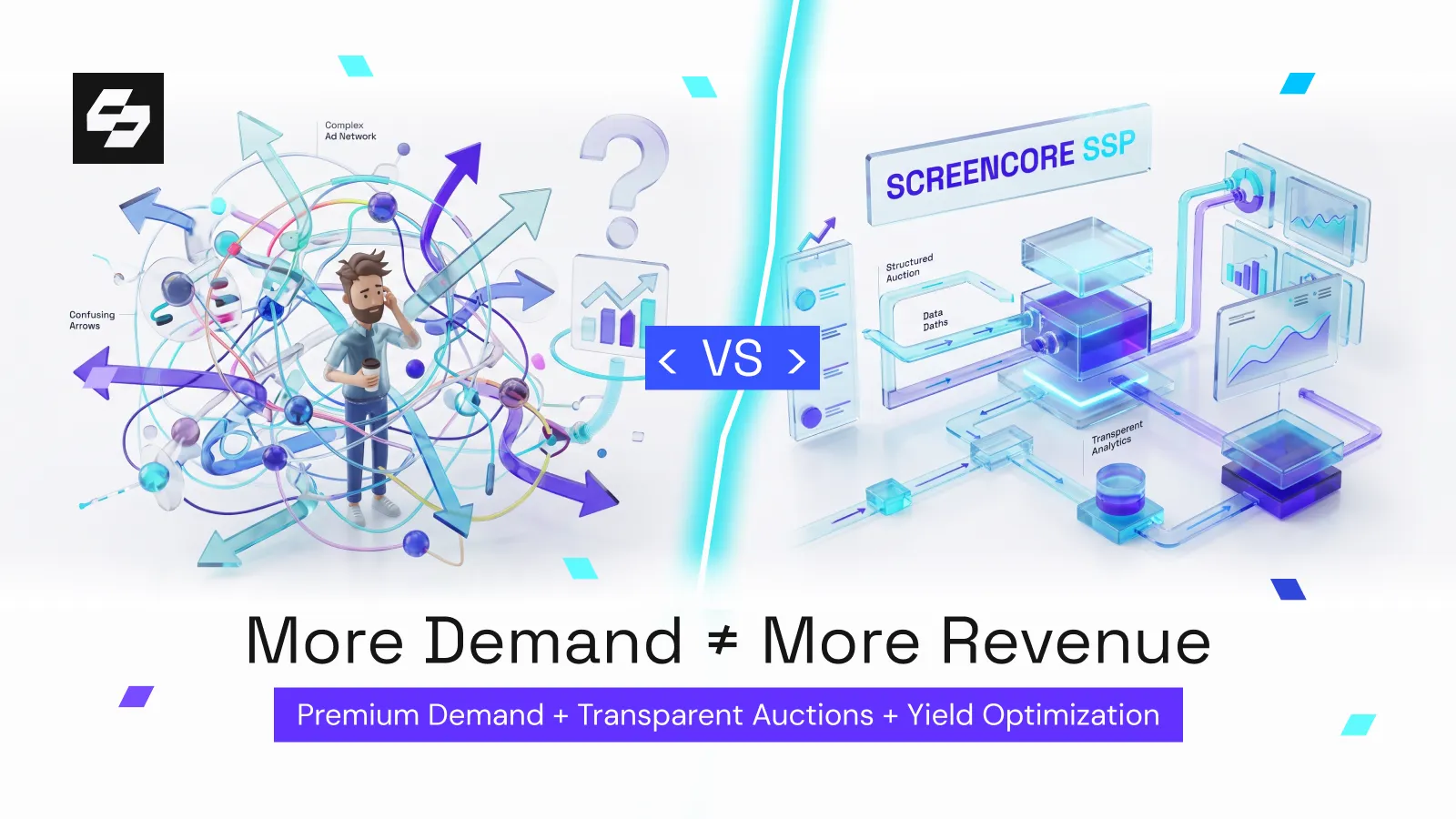 Screencore SSP combines premium demand, transparent auctions, and smart yield optimization to boost publisher ad revenue.
Why We're Launching Screencore SSP
Publisher monetization should not require choosing between performance and visibility.
Yet as integrations, partners and formats accumulate, the monetization stack can become fragmented. It gets harder to understand which demand relationships are contributing real value, how auctions are performing and where revenue opportunities may be getting lost.
Screencore SSP was built to make that process more transparent.
The platform connects publisher inventory with premium advertiser and agency demand, creating more opportunities for competition in eligible auctions. Smart yield optimization and real-time bidding are designed to support stronger fill rates and effective cost per thousand impressions (eCPM).
Both metrics matter, but neither tells the whole story on its own.
Fill rate shows how many available ad opportunities result in a served ad. eCPM shows the revenue generated per thousand impressions. A publisher can improve fill rate by accepting lower-priced demand and see little change in total revenue. Higher eCPMs are not particularly useful either if too much inventory remains unsold.
Effective publisher monetization requires looking at both sides of that equation.
Screencore combines demand access, auction technology and reporting so publishers can manage that balance without introducing another disconnected layer into their operations.
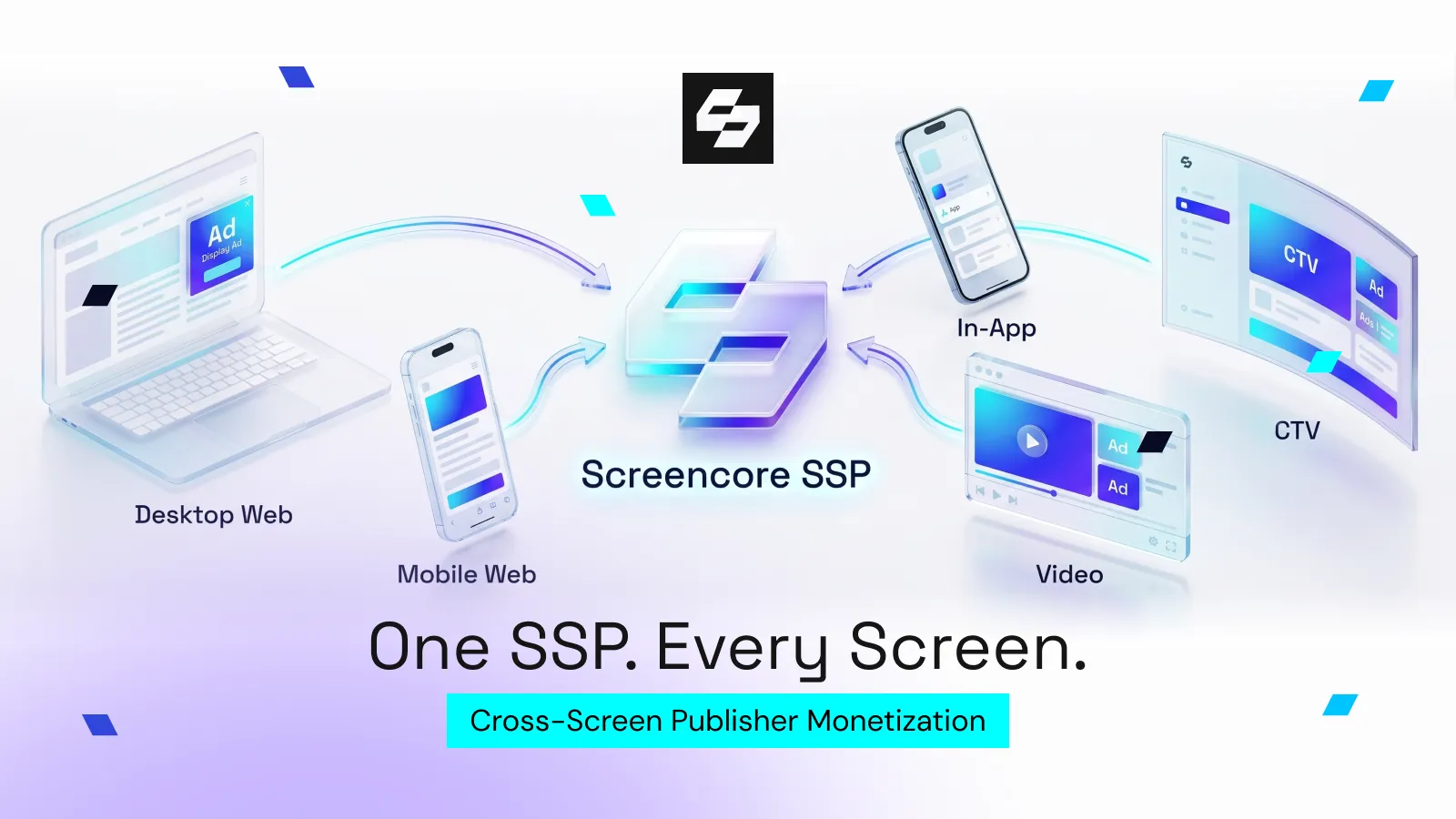
Screencore SSP connects web, mobile app, video, and CTV inventory through a single, consistent monetization framework.
One SSP for Web, Mobile, In-App, Video and CTV
Publisher inventory is increasingly spread across different screens and environments.
A media company may run a desktop site, mobile web properties and an app at the same time. Video publishers may distribute content across several channels, while streaming platforms have their own technical and commercial requirements.
Running each environment through a separate monetization setup can quickly make performance harder to compare and operations harder to maintain.
Screencore SSP supports desktop and mobile web banners and video, in-app banners and video, and CTV.
For web publishers, that can mean connecting display and video placements with competitive demand. For app developers, it means supporting in-app advertising through suitable integration methods. For CTV publishers, it means bringing programmatic monetization into the streaming environment.
These formats should not be treated as identical. Their creative requirements, delivery methods and user experiences differ.
The advantage of a cross-screen SSP programmatic advertising setup is that publishers can manage these environments through a more consistent monetization framework instead of building a completely separate process for each one.
The Next Step for App Publishers: An SSP SDK
App monetization comes with its own technical requirements.
Websites and mobile apps may both sell banner and video inventory, but the way that inventory connects to an SSP is different. Web publishers can work with browser-based integrations, while apps need technology designed for the application environment.
That is why an SSP SDK is part of the Screencore SSP roadmap.
The planned SDK will give app publishers a direct way to connect their applications with Screencore's programmatic infrastructure and monetize eligible traffic.
For developers, this means an integration path designed specifically for mobile app monetization rather than adapting a web-focused setup. For publishers, it creates another route for connecting in-app banner and video inventory with demand.
It also moves Screencore's supply-side offering closer to the point where those advertising opportunities originate.
We are keeping the announcement deliberately precise. The SDK is planned, but release timing, implementation instructions and additional SDK-specific functionality have not yet been confirmed for public communication.
More technical details will follow as the product develops.
Flexible Integrations Without a One-Size-Fits-All Setup
Publishers do not all use the same monetization stack, so there is little value in forcing them into the same integration model.
A large web publisher may already run header bidding. An app developer may have an established mobile monetization setup. A video publisher may rely on existing ad-serving workflows.
Replacing that infrastructure simply to connect another source of demand is rarely practical.
Screencore SSP supports OpenRTB, Prebid.js, Prebid Server, Prebid Mobile through the Prebid SDK, JavaScript tags and VAST tags.
Each option serves a different purpose.
OpenRTB enables real-time communication between programmatic platforms. Prebid integrations allow Screencore to work within supported header bidding and mobile bidding environments. JavaScript tags provide another option for web inventory, while VAST tags support video advertising workflows.
Rather than forcing publishers into a fixed architecture, the platform is designed to fit into existing infrastructure where possible.
That flexibility is useful during onboarding, but it also matters as a publisher grows, adds new formats or expands into new environments.
Better Yield Starts With Better Auction Competition
CPM often dominates conversations about publisher monetization.
That makes sense, but CPM alone can be misleading. A strong price on a small percentage of inventory does not necessarily translate into strong overall revenue.
Publishers need to look at the bigger picture: auction competition, fill rate, eCPM and demand quality.
Screencore SSP connects publisher inventory with premium global advertiser and agency demand. Bringing more relevant buyers into eligible auctions can help create stronger competition for available impressions.
From there, smart yield optimization and real-time bidding are designed to help improve fill rates and eCPMs.
These are optimization objectives rather than guaranteed outcomes. Inventory characteristics, market conditions, demand levels and auction dynamics will continue to affect results.
What the SSP provides is the infrastructure for connecting supply and demand, running auctions and evaluating performance through a more transparent workflow.
For publishers, that is a more useful foundation than optimizing toward a single headline metric.
Reporting That Helps Publishers Understand Their Inventory
Revenue is the outcome publishers care about, but a revenue total alone does not explain what is happening inside the monetization setup.
Teams also need to know where activity is coming from, how different environments compare and which parts of their inventory may require attention.
Screencore SSP includes reporting directly within the platform, with available dimensions including queries per second (QPS), geography, cities and operating systems.
That makes it possible to investigate performance from several angles.
A publisher active across multiple markets can compare activity by geography. An app business can look at operating-system differences. Technical teams can monitor request volumes and better understand how inventory is flowing through the platform.
This type of visibility also gives monetization, product and technical teams a shared set of data to work from.
At this stage, Screencore SSP does not provide a public reporting API. Reporting is available within the system.
Inventory Quality Is Part of Monetization
Advertising inventory is valuable partly because of the environment around it.
If a monetization setup generates demand but exposes a publisher to invalid traffic or malicious advertising, the consequences can go well beyond campaign performance. User trust and the quality of the property itself are also at stake.
Screencore SSP uses Pixalate and HUMAN for fraud detection and GeoEdge to help prevent malicious creatives.
The technologies address different parts of the quality equation. Fraud detection helps identify suspicious or invalid activity, while creative protection focuses on the ads being delivered into publisher environments.
Both belong inside the monetization conversation.
For Screencore, supply side platform advertising is not simply about increasing the number of bids entering an auction. It also means giving publishers tools and protections that support a more dependable monetization environment.
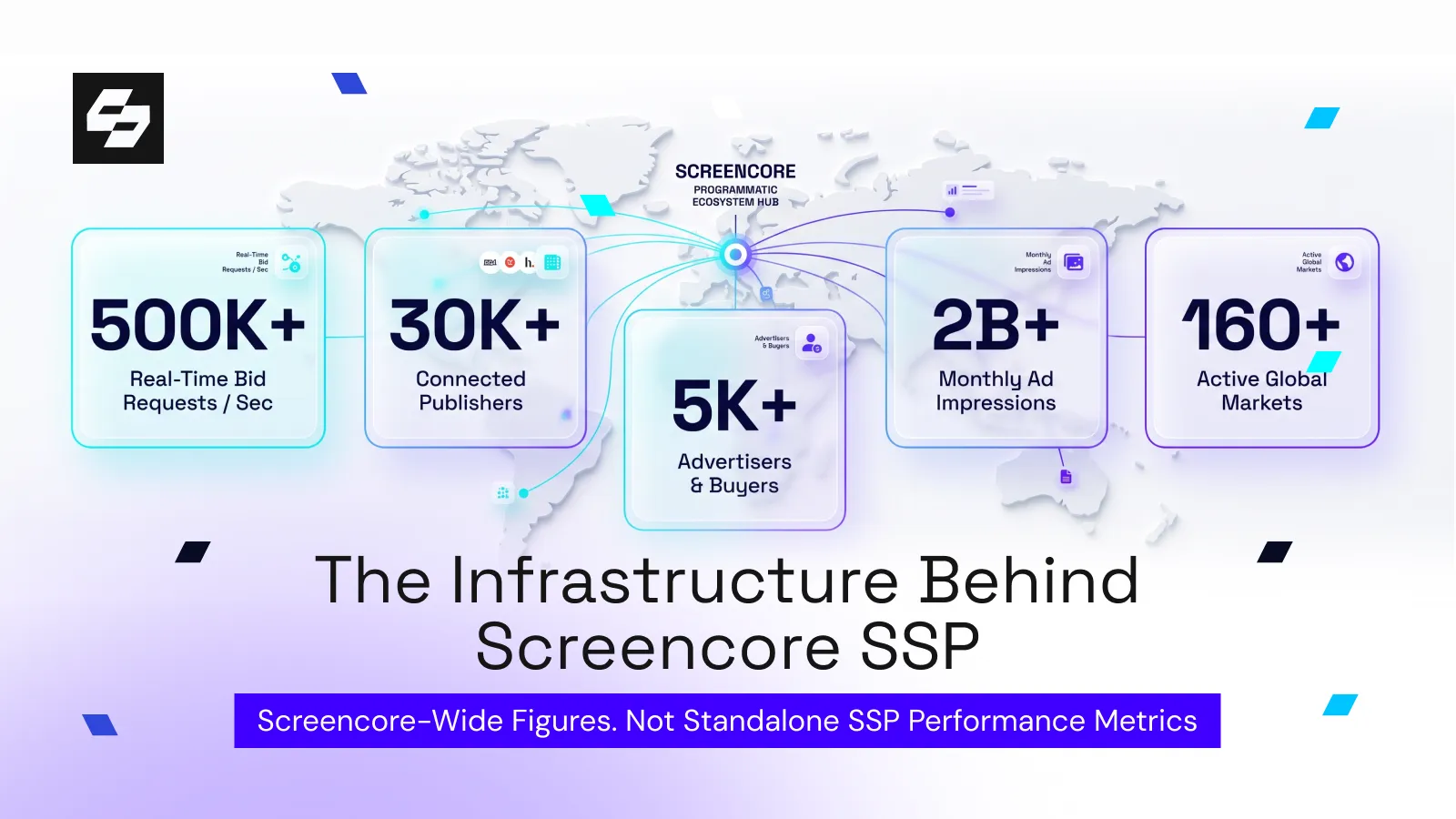
Powered by a global infrastructure processing over 500K real-time bids/sec and 2B+ monthly impressions across 160+ markets to support publisher growth.
Built on Screencore's Programmatic Infrastructure
Launching an SSP also raises an important question: what broader infrastructure sits behind it?
Across its programmatic business, Screencore reports more than 500,000 real-time bid requests per second, 30,000 connected publishers, 5,000 advertisers and buyers, over 2 billion monthly ad impressions and activity across more than 160 global markets.
The company also reports an average viewability rate above 95%.
These are company-wide figures. They should not be read as standalone performance results or capacity guarantees for Screencore SSP.
Instead, they provide context for the wider programmatic infrastructure behind the new supply-side offering.
For publishers comparing supply side platform companies, scale is only one part of the decision. The more practical question is how a platform connects demand, auction execution, reporting and inventory protection, and whether that setup fits the publisher's business.
That is the area Screencore is focusing on with its SSP.
Cleaner Supply Paths Matter on Both Sides of the Auction
Publishers and advertisers enter the programmatic ecosystem from different sides, but both benefit from understanding how an impression moves between supply and demand.
Publishers want to monetize inventory efficiently. Buyers want suitable placements, competitive auctions and visibility into what they are purchasing.
Too many intermediaries can make those relationships harder to follow. Pricing becomes less transparent, inventory paths become more difficult to understand and it is harder to see where value is being created or lost.
Screencore's broader programmatic approach focuses on efficient supply paths, transparent auctions and clearer visibility into supply, pricing and performance.
The SSP extends that approach to publisher monetization.
The objective is not to generate auction volume for the sake of volume. It is to create a more efficient connection between inventory and demand, supported by reporting and quality controls.
That gives publishers a better basis for evaluating how their monetization setup is actually performing.
What's Next for Screencore SSP?
With the launch of Screencore SSP, publishers can access Screencore's supply-side offering across supported web, mobile, in-app, video and CTV environments.
One of the most important next steps is the planned SDK, which will provide app publishers with a direct integration route for monetizing eligible traffic.
We will share more details about the SDK, implementation and other product developments once the relevant technical information is ready for public release.
For now, the focus of the platform is straightforward: premium demand access, transparent auctions, yield optimization, flexible integrations and inventory quality protection.
A supply-side platform should make publisher monetization easier to understand and easier to manage, while giving publishers the infrastructure they need to make more of each eligible impression.
That is what we are building Screencore SSP to do.
Your Inventory. More Opportunity. Powered by Screencore SSP.
Your inventory deserves more than another demand connection.
Bring premium global demand, transparent auctions and smart yield optimization into your monetization strategy with Screencore SSP.
Whether you monetize websites, mobile apps, video or CTV, our team can help you explore an integration that fits your inventory and existing setup.
Let's talk about what your inventory can do.
FAQ
What is an SSP in digital marketing?
An SSP, or supply-side platform, is technology that helps publishers sell advertising inventory through programmatic auctions. It connects available ad opportunities with demand from advertisers and buyers, allowing publishers to monetize websites, apps and other digital environments.
In simple terms, SSP in digital marketing sits on the publisher side of the programmatic transaction and helps make inventory available to potential buyers.
What is a supply side platform?
A supply side platform is the technology publishers use to make eligible advertising inventory available to programmatic demand, evaluate incoming bids and manage how impressions are sold.
It acts as a connection point between publisher inventory and the buyers competing for it through real-time auctions.
What is SSP in advertising?
SSP in advertising refers to the technology used on the supply side of programmatic media buying. While advertisers and agencies use buying technology to evaluate and purchase impressions, publishers use an SSP to make inventory available, manage auctions and support monetization.
What is Screencore SSP?
Screencore SSP is a supply-side platform designed to help publishers monetize inventory through transparent real-time auctions, premium global demand and smart yield optimization.
It supports web, mobile, in-app, video and CTV environments alongside flexible integrations, reporting and inventory quality protection.
How does Screencore SSP help publishers increase revenue?
Screencore SSP connects publisher inventory with premium advertiser and agency demand, helping create stronger competition in eligible auctions.
Its real-time bidding and yield optimization capabilities are designed to support improved fill rates and eCPMs across publisher inventory.
Actual results depend on inventory characteristics, auction dynamics and market demand.
Which advertising formats does Screencore SSP support?
Screencore SSP supports desktop and mobile web banners and video, in-app banners and video, and connected TV (CTV).
This allows publishers to manage monetization across several supported environments through the same broader programmatic approach.
Which integrations are supported by Screencore SSP?
Screencore SSP supports OpenRTB, Prebid.js, Prebid Server, Prebid Mobile through the Prebid SDK, JavaScript tags and VAST tags.
These options allow publishers to choose an integration method that works with their existing monetization infrastructure.
Will Screencore SSP offer an SDK for mobile app monetization?
Yes. An SDK is planned for Screencore SSP to help app publishers connect their applications directly to the platform and monetize eligible traffic.
The release date and detailed implementation documentation have not yet been announced.
What reporting is available in Screencore SSP?
Screencore SSP provides reporting within the platform, including data on queries per second (QPS), geography, cities and operating systems.
A public reporting API is not currently available.
How does Screencore SSP protect inventory quality?
Screencore SSP uses Pixalate and HUMAN for fraud detection and GeoEdge to help prevent malicious creatives.
Together, these technologies support inventory quality protection across the platform's monetization operations.