



Election season used to have a familiar media pattern.
Turn on local television in a competitive state and the commercial breaks made it obvious. Political advertising arrived quickly, bought heavily, and competed for a limited amount of airtime.
That pressure has not disappeared.
It has followed viewers into streaming.
Connected TV is becoming a significant part of U.S. political advertising, and the 2026 midterm cycle makes the shift hard to miss. AdImpact now projects total political advertising for the cycle at a record $11.6 billion. Broadcast TV remains the largest piece at 48%, but CTV is expected to capture roughly $2.7 billion, or 23% of spending.
For an advertising channel that played a much smaller political role only a few election cycles ago, that is a serious amount of money.
And political advertisers are not entering an empty market.
CTV demand is already growing.
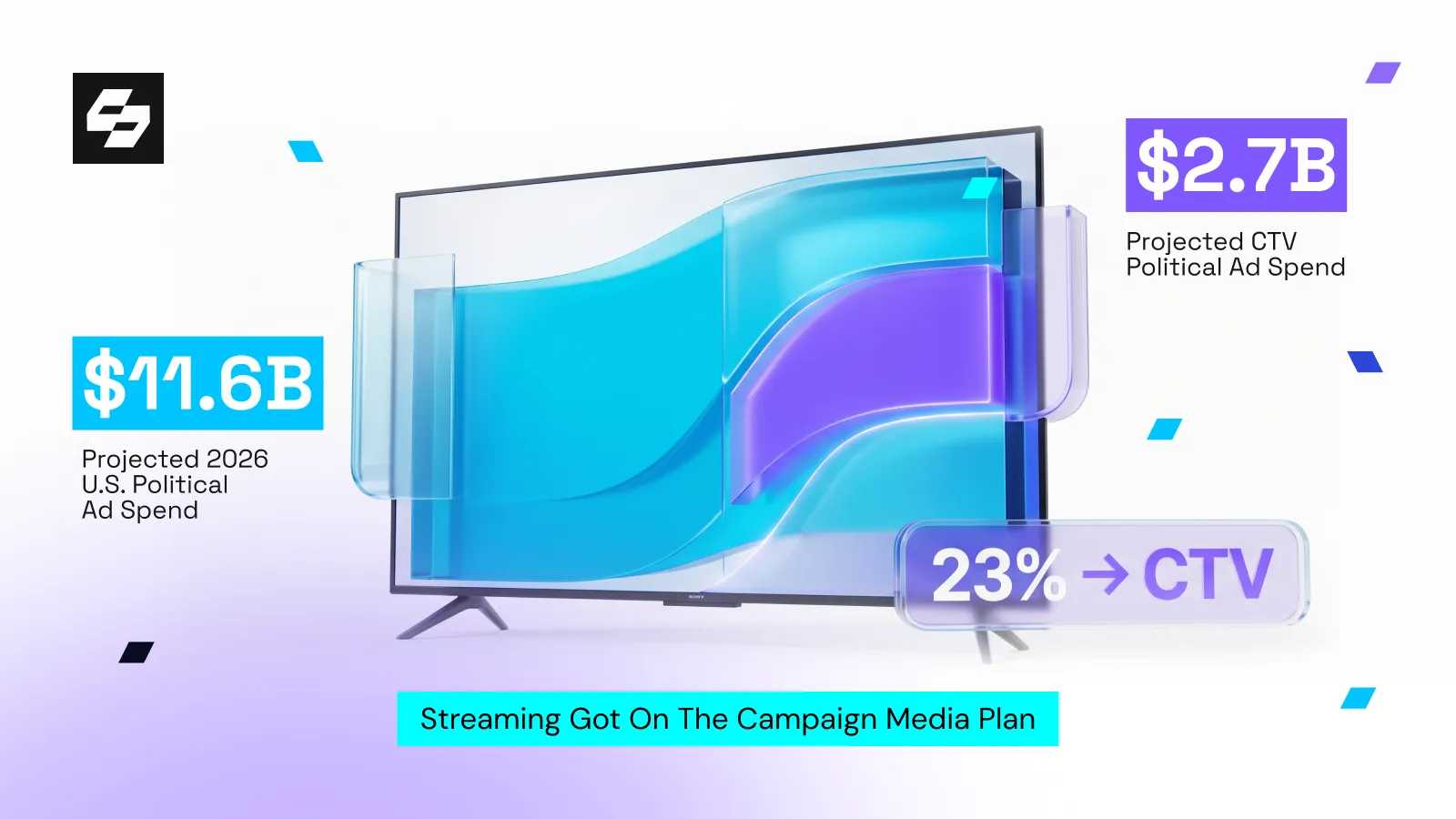
U.S. political ad spend projections highlight $2.7B shifting into connected TV streaming channels during election cycles.
Political Money Is Following Television Audiences
The reason CTV attracts political advertising is not particularly mysterious.
People still watch television. They increasingly watch it through internet-connected screens.
Advertisers followed.
IAB reported that CTV ad spend reached $23.6 billion in 2024, up 16% year over year, and projected another increase to $26.6 billion in 2025. By 2026, IAB expects CTV spending to grow another 13.8%.
Political demand is therefore arriving in a channel that commercial advertisers already consider a core part of the media mix.
This matters because election spending is highly concentrated.
A national consumer brand may advertise throughout the year. Political campaigns operate against immovable dates. Primaries happen when they happen. Election Day cannot be moved because CPMs became uncomfortable.
That produces a very different demand pattern.
Election Demand Can Change Local CTV Economics Fast
National CTV numbers only tell part of the story.
Political advertising is intensely geographic.
A Senate race, gubernatorial contest or competitive House district can produce heavy advertising demand in one market while a neighboring market sees far less pressure. That concentration makes election advertising especially important for local CTV inventory.
AdImpact's 2026 local CTV analysis projects $2.48 billion in political CTV spending for the midterm year in its earlier forecast, up 128% from the 2022 midterms. Its more recent national political-spending forecast has since increased the CTV figure to $2.7 billion.
The exact number will continue moving as campaigns develop.
The direction is much harder to dispute.
CTV has become a major election advertising environment.
When a large amount of budget enters specific markets over a relatively short period, the effect goes beyond political advertisers. Commercial brands are competing in the same broader attention economy.
Retailers do not stop advertising because an election is happening. Neither do automotive brands, financial services companies, restaurants or entertainment advertisers.
Everyone still wants the screen.
CTV Changes What “Television Advertising” Means During Elections
Broadcast political advertising has decades of established buying practices behind it.
CTV adds another layer.
Streaming inventory can be purchased through different combinations of direct deals, platforms and programmatic infrastructure. The environment also brings digital capabilities around audience selection, frequency management, measurement and reporting.
That is one reason the movement of political budgets into CTV is important beyond politics itself.
It puts more pressure on streaming advertising infrastructure.
Advertisers expect television-scale reach, but they increasingly expect digital-style control as well. They want to understand delivery. They want reliable audience information. They want measurement. They want to know where an impression ran.
Those expectations are not unique to political advertising.
Targeting has overtaken content quality as the leading criterion buyers use when making TV/video investment decisions. U.S. digital video spending overall is projected to exceed $80 billion this year, with digital video taking more than 60% of total TV/video advertising spend.
The screen is still television.
The buying expectations increasingly look like digital advertising.
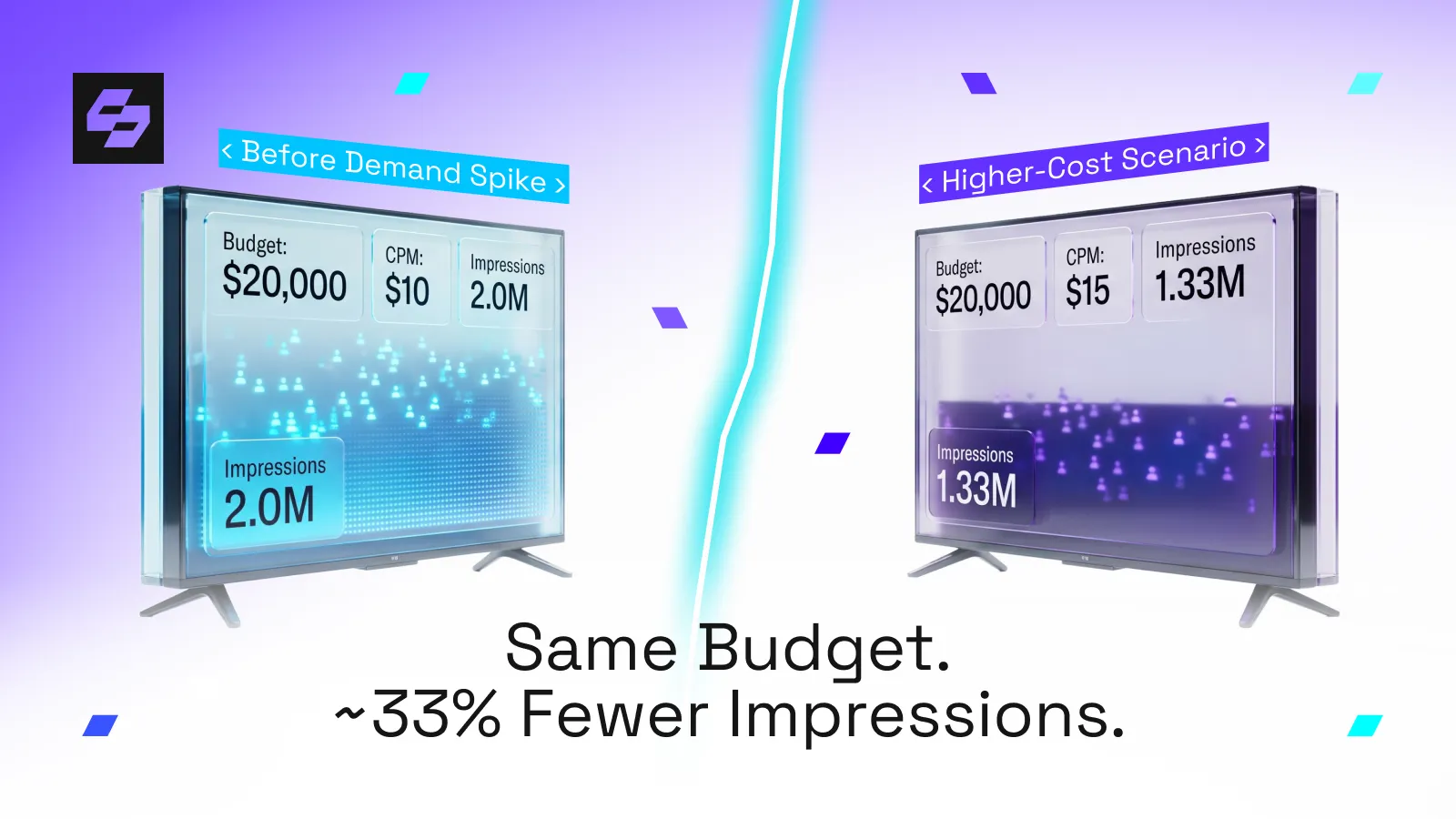
Elevated programmatic auction competition during demand surges increases clearing CPMs and reduces delivered impression volume.
More Demand Makes Supply Quality More Important
High-demand periods expose weak infrastructure surprisingly quickly.
When inventory is plentiful, inefficiencies can hide. Buyers have alternatives. Pricing is easier to absorb. A questionable supply path may not receive much attention.
When demand rises sharply, those details become harder to ignore.
Buyers need to understand what inventory they are accessing, where it comes from and how it is being sold. Publishers and platforms need infrastructure capable of handling increased auction activity without losing transparency.
This is particularly relevant in CTV because the supply landscape is fragmented across apps, streaming platforms, device ecosystems and intermediaries.
A television impression is not automatically a premium impression simply because it appeared on a large screen.
That distinction matters even more when billions of additional advertising dollars are competing for streaming audiences.
Election Years Also Put Measurement Under Pressure
Political demand creates another interesting effect: it makes measurement problems more visible.
CTV promises addressability and accountability that traditional television could not always provide at the same level. But measuring streaming campaigns remains complicated.
Households use multiple devices. Streaming services have different identity environments. Signal availability varies. Cross-platform reach can be difficult to reconcile cleanly.
Meanwhile, advertisers increasingly expect outcomes, not just completed video views.
As digital video budgets have expanded, buyer expectations around performance, measurement and transparency have risen with them.
That creates a straightforward challenge for the CTV ecosystem.
More money entering the channel means more scrutiny over what that money actually produces.
Political advertising adds another large pool of demand to that equation.
Political CTV Has Its Own Transparency Requirements
There is another important difference between a standard streaming campaign and political advertising: political communications operate under specific disclosure rules.
For U.S. federal political advertising, Federal Election Commission rules require disclaimers on covered public communications, including paid communications distributed through websites, digital devices, applications and advertising platforms.
Internet video has specific requirements as well. When a disclaimer appears within a covered internet video communication, the FEC requires it to remain visible for at least four seconds without requiring the viewer to take another action.
That sounds like a creative detail.
For AdTech infrastructure, it is not.
Political advertising involves questions around advertiser identification, creative compliance, records, platform policies and applicable federal and state requirements. Streaming platforms and technology providers need systems that can distinguish these campaigns and apply the appropriate processes.
As political CTV spending grows, those workflows move from edge cases toward a more meaningful operational requirement.

Surging political buyer budgets constrain available premium streaming video inventory slots for commercial advertisers.
Election Demand Is Becoming Part of CTV Planning
There is an easy mistake to make here.
Treat political advertising as a temporary spike that matters only to political campaigns.
The market impact is broader.
The 2026 calendar already contains several major demand events. IAB notes that the Winter Olympics, FIFA World Cup and U.S. midterm elections are contributing to advertising demand across video environments.
Political spending adds another concentrated layer, particularly in competitive local markets.
For commercial advertisers, that can mean a different supply environment from one month to the next. For publishers, it creates monetization opportunities but also puts pressure on forecasting and inventory management. For AdTech platforms, it raises the value of transparent supply, reliable delivery data and infrastructure that can handle rapid changes in demand.
Election Day passes.
The infrastructure expectations do not.
From Impressions to Incremental Impact
CTV's growing political role also raises a familiar measurement question.
Did the advertising actually create an additional effect, or did the campaign simply reach people who would have taken the same action anyway?
That question is bigger than political advertising. It sits at the center of performance measurement across digital media.
For a deeper look at how advertisers separate correlation from real advertising impact, read our previous article, “What Is Incrementality in Advertising? And Why Does It Matter?”
It is especially relevant as CTV budgets grow and advertisers demand stronger evidence of what those investments actually deliver.
CTV Is Becoming Core Advertising Infrastructure
Political advertising did not create the shift toward streaming.
It is accelerating it.
The 2026 election cycle shows how quickly CTV has moved from an emerging extension of television buying to a significant destination for major advertising budgets. Political CTV spending is now measured in billions, while the overall CTV market continues posting double-digit growth.
That combination changes the market.
Inventory becomes more competitive. Local demand becomes less predictable. Measurement matters more. Supply transparency becomes harder to treat as an optional extra.
For AdTech companies, the takeaway is less about politics than infrastructure.
The streaming advertising stack has to be ready for demand that can arrive quickly, concentrate heavily in particular markets, and disappear just as fast.
Screencore builds programmatic infrastructure for an advertising market where CTV, video and data-driven buying increasingly overlap. From transparent supply connections to scalable programmatic execution, we help advertising businesses build technology that can perform when demand gets complicated.
Planning your next CTV or programmatic advertising project?
Talk to the Screencore team and see how the right infrastructure can support it.