



A campaign dashboard showing a 6.0x Return on Ad Spend (ROAS) looks like an immediate win. But behind that metric lies a fundamental question that standard attribution models fail to answer: How many of those sales would have happened anyway?
In digital advertising, high ROAS often reflects credit-claiming rather than actual revenue growth. Ad networks frequently target existing customers or high-intent buyers who were already on the verge of purchasing, claiming full credit for conversions that required zero paid influence.
Understanding incrementality is the key to separating real business impact from inflated platform metrics, ensuring every ad dollar spent drives net-new revenue.
What Is Incrementality in Advertising?
Incrementality measures the true lift generated by an advertising campaign—specifically, the conversions, revenue, or brand lift that occurred solely because the ad was shown.
It isolates cause and effect by comparing two outcomes:
The Observed Metric: Sales generated while ads were running.
The Counterfactual Baseline: Sales that would have occurred organically during the exact same period without ads.
Incremental Lift = Conversions from Exposed Audience − Conversions from Control Audience
If an ad campaign yields 1,000 attributed conversions, but 600 of those buyers would have purchased organically via search or direct traffic anyway, the true incremental contribution is 400 conversions.

Platform campaign dashboards obscure actual incremental performance by blending organic customer demand with paid conversions.
The ROAS Trap: Attributed vs. Incremental Growth
Most ad platforms rely on last-touch or self-attributing lookback windows. Under these models, if a user views or clicks an ad within a 7-day or 28-day window and subsequently converts, the platform claims 100% credit.
This structure incentivizes programmatic algorithms to bid heavily on low-funnel, high-intent audiences — such as branded search terms, retargeting pools, or existing email subscribers — where conversion probability is already near 100%.
Metric | Attributed Measurement (ROAS) | Incremental Measurement |
Primary Question | "Which ad touched the user before they bought?" | "Did the ad directly cause a sale that wouldn't have happened?" |
Data Focus | Pixel touchpoints and lookback windows | Randomized control testing and lift analysis |
Optimization Goal | Maximize reported dashboard conversions | Maximize total net-new company revenue |
Primary Risk | Double-paying for organic or brand-loyal buyers | Overlooking high-touch, upper-funnel growth channels |

Randomized control trial testing compares exposed and unexposed audience conversion rates to measure true ad lift.
How Incrementality Testing Works: Exposed vs. Control Groups
Measuring true incremental lift requires scientific testing methodology, mirroring clinical trials through Randomized Controlled Trials (RCT) or Matched-Market Testing.
The 3-Step Testing Framework
Audience Splitting: A target audience is randomly divided into two identical segments:
Exposed Group: Receives the active campaign creative.
Control Group: Receives no ad, a public service announcement (PSA), or placebo content.
Conversion Tracking: Both groups are monitored over the exact same flight dates under identical market conditions.
Lift Calculation: The baseline conversion rate of the Control Group is subtracted from the Exposed Group.
For example, if 12.4% of the Exposed Group converts while 9.1% of the Control Group converts organically, the campaign delivered a +3.3 percentage point incremental lift.
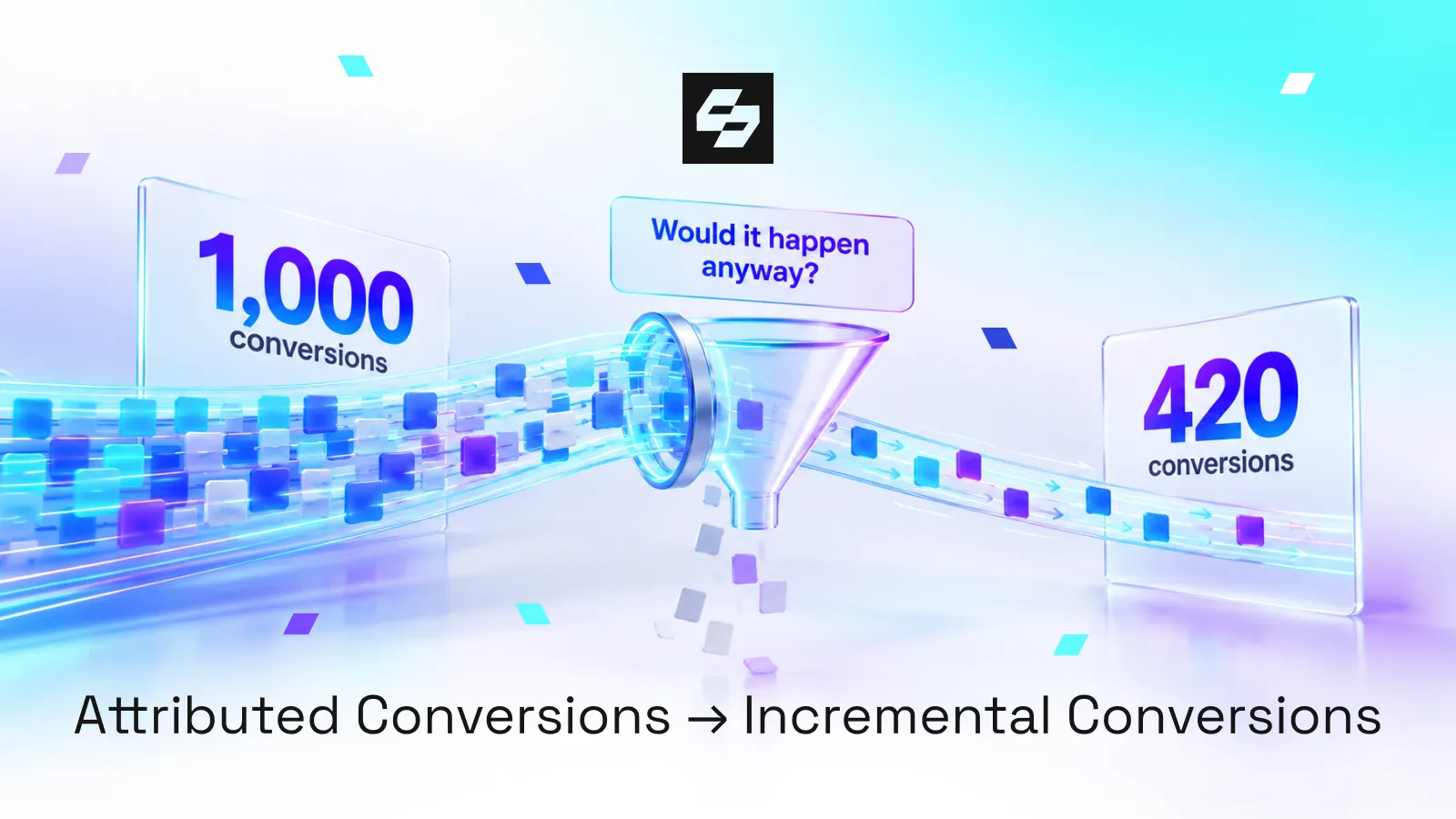
Attribution models isolate genuine incremental conversions from organic customer purchases to eliminate redundant ad spend.
Filtering Out Non-Incremental Spend
Transitioning from attributed metrics to incremental measurement reveals how much media spend actually contributes to enterprise value.
When campaigns are filtered through incrementality testing, media budgets shift away from saturated retargeting loops and toward scalable, top-of-funnel channels like Connected TV (CTV) and programmatic video that drive genuine brand discovery.
4 Reasons Incrementality Matters for Programmatic Advertisers
Eliminates Budget Waste: Identifies and scales back campaigns that over-index on users who would buy anyway, freeing up capital for high-growth initiatives.
Validates Upper-Funnel Channels: Premium channels like Connected TV (CTV) often look underpowered in strict last-click models but show massive incremental lift when tested properly.
Uncovers Cross-Channel Overlap: Prevents double-counting when Meta, Google, and DSPs simultaneously claim credit for the same single customer journey.
Protects Margin & Bottom-Line Growth: Focuses media buying on actual revenue expansion rather than chasing artificially inflated platform ROAS targets.
Driving Incremental Growth with Screencore
Screencore delivers transparent programmatic infrastructure built to optimize media execution across CTV, video, native, and display environments.
By integrating direct supply paths (SPO), advanced cross-channel frequency controls, and clean auction transparency, Screencore enables media buyers to eliminate redundant bid overlap and deploy media budgets where they generate measurable, net-new business impact.
FAQ
What is the difference between ROAS and Incremental ROAS (iROAS)?
Standard ROAS calculates total attributed revenue divided by ad spend. Incremental ROAS (iROAS) divides only the net-new revenue generated specifically by the ad campaign by the ad spend, providing a true measure of campaign profitability.
How often should advertisers run incrementality tests?
High-volume spenders should run incrementality tests quarterly or whenever scaling into new channels (like CTV), launching major creative shifts, or re-evaluating core retargeting allocations.
Does incrementality testing require cookie tracking?
No. Modern incrementality methodologies utilize geo-matched market testing, ghost bidding, or publisher-side panel holds, making them fully privacy-safe and cookieless-compliant.