



Why Political Advertising Could Put Premium Inventory Under Pressure
Political advertising has always changed the rhythm of the U.S. media market. The 2026 election cycle could make that effect much more visible in programmatic advertising, particularly across Connected TV and other premium video environments. More political money is entering digital channels, while campaigns are competing for many of the same high-quality audiences and placements that commercial advertisers want.
For brands and agencies, this creates a practical media-buying problem. Premium inventory does not suddenly multiply because political demand increases. When more advertisers want the same impressions at the same time, auctions become more competitive, prices can move, and buyers have less room for inefficient decisions.
And 2026 is shaping up to be a very big test.
Record Political Spending Means More Competition
Political advertising spend for the 2026 U.S. election cycle is currently projected to reach approximately $11.6 billion, making it the most expensive cycle on record. That would surpass the $8.9 billion spent during the 2022 midterms and even the $11.2 billion spent during the 2024 presidential election cycle. Broadcast television is still expected to take the largest share, with projected spending of around $5.6 billion.
But the more interesting number for programmatic buyers is CTV. AdImpact now expects political Connected TV spending to reach approximately $2.7 billion, representing 23% of total cycle spending. CTV is the fastest-growing media type in political advertising, while EMARKETER also expects television in its different forms to remain central to political media spending this year.
That money has to land somewhere. Much of it will be competing for environments that already attract brands because of their content quality, audience value and high-impact video experience.
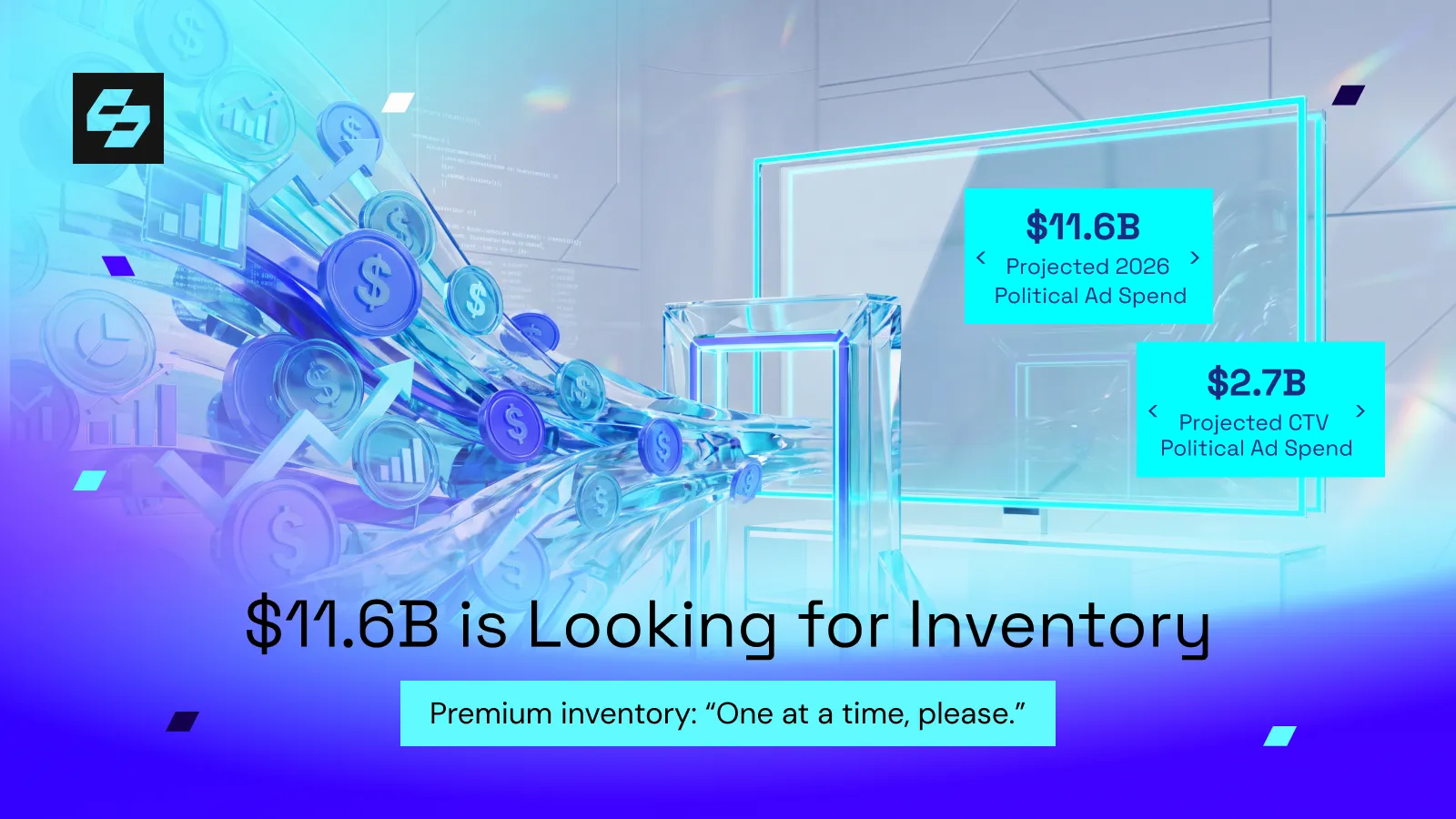
2026 U.S. political advertising spend forecast showing $11.6 billion total spend and $2.7 billion in CTV.
Why CTV Has Become So Important to Political Advertising
Broadcast television still gives political campaigns enormous reach, but CTV adds something different: television-style impact with more digital control. Campaigns can use streaming environments to reach audiences more selectively while applying geographic and other relevant signals to media activation.
That matters in a midterm election. Political campaigns are often less interested in reaching every U.S. household than in concentrating media investment around states and markets where specific races are competitive. AdImpact’s latest forecast, for example, points to substantial increases in expected political spending in states including Ohio, Texas and Maine as individual races attract more investment.
This concentration is what commercial advertisers should watch. Political advertising will not put equal pressure on every programmatic impression in the country. The impact can be much stronger when valuable geography, premium content, CTV supply and high-demand audiences overlap.
Premium Inventory Is Premium Because It Is Limited
“Premium inventory” is one of those terms AdTech uses constantly, sometimes too casually. In practice, the inventory advertisers value most tends to have something that cannot be scaled infinitely: quality content, trusted publishers, strong viewability, valuable audiences or high-impact environments.
Election spending makes that limitation easier to see. A campaign may have plenty of theoretical impressions available while still facing intense competition for the subset that actually matches its media strategy. Add geography, audience requirements, format, content quality and timing, and the available pool can shrink quickly.
This is already part of the discussion around local CTV in 2026. AdImpact has warned that major events throughout the year, including the midterm elections, can tighten inventory and increase demand in local CTV markets. Its earlier 2026 analysis projected political CTV spending more than doubling compared with the 2022 midterms.
For media buyers, the distinction between available inventory and valuable inventory becomes critical.

Political campaigns and commercial advertisers competing for limited premium programmatic inventory.
What Happens Inside the Programmatic Auction
Programmatic auctions respond to competition immediately. If several buyers value the same impression, the market determines how aggressively they need to bid for it. Add large political budgets, fixed campaign deadlines and concentrated geographic demand, and that competition can become much sharper.
This is where commercial advertisers may start feeling election pressure even if they have nothing to do with politics. A retail, automotive, finance or travel campaign could simply be trying to reach the same CTV household or premium publisher audience that several political buyers also want.
The auction itself still happens in milliseconds, but the intelligence behind the bid matters more when supply becomes competitive. Modern buying platforms may evaluate geography, audience signals, device, content environment, frequency, historical performance, inventory quality and campaign goals before deciding whether an impression is worth buying. Screencore has previously explored how this decision layer is changing as AI and real-time optimization become more deeply embedded in programmatic infrastructure.
Paying more is one response to competition. Making better decisions is usually the more sustainable one.
CTV Could Feel the Pressure First
CTV sits in an interesting position in 2026. Commercial advertisers continue moving budgets toward streaming, while political campaigns increasingly see the same environment as a way to combine television reach with more precise digital activation. That creates two major sources of demand moving toward premium streaming supply at the same time.
The timing matters too. Political campaigns have an immovable finish line, which can make the final weeks of an election cycle unusually competitive. Commercial brands may be able to move budgets, adjust pacing or shift campaign timing. Political advertisers approaching Election Day have far less reason to wait.
For publishers, that competition can create a strong monetization opportunity. For advertisers, it means CTV planning needs to account for changing market conditions rather than assuming that the inventory and pricing available earlier in the year will look identical closer to November.
More Supply Paths Do Not Automatically Solve the Problem
When inventory becomes harder to secure, adding more supply can look like the obvious solution. In programmatic advertising, however, more connections do not always mean more unique or valuable opportunities. Multiple routes can sometimes lead buyers back to the same inventory, while unnecessary intermediaries make it harder to understand cost and supply quality.
That is why supply-path efficiency becomes more important when competition rises. Buyers need to understand what they are accessing, how efficiently they are reaching it and whether an impression genuinely deserves the bid. Screencore’s programmatic approach emphasizes transparent infrastructure, verified inventory and efficient supply paths across CTV, video, display and mobile environments.
When media is inexpensive, inefficiency can hide inside the numbers. When competition increases, it becomes much easier to spot.
Advertisers Should Prepare Before the Final Election Push
The November election is the finish line, not the starting point for political media demand. Spending builds throughout the cycle as campaigns identify competitive races, budgets are released and media strategies become more concentrated. AdImpact says current 2026 political spending is already pacing well ahead of previous cycles, with early pre-booking indicating strong demand through campaign season.
Advertisers therefore need flexibility before the busiest period arrives. That means understanding which environments matter most to campaign performance, watching how pricing and availability develop, and being prepared to reallocate spend when a particular supply source becomes inefficient.
This does not mean brands should automatically pull campaigns from election periods. Far from it. It means rigid buying strategies become riskier when market conditions can change quickly.
AI Has a Bigger Job When Auctions Get Crowded
As competition increases, programmatic systems have more decisions to make under pressure. An available impression is not necessarily a good impression, and winning an auction is not useful if the price no longer makes sense for the expected outcome.
AI-driven optimization can help evaluate large numbers of signals and adjust bidding, pacing and targeting as campaign conditions change. This is especially relevant in CTV, where streaming fragmentation, audience signals, inventory quality and pricing all need to be considered at enormous speed.
Explore this in more detail in our previous article, AI in CTV Advertising: How It’s Revolutionizing AdTech, including how AI is influencing programmatic buying, optimization, creative execution and measurement across Connected TV.
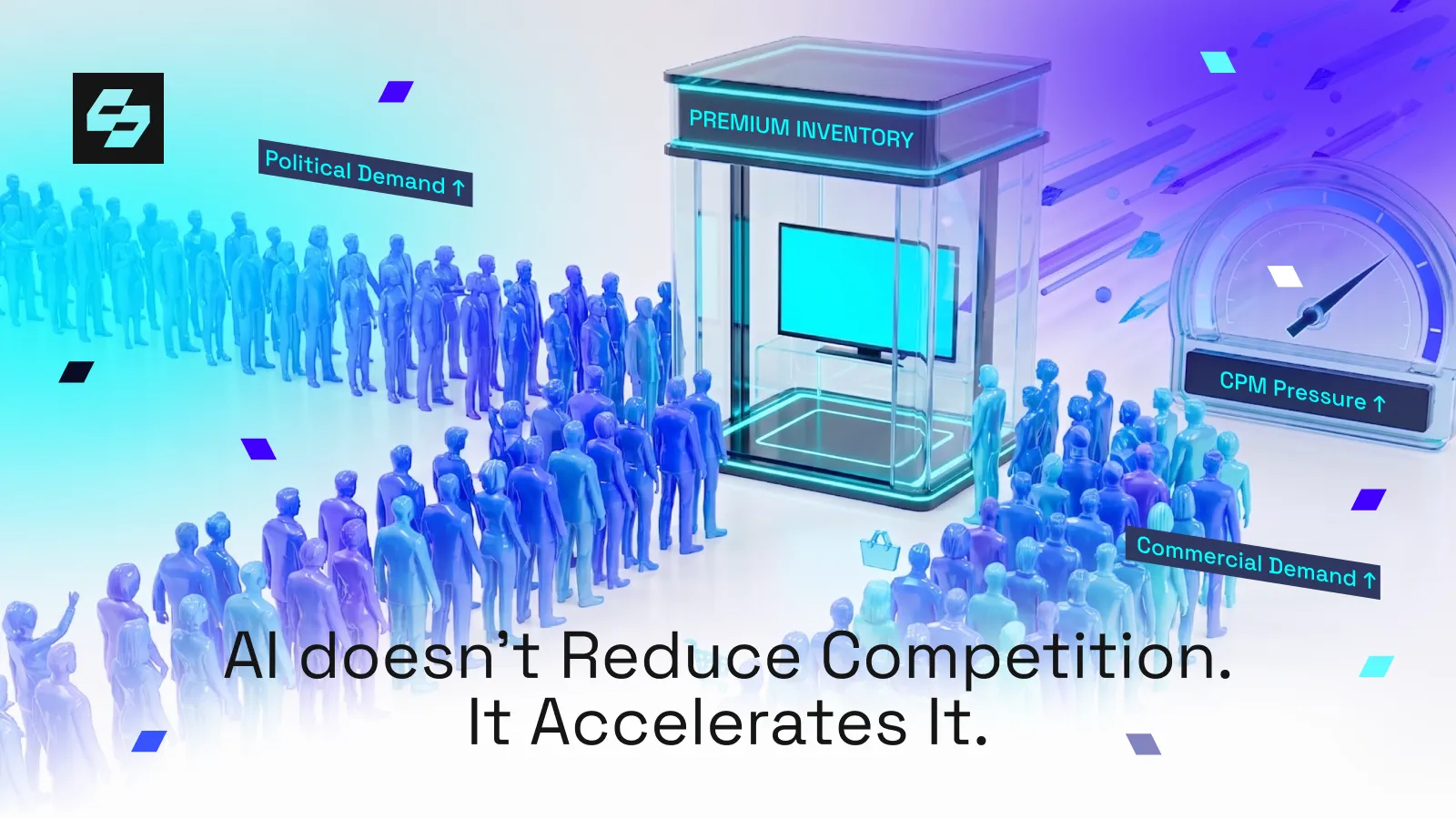
AI can make bidding faster and more responsive, but it doesn’t create more premium supply. When political and commercial demand converge, competition for high-value CTV inventory can intensify.
2026 Will Be a Stress Test for Premium Programmatic
The election cycle will eventually pass. What it reveals about programmatic buying will be more useful.
A market with billions of additional advertising dollars makes weak media strategies expensive. Inefficient supply paths become harder to justify. Slow optimization has a bigger cost. And depending too heavily on a narrow pool of premium inventory leaves fewer options when competition suddenly increases.
For publishers, the same environment can create an opportunity to capture more value from high-quality inventory. For advertisers and agencies, the advantage will come from knowing where to compete, what an impression is actually worth and when to move the budget somewhere else.
That is the part of election advertising worth watching beyond politics.
More demand will enter the market. The winners will not simply be the buyers willing to spend more. They will be the ones making better decisions with every bid.
At Screencore, we connect advertisers and publishers across CTV, video, display and mobile through transparent programmatic infrastructure built for real-time decision-making. If your team is preparing for a more competitive media market around the 2026 U.S. elections, let’s discuss how to keep premium inventory access efficient, transparent and performance-focused.