


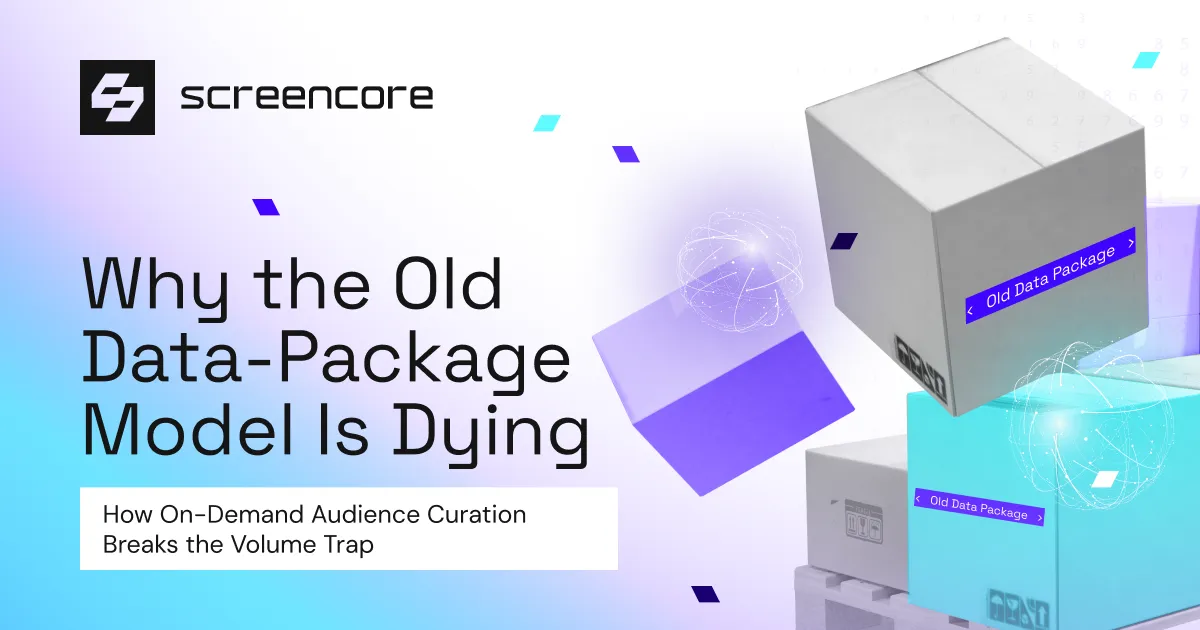
The programmatic ecosystem was built on the flawed premise that data abundance equals superior results. Buyers invested heavily in bundled third-party audience data and broad segments to achieve scale. This strategy has proven unsustainable, resulting in diminishing returns, stagnant performance metrics, and an uncontrolled escalation of advertising costs. It is time to move beyond the data volume myth and embrace data-efficient targeting methods.
Today, that model is breaking down. The market is learning a hard truth: static data packages don’t create precision. They create noise. As programmatic environments grow more complex, success is no longer about how much data you buy. It’s about how intelligently you activate it.
This is where on-demand audience curation steps in — and why it’s quickly replacing the old data-package model.
The Problem With Data Packages in a Real-Time World

Programmatic data volume trap visualization showing 90% irrelevant pre-packaged audience segments.
Data packages were built for a slower, simpler programmatic era. They bundle users into fixed segments based on historical behaviors, inferred interests, or aggregated signals that may already be outdated by the time a bid happens. Once attached to a bidstream, these segments add cost without necessarily adding clarity.
The data business has become increasingly tangled, with overlapping vendors, duplicated segments, and unclear value attribution. Buyers often pay multiple times for the same signals — without knowing which data actually drives results.
In practice, this creates the volume trap. More impressions are targeted, but fewer perform. CPMs rise, conversion rates stall, and optimization becomes guesswork rather than strategy.
Why Volume Stops Working at Scale
The more data layers advertisers add, the harder it becomes to understand what’s actually influencing performance. When targeting is based on rigid audience packages, DSPs are forced to bid broadly, hoping scale compensates for inefficiency.
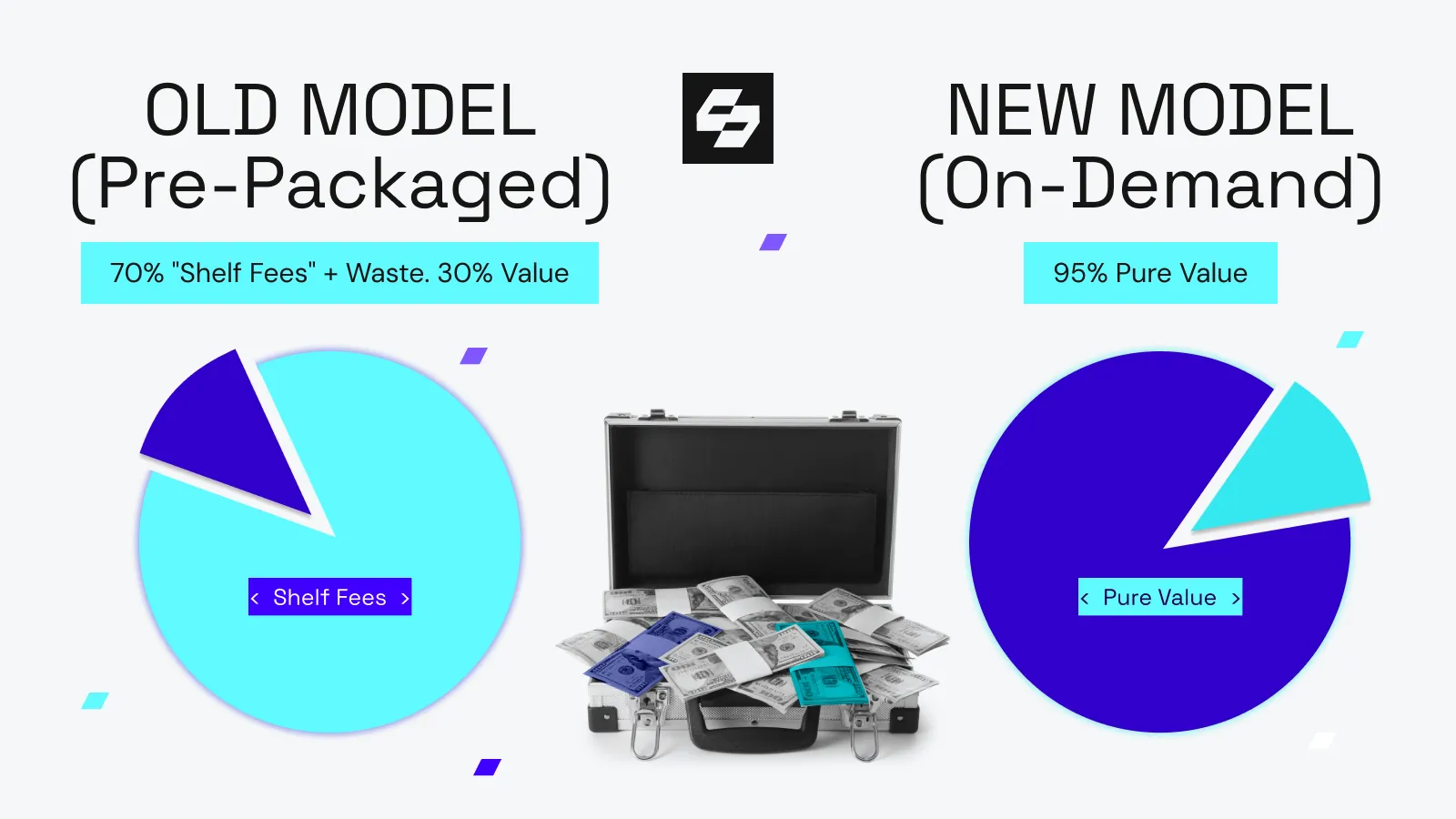
Data tax cost comparison: Chart showing 70% programmatic waste in pre-packaged model vs. 95% value in on-demand curation.
But scale without control is expensive. Excessive data costs inflate CPMs. Redundant segments dilute signal quality. And static audiences fail to reflect real user intent in the moment.
At Screencore, operating an open RTB-driven platform processing hundreds of thousands of requests per second and connecting hundreds of buyers with tens of thousands of publishers, we see this pattern clearly. Performance doesn’t improve when buyers widen the funnel. It improves when they clean it.
On-Demand Audience Curation Changes the Equation
On-demand audience curation flips the model entirely. Instead of buying fixed data packages upfront, DSPs dynamically assemble audiences in real time based on live signals, context, device behavior, and supply-side characteristics.

On-Demand Curation visualization: Precision targeting achieving 10X higher accuracy by dynamically assembling ideal audiences.
This approach treats audiences as something you build — not something you buy off the shelf.
Rather than paying for every data point attached to an impression, advertisers only activate the signals that matter for that moment, that placement, and that objective. The result is tighter targeting, cleaner bidstreams, and far less waste.
At Screencore, audience activation is designed to work inside clean auction environments, where signal integrity, transparency, and supply quality are enforced before optimization even begins. That foundation makes on-demand curation not just possible, but effective.
Why On-Demand Curation Lowers CPMs and Improves Outcomes
When audiences are built dynamically, fewer impressions are wasted on irrelevant users. Bids become more selective, not more aggressive. This naturally reduces auction pressure on low-quality supply while increasing win rates on placements that actually convert.
CPMs stabilize because buyers stop competing for inflated segments. Performance improves because impressions are aligned with real intent instead of assumed interest. Most importantly, advertisers regain visibility into why a campaign works — and where budget truly delivers value.
This is how DSPs break free from the volume trap without sacrificing reach.
The Role of Clean Auctions in Audience Efficiency
On-demand audience curation only works in environments where the bidstream itself is trustworthy. Resold inventory, duplicated requests, and polluted supply paths distort signals and undermine even the smartest audience strategies.
That’s why Screencore’s platform is built around clean auctions, direct publisher integrations, and strict inventory verification across web, mobile, CTV, audio, and immersive formats. By filtering noise before bidding begins, audience signals remain intact and actionable.
When auctions are clean, data works harder. When they aren’t, no amount of targeting can save performance.
Why This Shift Matters Now
Privacy regulation, signal loss, and growing scrutiny on data practices are accelerating the decline of packaged data. Advertisers can no longer justify paying for opaque segments with unclear ROI. Publishers can no longer afford ecosystems that devalue quality inventory through indiscriminate scale.
On-demand audience curation aligns with where programmatic is headed: fewer assumptions, more verification, and smarter use of data at every stage of the auction.
If you’re exploring how clean auction design and supply integrity support this shift, our previous article “Why High-Integrity Auctions Beat the Volume Trap” is a perfect companion read.
The Future Is Curated, Not Packaged
The era of buying audiences by the bundle is ending. In its place is a more disciplined, performance-driven approach where data is activated with purpose, not piled on for scale.
DSPs that embrace on-demand audience curation will reduce waste, control costs, and deliver stronger outcomes. Publishers that support clean, transparent auctions will attract smarter demand. And advertisers will finally escape the cycle of rising CPMs and flat performance.
At Screencore, this isn’t a theory — it’s how our platform is built.
Ready to move beyond data volume and start buying smarter audiences? Let’s design a cleaner, more efficient programmatic strategy together.