


.webp)
The promise of CTV was simple: premium environments, verified audiences, and TV-level accountability at digital speed. Instead, the ecosystem inherited many of the open web’s biggest problems — only now they are more expensive. Resold supply chains, misrepresented placements, bundled traffic, and incomplete device signals have made CTV one of the least transparent channels in programmatic.
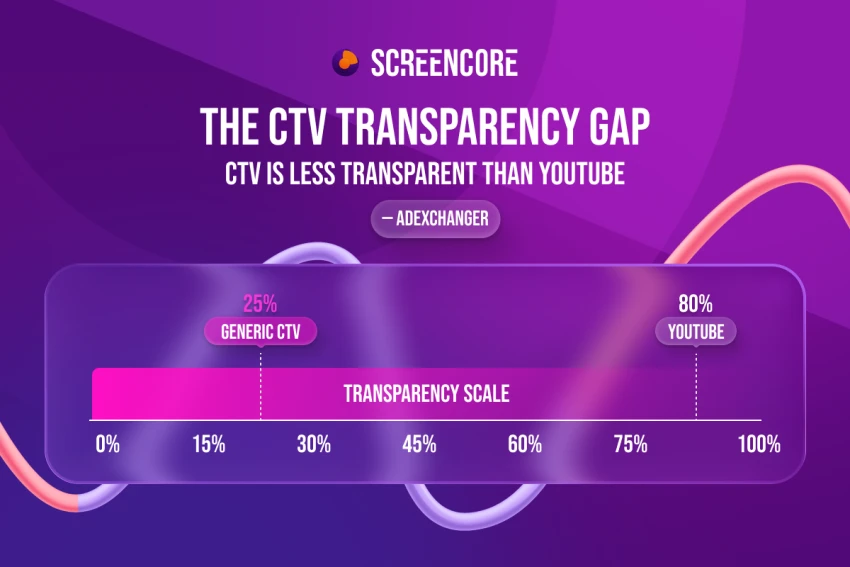
Bar chart comparing generic CTV transparency (25%) to YouTube (80%), emphasizing that CTV is less transparent.
CTV paths often break before they even reach the buyer, creating an environment where advertisers struggle to understand what they’re paying for and why the outcomes vary so dramatically. And when the average CTV bid request passes through multiple intermediaries before reaching the DSP, buyers are left with noise instead of clarity, risk instead of relevance, and inflated CPMs instead of predictable performance.
The heart of the problem is not CTV itself — it’s the unhealthy auction paths surrounding it.
The Real Cost of Resold and Bundled CTV Inventory
When a DSP receives a CTV impression, it must be able to trust the signal. But with resold supply, that trust is compromised the moment the impression enters the auction. The more an impression is passed around, packaged, or masked, the harder it becomes to verify the source, the audience, and the value.
Reselling adds unnecessary hops, making fees invisible and creating a bidding environment where the DSP optimizes against incomplete information. Bundled inventory makes matters worse by obscuring true placements behind vague labels like “CTV Household Package,” leaving buyers guessing whether their ads appeared on a premium app or a low-quality stream.

Illustration of gamblers losing 30% of their budget due to buying the same CTV impression multiple times, highlighting waste from duplication.
As bid-streams grow noisier, performance becomes unstable. Even the smartest algorithms cannot optimize effectively when the signals are compromised. Advertisers end up paying TV-level CPMs for inventory that does not perform like TV at all. In the long run, these practices erode trust and artificially inflate a marketplace that should be reducing inefficiencies — not multiplying them.
Screencore sees this firsthand across the 300+ global buyers and 30,000+ publishers connected to our marketplace, as well as the 15,000 campaigns running across omnichannel formats. The difference between clean and noisy supply is visible in every KPI, from pacing consistency to conversion rates. A clean path doesn’t just perform better — it behaves better.
Why DSPs Must Become the Gatekeepers of Auction Integrity
CTV transparency cannot be solved at the publisher level alone. DSPs sit closest to the buy-side decision — which means they have the responsibility and the power to enforce clean auctions.

Illustration of robotic arms removing resellers from the supply path, achieving 98% direct, brand-safe supply.
A DSP committed to integrity must reject resold supply proactively instead of merely scoring it. It must remove bundled or package-based traffic before bids ever go out. It must verify device-level information in real time, not after the report. And it must identify suspicious inventory paths the moment they appear, not weeks later when budgets are already gone.
When DSPs treat quality as a precondition rather than a post-analysis, the marketplace stabilizes. Signals become clearer. Budgets become more predictable. And performance becomes easier to scale without unpredictable volatility.
Screencore prioritizes this approach with a marketplace infrastructure built around direct supply, real-time verification partners, and clean bid-stream logic. Direct connections reduce hops and eliminate ambiguity. Continuous fraud and quality checks — powered by our partners ensure that CTV, mobile, and web impressions meet the same rigor before they’re allowed to compete in the auction. This alignment of speed and safety is what gives buyers the confidence to scale into CTV without inheriting the ecosystem’s chaos.
Why Clean Auctions Drive Better ROI Than Broad CTV Access
The fastest way to increase CTV performance is not by bidding on more impressions — it’s by removing the wrong ones. Clean auctions strengthen the link between audience intent and impression quality, giving algorithms stronger signals to optimize against. When DSPs eliminate ambiguous, resold, duplicated, or inflated CTV supply, the remaining inventory reveals a truer performance curve.
Advertisers see reduced CPA volatility, steadier pacing, and stronger attribution clarity. Publishers see fairer competition and higher real yields. And the market begins to correct itself as quality inventory rises and resold supply loses its artificial value.
In a world where each CTV impression is expensive, precision is worth more than scale.
How Advertisers Can Identify a High-Integrity DSP
Brands evaluating DSPs must shift from asking “How much CTV supply do you have?” to asking “How clean is the supply you allow into the auction?” A high-integrity DSP should be able to articulate how it authenticates sources, rejects resold paths, verifies CTV device IDs, and prevents signal degradation.
If a DSP cannot explain how it protects buyers from intermediaries, cannot trace an impression back to its origin, or cannot guarantee that bundled packages are being unwrapped at the source, then it cannot guarantee performance. Transparency is not a feature — it is proof that the DSP is working in the advertiser’s best interest.
This shift mirrors what we described in our previous article “Why High-Integrity Auctions Are the New Currency — and How DSPs Can Beat the Volume Trap”, where we explored why the industry is moving from volume-based thinking to integrity-led performance.
CTV’s Future Will Belong to Clean-Path DSPs
The next generation of CTV programmatic won’t reward platforms that aggregate the most supply. It will reward DSPs that guard the quality of every impression they accept. The ecosystem is moving toward a clear reality: CTV growth depends on trust, and trust depends on clean auctions.
DSPs willing to reject resold and bundled supply today will deliver better performance tomorrow. Advertisers will reward them. Publishers will benefit from them. And the entire ecosystem will become healthier, more predictable, and more aligned with the value that premium CTV inventory is meant to provide.
Screencore is committed to this direction. For us, integrity is not a feature — it’s the foundation of the marketplace we operate.
Ready to Activate Clean, High-Integrity CTV Auctions?
CTV doesn’t have to be a black box — not when the DSP demands clarity at the source. If you’re ready to build campaigns on clean supply paths, verified signals, and real performance outcomes, the Screencore team is here to help.