



Mobile programmatic advertising has always been about speed. Bids happen in milliseconds, user signals change constantly, and demand fluctuates by the second. But while the market accelerated, the underlying stack stayed largely manual, fragmented, and reactive. That gap is now closing.
AI agents are beginning to reshape how the mobile ad stack operates, moving programmatic from rule-based optimization toward continuous, autonomous decision-making. This shift is not theoretical. It is already happening as new platforms, including CloudX, introduce AI agents designed to actively manage mobile monetization rather than simply report on it.
For publishers, this change matters. The rise of AI agents signals a move away from static setups and toward adaptive infrastructure that can protect yield, improve traffic quality, and respond to real-time market signals without constant human intervention.
What AI agents actually are in ad tech
In ad tech, AI agents are not just smarter algorithms or better dashboards. They are autonomous software systems designed to observe the environment, make decisions, take action, and learn from outcomes.
Traditional optimization relies on predefined rules. A human sets floors, adjusts refresh logic, manages demand partners, and reacts to performance drops after they happen. AI agents flip that model. They monitor thousands of signals in real time and act immediately, without waiting for manual input.
In the mobile ad stack, an AI agent can evaluate session quality, user behavior, latency, demand density, and yield performance simultaneously. It does not optimize one metric in isolation. Instead, it balances revenue, user experience, and long-term monetization health as conditions change.
This is why AI agents are being described as stack-level components rather than features. They sit across mediation, auction logic, and yield management, influencing how the entire system behaves.

A conceptual look at AI agents as "Autonomous Optimization Engines" that monitor, learn, and act on data in real time.
Why mobile programmatic needs AI agents now
Mobile programmatic is uniquely complex. Sessions are shorter, user intent shifts rapidly, and inventory quality varies widely. Publishers also face stricter privacy rules, limited identifiers, and rising pressure to protect app performance.
Manual optimization cannot keep up with these dynamics. Even the best ad ops teams operate with delays. By the time a pricing issue or demand imbalance is identified, revenue has already been lost.
AI agents address this problem by operating continuously. They do not optimize once per day or once per campaign. They optimize every session, every auction, and every user interaction.
Platforms using AI agents aim to “rewire” the mobile ad stack so optimization becomes proactive rather than reactive. For publishers, that shift represents a fundamental change in how yield is protected.

Visualizing the evolution from manual stack tuning to autonomous yield control where programmatic no longer waits for humans.
How AI agents automate optimization and yield
AI agents excel at managing complexity at scale. In mobile programmatic, this means automating decisions that were previously siloed across tools and teams.
An AI agent can dynamically adjust floor prices based on live demand signals instead of static historical averages. It can detect low-quality traffic patterns early and reduce exposure before they impact overall yield. It can balance monetization pressure with user experience by controlling refresh rates and auction density at the session level.
Most importantly, AI agents learn. When a decision leads to better outcomes, the system reinforces that behavior. When it harms performance, the agent adapts. Over time, this creates a monetization strategy that evolves with the market rather than falling behind it.
This kind of automation does not replace strategy. It replaces manual execution. Publishers still define goals and guardrails, but AI agents handle the operational complexity required to achieve them.
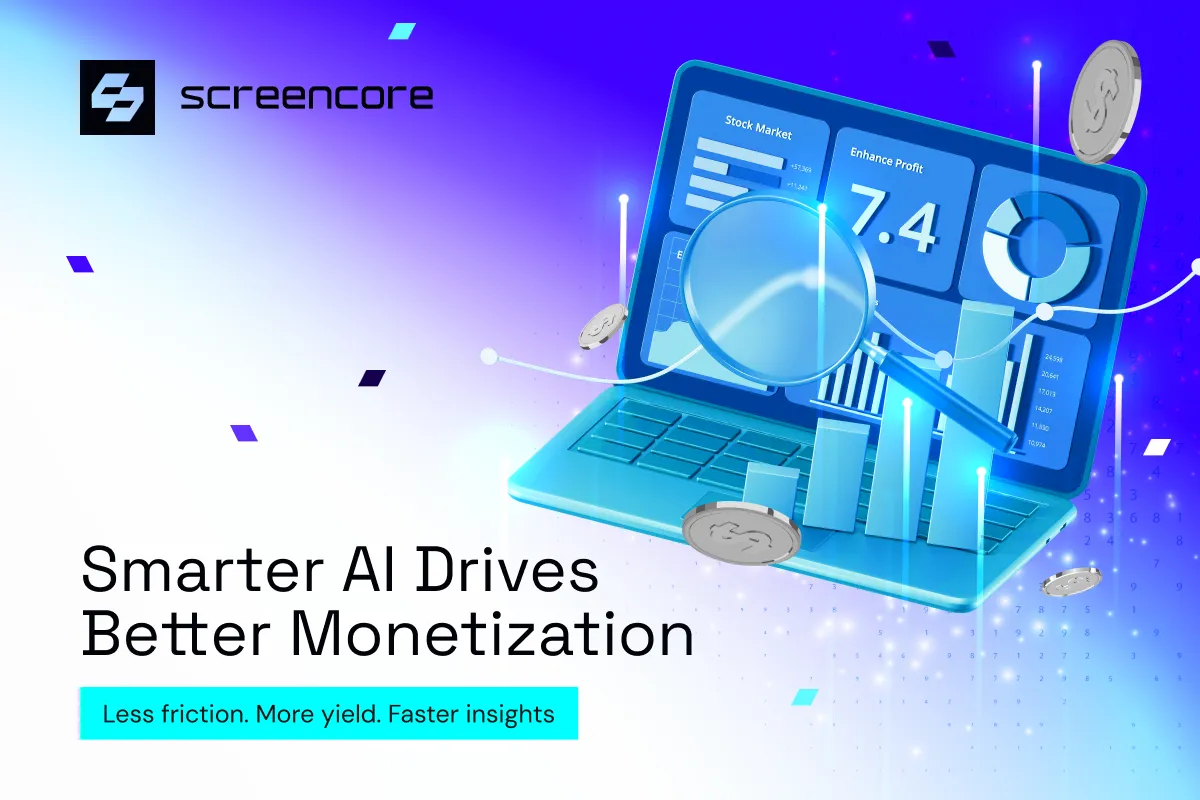
How Smarter AI drives better monetization by reducing friction and increasing yield through faster, data-driven insights.
What this means for publishers adapting to mobile programmatic
For publishers, AI agents introduce both opportunity and responsibility. The opportunity lies in efficiency. Less manual work means more consistent performance and fewer revenue leaks. Teams can focus on strategic partnerships, product development, and audience growth instead of constant troubleshooting.
The responsibility lies in control. AI agents must operate within transparent frameworks. Publishers need visibility into how decisions are made, what signals are prioritized, and how outcomes are measured.
At Screencore, we see AI agents as accelerators, not black boxes. Automation only works when built on clean data, transparent supply paths, and clear performance accountability. Without those foundations, even the most advanced AI can amplify existing inefficiencies.
Publishers that succeed in 2026 and beyond will be those who combine AI-driven automation with disciplined auction design and inventory integrity.
AI agents and the future of publisher monetization
AI agents are not a short-term trend. They represent a structural shift in how programmatic stacks are designed. As mobile traffic continues to dominate and privacy constraints tighten, adaptive systems will become essential.
Publishers who rely solely on static setups and manual optimization risk falling behind. Those who embrace AI agents thoughtfully can unlock more stable revenue, stronger demand relationships, and better user experiences.
This transition mirrors broader changes across ad tech. Automation is moving closer to the core of decision-making, but the winners will be platforms and publishers that keep humans in the loop, defining strategy while machines handle execution.
If you’re exploring how AI fits into your monetization strategy, we recommend revisiting our previous article on responsible AI in ad tech, where we break down why data quality, privacy, and human oversight remain essential as automation accelerates.
Build a cleaner, smarter mobile programmatic stack
AI agents are changing how mobile programmatic works. The question is not whether to adopt automation, but how to do it without sacrificing transparency, control, or trust.
At Screencore, we help publishers design clean auction environments where advanced automation enhances performance instead of obscuring it. If you want to understand how
AI-driven optimization can fit into a high-integrity programmatic strategy, our team is ready to help.