



For years, the programmatic auction sounded simple.
An impression becomes available. Advertisers bid. The auction selects a winner. The ad appears.
All of this happens in milliseconds.
But behind those milliseconds, the programmatic advertising ecosystem is changing. Auctions are becoming more complex, AI is taking a bigger role in decision-making, supply paths are under greater scrutiny, and advertisers are demanding more transparency around where their budgets go.
The basic purpose of the auction remains the same: connect the right advertising opportunity with the right buyer. What is changing is how that opportunity is evaluated, packaged, routed, priced, and optimized.
For advertisers, the new programmatic auction creates both opportunity and pressure. Buying more impressions is no longer enough. The real competitive advantage comes from making better decisions about which impressions are worth buying in the first place.
The Programmatic Auction Is No Longer Just About the Highest Bid
Real-time bidding transformed digital advertising by allowing individual impressions to be evaluated and purchased automatically.
A user opens a website, app, or streaming environment. An advertising opportunity becomes available. A bid request moves through the programmatic ecosystem, where demand-side platforms evaluate whether that impression matches an advertiser’s campaign requirements. Eligible buyers submit bids, and a winner is selected.
That fundamental process still exists.
What has changed is everything surrounding it.
Today, an impression may pass through publishers, SSPs, exchanges, resellers, DSPs, data providers, verification companies, and measurement partners. At the same time, the number of signals used to evaluate each opportunity has grown significantly.
The result is an auction that is no longer simply asking, “Who will pay the most?”
The more important question is becoming, “Which buyer can identify the value of this opportunity most accurately?”
That is a very different competition.
Every Bid Is Becoming an Intelligence Decision
Modern programmatic advertising depends on decisions made at enormous speed.
A DSP may need to consider the campaign objective, available audience signals, content environment, device, geography, frequency, historical performance, inventory quality, budget pacing, and expected outcome before deciding whether to bid.
Then it must decide how much that opportunity is worth.
This is why the programmatic auction is increasingly becoming an intelligence layer rather than simply a transaction mechanism.
The strongest technology is not necessarily the technology that bids most often. It is the technology that can identify valuable opportunities, avoid inefficient ones, and continuously learn from campaign performance.
AI and machine learning are becoming increasingly important in this process. They can analyze signals at a scale that would be impossible for human teams to manage manually, helping platforms adjust bids, placements, and budgets as campaign conditions change.
At Screencore, advanced data intelligence and AI-powered optimization support campaign activation across CTV, video, display, mobile, and in-app environments. The platform processes 500,000 real-time bid requests per second across more than 160 active global markets, making intelligent real-time decisioning a critical part of campaign execution.
The auction may last milliseconds. The intelligence behind the bid is what determines whether those milliseconds create value.
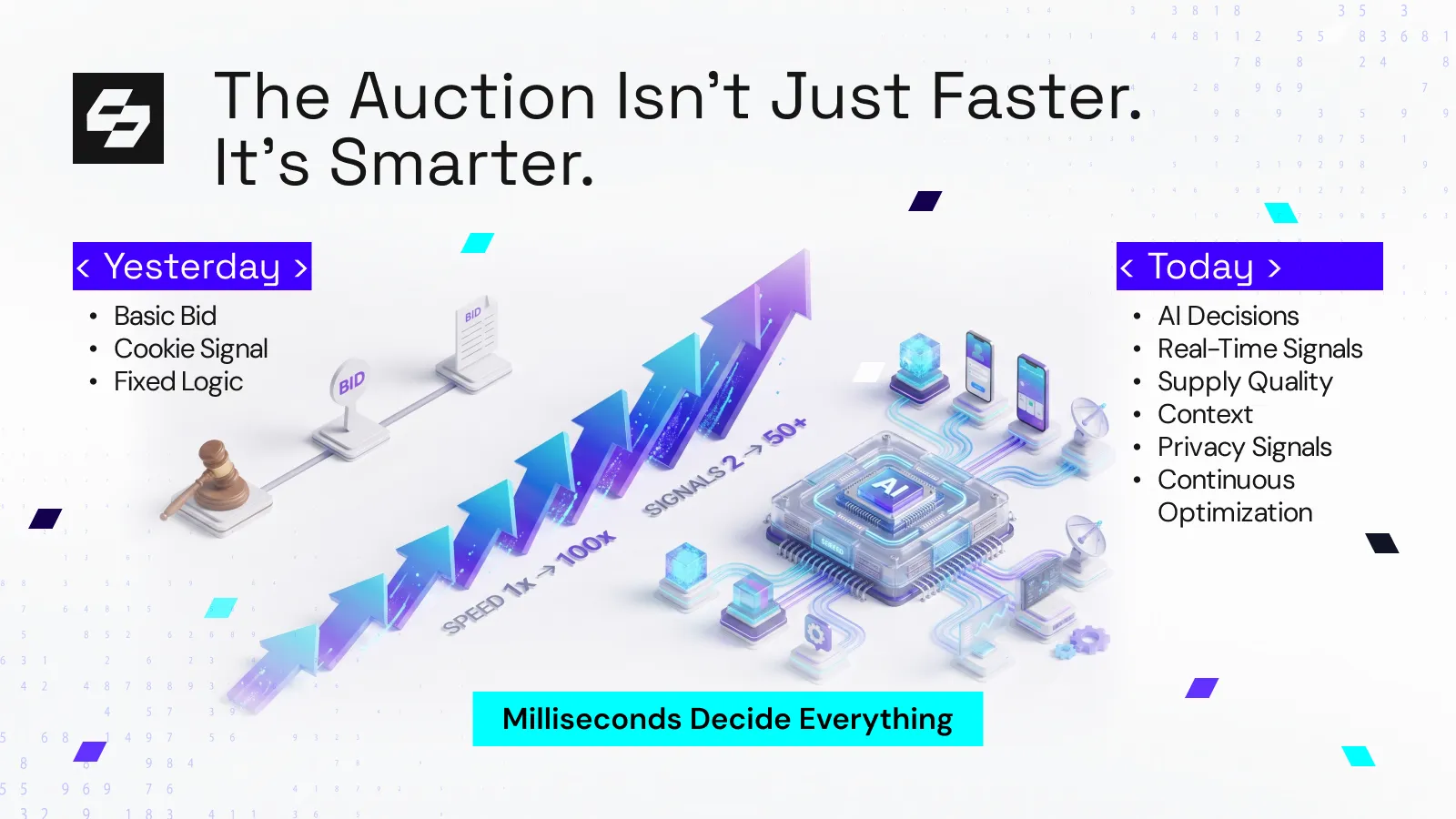
Modern programmatic auctions do far more than compare bids. AI evaluates hundreds of signals in real time—including audience context, inventory quality, campaign goals, and performance history—to determine whether an impression is truly worth buying.
More Supply Does Not Always Mean More Opportunity
Programmatic advertising has created enormous access to digital inventory.
But access and value are not the same thing.
The same advertising opportunity can sometimes reach buyers through several different supply paths. Each route may involve different intermediaries, costs, signals, and levels of transparency.
This can create duplication and make it more difficult for advertisers to understand exactly what they are buying.
As the programmatic ecosystem evolves, advertisers are paying more attention to supply path optimization. Instead of treating every available route equally, buyers are looking for cleaner and more efficient connections to quality inventory.
The goal is not simply to receive more bid requests.
The goal is to receive better opportunities.
This is particularly important because signals can lose value as an impression moves through a fragmented supply chain. If important information becomes incomplete or unclear, a buyer may have less context for making an accurate bidding decision.
For advertisers, efficient supply paths can therefore become a performance advantage. Screencore’s programmatic infrastructure focuses on verified premium inventory, transparent auctions, and clearer visibility into supply, pricing, and performance. The objective is to help buyers reduce unnecessary complexity and direct more media spend toward meaningful advertising opportunities.

Every bid request contains a wealth of information. Modern DSPs analyze contextual signals, supply quality, audience relevance, device, geography, historical performance, and campaign objectives before deciding whether—and how much—to bid.
AI Is Changing What Happens Before the Bid
AI is often discussed as a tool for campaign optimization.
Its influence on the programmatic auction can go much further.
AI-powered systems can help determine which opportunities should be evaluated, how inventory should be valued, how budgets should move, and how campaigns should respond to performance signals in real time.
This creates the potential for a much more dynamic advertising ecosystem.
Instead of relying only on fixed rules, modern platforms can continuously analyze what is working and adjust their decision-making accordingly.
But automation alone is not the answer.
AI operating on weak signals, low-quality inventory, or opaque supply paths can simply make inefficient decisions faster.
The quality of the infrastructure still matters.
Advertisers need technology that combines automation with transparency. They need to understand what is being optimized, where ads are running, and how campaign decisions connect to measurable performance.
At Screencore, AI-powered optimization works alongside transparent reporting and verified inventory. The goal is to improve bids, placements, and budgets while maintaining visibility into campaign performance and media spend.
The future of programmatic is not AI replacing control. It is AI making control more intelligent.
The Auction Is Moving From Impressions to Outcomes
For a long time, programmatic success was heavily associated with scale and cost.
How many impressions did the campaign buy? What was the CPM? How much reach did the budget generate?
Those metrics still matter, but advertisers increasingly want to understand what happened after the impression.
Was the ad actually viewable? Did it appear in a suitable environment? Did it reach a relevant audience? Did it contribute to engagement or another meaningful campaign outcome?
A low-cost impression that creates no value is not efficient media.
This is why the modern programmatic auction is becoming more outcome-aware. The value of an impression should not be judged only by its price. It should also be evaluated according to its quality and its potential contribution to campaign performance.
Screencore connects more than 5,000 advertisers and buyers with over 30,000 publishers and reports an average viewability rate above 95% across its programmatic ecosystem.
The shift is clear: advertisers do not simply need more opportunities to bid. They need better opportunities to perform.

The lowest bid isn’t always the smartest investment. Success is measured by quality impressions, meaningful engagement, viewability, transparency, and business outcomes—not simply by winning more auctions.
Cross-Screen Advertising Makes Every Auction More Complex
The modern consumer does not live on one screen.
A person may watch streaming content on a CTV device, browse on mobile, use an app, and visit websites on a laptop during the same day.
For advertisers, this creates new opportunities to reach audiences. It also makes programmatic decision-making more complex.
A platform must evaluate not only whether an impression is valuable, but also where and when that impression fits into a broader campaign strategy.
CTV inventory, mobile environments, video placements, and traditional display do not behave in exactly the same way. They can involve different signals, formats, measurement models, and user experiences.
This is why cross-screen activation is becoming an important part of modern programmatic infrastructure.
Screencore enables advertisers and agencies to activate campaigns across CTV, video, display, mobile, and in-app environments while using advanced targeting, AI optimization, and transparent reporting to support campaign performance.
The auction may happen on one screen. The advertising strategy must understand the entire journey.
Transparency Is Becoming a Performance Advantage
Transparency is often presented as a trust issue in programmatic advertising.
It is also an optimization issue.
Advertisers cannot confidently improve what they cannot clearly understand.
If a buyer has limited visibility into inventory quality, supply paths, pricing, or performance, it becomes harder to identify why one source delivers results while another consumes budget without creating value.
Greater transparency helps advertisers make better decisions before and after the auction.
It can help teams evaluate supply partners, understand campaign performance, identify inefficient paths, and move budgets toward stronger opportunities.
Screencore is built around transparent programmatic connections between brands and premium publishers. Its infrastructure combines verified inventory, privacy-first technology, real-time optimization, and reporting designed to give advertisers greater visibility into performance and spend.
In the new programmatic auction, transparency is not separate from performance.
It is part of performance.
The Future Belongs to Better Decisions
The programmatic auction is becoming faster, smarter, and more complex.
AI will continue to influence bidding and optimization. CTV and cross-screen media will create new types of advertising opportunities. Supply paths will continue to evolve. Advertisers will demand greater transparency and stronger connections between media investment and business outcomes.
The winners will not necessarily be the advertisers making the most bids.
They will be the advertisers making the best decisions.
That means choosing programmatic technology that can combine scale with quality, automation with transparency, and real-time bidding with meaningful performance intelligence.
The future of the programmatic auction is not simply about moving faster.
It is about making better decisions at machine speed.
Identity Is Changing Too. Is Your CTV Strategy Ready?
The programmatic auction is only one part of a much bigger transformation.
As CTV grows and the advertising industry moves toward a more privacy-first ecosystem, advertisers are also rethinking how audiences can be identified and reached across fragmented environments. Email-based IDs may appear to offer a simple solution, but their role in CTV introduces important questions around scale, interoperability, and addressability.
Want to explore the identity challenge behind the next generation of CTV advertising? Read our previous article on email-based IDs and the challenges they face in CTV.
Make Every Programmatic Decision Work Harder
Every auction is an opportunity. But not every impression deserves your budget.
Screencore helps advertisers and agencies activate campaigns across CTV, video, display, mobile, and in-app environments with AI-powered optimization, verified premium inventory, transparent reporting, and privacy-first programmatic infrastructure.
Don’t just compete in more auctions. Build a smarter path from every bid request to a measurable business outcome.